Yes. And Here Is the Number Most Companies Will Not Give You
Artificial turf gets hot. Not warm, hot, and the honest way to answer the question is with measured surface temperatures rather than reassurance.
The reference study people in the industry still quote is from Brigham Young University in June 2002. On a synthetic field, average surface temperature measured 117 degrees Fahrenheit. On natural grass in the same conditions, 78. On asphalt, 110. So the synthetic surface ran hotter than the asphalt parking lot next to it, and roughly 39 degrees hotter than the grass it replaced. The peak reading in that work was 200 degrees on a 98 degree day, and even in October the surface hit 112.4 degrees, which was 32.4 degrees above the air temperature that day.
Those are athletic field numbers on a dense, high-traffic system in Utah. What we actually measure on Central Florida residential lawns is a bit lower and still substantial. On a typical summer day with air temperature in the nineties, turf surface temperature commonly sits between 120 and 150 degrees, and in unshaded direct midday sun it can pass 160. Nearby natural grass on the same afternoon usually measures 75 to 95 and rarely tops 100.
That gap, roughly 35 to 55 degrees hotter than the lawn it replaced, is physics rather than a product defect, and no product eliminates it. What the rest of this article covers is the part that is actually in your control: how much of that gap you can close, with what, for how long, and which of the popular fixes are worth paying for.
Four Reasons It Gets Hot, and Only Two You Can Buy Your Way Out Of
Understanding the mechanism is what separates a fix that works from a fix that sounds good on a brochure.
- No evapotranspiration. This is the big one and it is unfixable. Living grass is constantly pulling water up and releasing it through the blades, and that evaporation carries heat away all day long. It is why a lawn feels cool at 2pm and a driveway does not. Synthetic fiber does none of it, so a turf lawn loses the single largest cooling mechanism a yard has.
- No soil thermal mass underneath. A natural lawn sits on damp soil that absorbs heat and releases it slowly. A turf system sits on compacted, free-draining aggregate designed to shed water fast, which is correct for Florida rain and unhelpful for temperature.
- Fiber and backing absorb solar radiation. Polyethylene blades and the backing behind them take on heat readily, and dark thatch layers woven in for realism absorb more than the green fibers above them.
- The infill stores and re-radiates it. This is the one most people ignore, and it matters more than the grass. The infill is the mass in the system. Black crumb rubber in full sun behaves like a layer of small dark stones, and it holds heat long after the sun has moved.
The two you can actually influence are the last two: what infill you put in, and whether the sun reaches the turf at all. Everything else on the market is a refinement of those.
The Temperature That Matters Is the Burn Threshold, Not the Comfort Threshold
People argue about whether turf is "too hot" without agreeing on what too hot means. There are published thresholds, so use them.
- About 109 degrees: the point at which adult skin starts to register heat as pain. Below this, a surface is merely unpleasant.
- 111 degrees: injury becomes possible with prolonged contact. Relevant for a child sitting down or a dog lying on the surface, not for walking across it.
- 140 degrees: the line that matters. ASTM C1055 recommends surfaces stay at or below 140 degrees, because the average person can touch a 140 degree surface for about five seconds before irreversible burn damage. Contact above 140 for three seconds can produce a first-degree burn.
Put that next to the field numbers and the picture gets clear. A turf lawn at 120 to 135 degrees is uncomfortable and safe for brief barefoot contact. A turf lawn at 150 to 160 degrees in unshaded midday sun is above the standard threshold, and it is a genuine hazard for a toddler who falls on it or a dog that lies down on it. That is the honest way to frame the decision: not hot versus cool, but how many hours per day your specific yard spends above 140.
The dog version of this question, including paw contact and the drainage and infill choices that go with it, is covered in our guide to pet friendly artificial turf in Florida.
Cooling Infill: What the 30 to 50 Degree Claim Actually Means in Florida
Evaporative cooling infills, sold under names like HydroChill and T Cool, are the headline fix. They are coated sand products that hold moisture, and as the surface heats the stored water evaporates and carries heat away. The manufacturer claim is a reduction of roughly 30 to 50 degrees Fahrenheit compared to the same turf with standard infill.
Two things are worth saying plainly about that number, and neither is in the sales sheet.
First, the arithmetic. A 30 to 50 degree drop off a 150 degree surface is a 20 to 33 percent reduction, which is real and useful, but it lands you at 100 to 120 degrees rather than at grass temperature. It is the difference between a surface that can burn and a surface that is merely hot. Nobody is delivering a cool lawn.
Second, the climate. These products were developed and are most loudly marketed in the desert Southwest, and evaporative cooling performs in proportion to how much moisture the air can still absorb. Central Florida summer air is already carrying a lot. Orlando dew points sit around 73 degrees in July, and relative humidity that peaks near 92 percent overnight still only drops to about 59 percent by early afternoon. Phoenix at 105 degrees is frequently under 20 percent. Evaporation still happens here, which is why the product is not useless, but expecting the desert number in a Florida July is how homeowners end up disappointed by a product that technically worked.
The honest Florida version: an evaporative infill measurably lowers the peak, it works best right after rain or irrigation, and it fades as the stored moisture leaves. In our climate the rain is frequent, which helps, and the humidity is high, which hurts. Budget for it as a meaningful improvement rather than a solution, and be skeptical of anyone quoting the top of the manufacturer range as if it were a Florida measurement.
(321) 353-7445Get Immediate Service
Infill Ranked by Heat, Coolest to Hottest
If you change nothing else, change this. Infill is the cheapest lever with the biggest effect, and it is chosen for you by default on most bids.
- Evaporative coated infill (HydroChill, T Cool and similar): the coolest option while hydrated, at a real premium per square foot. Best value on small, high-contact areas rather than across an entire lawn.
- Acrylic-coated rounded silica (Envirofill and similar): light colored, reflective, does not compact, and antimicrobial versions help with odor. A solid middle choice that runs noticeably cooler than dark infills without the premium of an evaporative product.
- Plain silica sand: light in color, inexpensive, thermally neutral. Unremarkable and perfectly acceptable for a lawn area that gets some shade.
- Zeolite: chosen for ammonia capture in pet areas rather than for temperature. Thermally similar to sand, so it is neither a heat fix nor a heat problem.
- Black crumb rubber: the hottest common infill by a wide margin and the one behind most of the extreme readings people cite. It is dark, dense and slow to release heat. In Central Florida residential work there is no good reason to specify it.
One installation detail that matters more than brand: infill depth and coverage. Thin or patchy infill leaves fiber standing unsupported and lets the dark backing see direct sun, which pushes the reading up regardless of what the bag said.
Watering It Is the Cheapest Fix, and It Is Also the Most Temporary
Spraying the surface with a hose during peak heat drops turf temperature by roughly 30 to 50 degrees almost immediately. It is free, it works on any system with any infill, and it is what every turf owner in Florida eventually learns to do before the kids go out.
The limits are just as real. On plain sand or rubber infill the effect is short, often twenty to forty minutes on a hot afternoon, because there is nothing holding the moisture. On an evaporative infill the same watering lasts substantially longer, which is the actual argument for paying for one: not that water cools the turf, but that the infill keeps the water around long enough to matter.
Two practical notes. Water before use rather than during, so the surface is already down when people walk out. And do not talk yourself into daily irrigation as a routine, because at that point part of the water savings that justified the turf has quietly gone back out the hose. Our turf versus sod cost comparison works that math over ten years.
Shade Is the Only Permanent Fix
Everything else on this page manages the symptom. Shade removes the cause, and the effect is not subtle: turf that never receives direct midday sun generally stays within about 10 to 20 degrees of air temperature, which in a Central Florida summer puts it in the same range as a shaded concrete walkway rather than in burn territory.
- Existing tree canopy: the best option and the one most people accidentally remove. A live oak over a turf area is worth more than any infill upgrade you can buy.
- Shade sails and pergolas: effective, and worth positioning for 11am to 4pm rather than for looks. That window is when the surface crosses the threshold.
- Building and fence shadows: free, and they are the reason exposure matters. A turf area on the north or east side of a house gets direct sun for a fraction of the day. The same square footage on the south or west side is in full sun through the hottest hours.
This is why the single most useful thing you can do before signing a turf contract costs nothing: stand in the yard at 1pm and again at 4pm in summer and note where the sun actually lands. The area that is shaded at both times is the area where turf performs best. If a privacy fence is part of how you plan to get that shade, our backyard privacy guide covers height and placement, and KS Solutions installs the fence and the turf as one project.
Zone the Yard: Turf Where It Belongs, Hardscape Where It Does Not
The best-performing Central Florida backyards we install are not all turf. They are zoned, and temperature is one of the reasons. Here is how the surfaces compare under peak sun, using the ranges we have measured and published across our work:
- Natural grass: 75 to 95 degrees, rarely above 100.
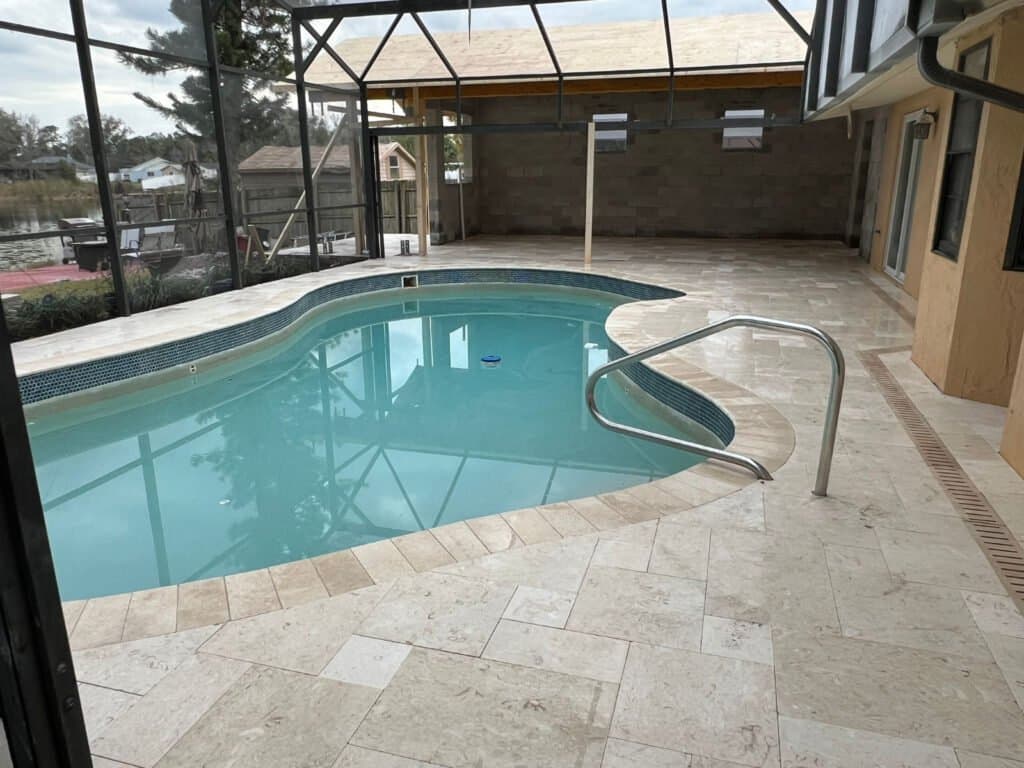
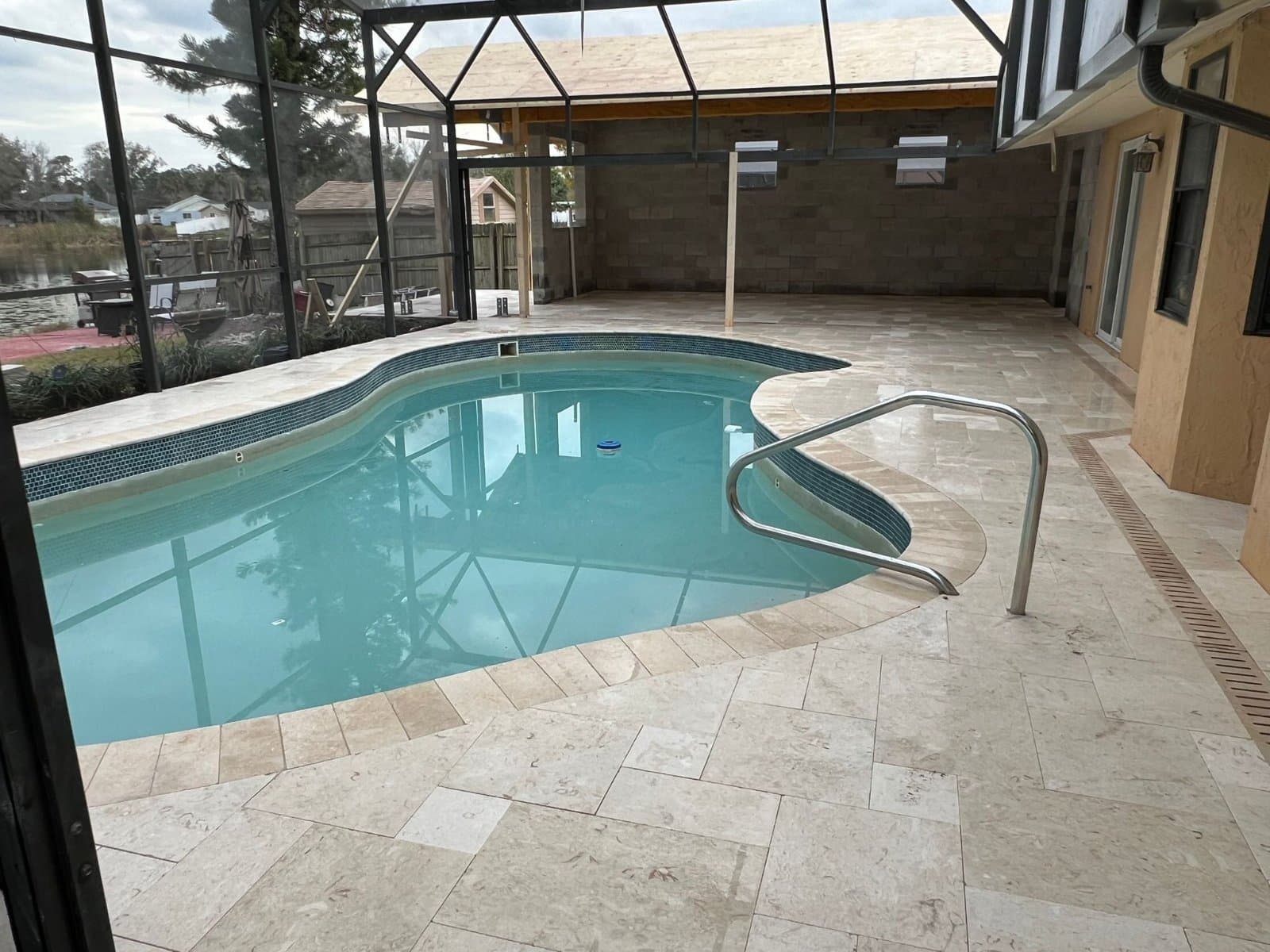
- Light travertine, marble or ivory porcelain: typically under about 110 degrees, roughly 25 to 35 degrees cooler than dark concrete.
- Light-colored brick and concrete pavers: around 118 degrees.
- Dark brick and concrete pavers: 135 to 145 degrees.
- Artificial turf, standard infill, full sun: 120 to 150 degrees, over 160 at midday peak.
Read that list and the design answer writes itself. The surfaces people stand barefoot on for long stretches, pool decks and patios, should be light travertine or light porcelain, and that is exactly what we recommend in the travertine versus brick versus porcelain comparison and the pool deck paver guide. Walkways and driveways take brick pavers, where the temperature matters less because nobody lingers. Turf goes where it earns its keep: the shaded play area, the dog run, the side yard that will not grow grass, and the strip between pavers.
The one turf application where heat is almost a non-issue is a backyard putting green, because the short nylon fiber and heavy sand infill behave differently from a landscape lawn, and because you walk it in shoes.
Measure Your Own Yard in Ten Minutes
You do not have to take anyone's word for any of this, including ours. An infrared thermometer costs about twenty dollars and settles the argument.
- Pick a clear summer afternoon between 1pm and 3pm. That is when the surface peaks, not noon.
- Take five readings across the proposed area. Full sun, partial shade, full shade, next to the house, and next to the fence. The spread between them tells you whether the yard needs zoning or one fix.
- Read the existing surfaces too. Your driveway, your patio and your current lawn, so you have a local baseline instead of an internet number.
- Water one spot and re-read it at 5, 20 and 40 minutes. That curve is the honest preview of what watering will buy you day to day.
If you already have turf and want to know what you are working with, the same test tells you whether the problem is exposure, which shade fixes, or infill, which a top-dress can partly fix without replacing the grass.
Two Specs Sold as Heat Fixes That Barely Move the Number
Fiber color. Lighter, olive-toned fiber does absorb marginally less than a deep emerald, and it also looks more like real Florida turf. The temperature difference is a few degrees. Buy the color you like, not the color someone promises will keep you cool.
Face weight. This is the big number on every spec sheet, quoted in ounces per square yard, and it is the one most likely to be pushed hard in a sales conversation. It says almost nothing about heat, and as we covered in how long artificial turf lasts in Florida, it says less about lifespan than backing does. Heavier fiber can actually hold heat slightly longer. It is a density and appearance spec, not a thermal one.
What does move the number, in order: shade, infill choice, infill depth and coverage, then everything else.
What We Spec in Central Florida
For a residential lawn in Orlando, Kissimmee or Lakeland that takes real midday sun, the package that has held up for us is a light-colored coated infill at proper depth, an evaporative infill upgrade limited to the high-contact zone rather than the whole lawn, shade planned for the 11am to 4pm window, and the area itself sized honestly so that full-sun square footage that nobody uses does not get turfed at all.
That last point is the one homeowners push back on and later thank us for. A smaller, better-placed turf area with a light paver surface around it outperforms a wall-to-wall turf yard on temperature, on cost and on how much the space actually gets used in July.
We install artificial turf, brick pavers and fencing across Central Florida, including Orlando, Kissimmee, Lakeland and Winter Park. If you want the heat question answered for your specific yard rather than in general, we will read the exposure on site before quoting anything. Start at our contact page, and if you have turf already down, ask about a maintenance plan that includes an infill top-dress, which is the cheapest temperature improvement available to an existing lawn.
The Honest Bottom Line
Artificial turf in Florida runs 35 to 55 degrees hotter than the grass it replaced, and in unshaded midday sun it crosses the 140 degree threshold where brief contact can burn. Nothing on the market changes that fully. Shade, a light coated or evaporative infill and a hose change it enough to matter, usually bringing a full-sun lawn down into the 100 to 120 range where it is uncomfortable rather than dangerous.
If your yard is mostly full sun and you have small children or dogs that lie down outside, the right answer may be less turf rather than better turf. If your yard has canopy, or the turf area is on the north or east side, or the space is a dog run rather than a barefoot play area, turf is a good decision and the heat is manageable. That is the whole answer, and anyone who tells you their product does not get hot is selling a claim no synthetic surface can meet.