The Range Is 8 to 20 Years, and That Spread Is the Real Answer
Ask five turf companies how long artificial grass lasts and you will get five numbers, all of them technically defensible. Most synthetic grass lasts between 10 and 20 years depending on quality, usage and maintenance. The life expectancy commonly quoted for a residential yard is 12 to 15 years. Sports fields, which take far heavier traffic, run 8 to 10. Quality turf that is actually maintained reaches 15 to 20. Budget grade product lands nearer 10 once sun and foot traffic get involved, and genuinely cheap imported turf can fade or flatten in 5 to 7 years.
Every one of those figures is true for the product it describes. That is the point. The useful question is not how long does turf last, it is which of those brackets did I buy, and the answer is sitting on a spec sheet you may never have been shown.
Three specifications account for nearly the whole spread, and Florida weights them differently than a northern climate would. In order of how much they matter here: the backing, the UV stabilization, and the face weight. Everything else, including infill choice and installation quality, adjusts the number by a year or two in either direction. These three set the bracket.
Backing: the Spec That Decides More Than Anything Else
The backing is the sheet the grass blades are stitched into, and it is the part of the product you never see after installation. It is also where turf actually dies. Blades fade and flatten gradually and visibly. Backing fails suddenly, and when it goes the fibers release, the seams open and the turf is finished regardless of how the grass itself looks.
- Latex backing: flexible, stable, widely used and cheaper, which makes it the default on budget and mid range product. It performs acceptably under moderate foot traffic. The problem is its end of life behavior: latex backed turf deteriorates within one to two years after the warranty period ends, which puts a practical ceiling of 8 to 12 years on the product no matter how well you treat it.
- Polyurethane backing: does not crumble or degrade, and has routinely held up better in aging tests. It is more resistant to moisture, to temperature swings and to general wear, and it retains fibers better. Manufacturers know this, which is why polyurethane backed products carry the longer warranties. It costs more per square foot.
Florida punishes latex specifically, and the reason is humidity rather than heat. Moisture cycling is exactly the stress latex tolerates least, and a Central Florida summer is four months of daily moisture cycling. If you are choosing between a higher face weight on a latex backing and a moderate face weight on polyurethane, take the polyurethane. Heavier blades on a backing that fails at year 10 buys you nicer looking grass for the same short life.
Ask for the backing type in writing before you sign anything. If a quote does not name it, that is information too.
UV Stabilization: In the Resin, Not Sprayed On
Florida's UV load is the main aging factor for the fibers themselves, and the distinction that matters is where the protection lives. UV stabilizers built into the polyethylene resin at the extrusion stage are part of the fiber for its whole life. Stabilizers applied as a surface coating wear off, and once they are gone the fiber ages at the unprotected rate.
Turf with proper resin level UV stabilization shows minimal fading over 15 to 20 years. Turf without it turns pale and brittle, and brittle is the word to pay attention to: faded turf is a cosmetic problem, brittle turf snaps at the blade base under foot traffic and does not recover from brushing. That is the failure mode that makes a lawn look worn out years before the backing gives up.
There is no way to inspect this from the driveway, which is why it is a documentation question. The manufacturer's spec sheet either states resin level UV stabilization or it does not, and the warranty language either covers excessive fading and UV degradation or it excludes them. A warranty that specifically covers UV degradation is a manufacturer betting its own money on the stabilization, and that is worth more than any claim made verbally.
Face Weight: Useful, and Consistently Oversold
Face weight is the weight of yarn in the product excluding the backing, quoted in ounces per square yard. A denser, heavier turf resists crushing longer because more fibers share the load underfoot, so it holds its appearance through more traffic before matting sets in.
The practical ranges are narrower than the marketing suggests. The most popular products fall between 40 and 60 ounces, which balances density, durability and a realistic look for typical residential use. Above roughly 80 ounces per square yard the product is noticeably thicker and softer. For most residential yards, 60 to 70 ounces performs well, and you do not need 100.
Here is where homeowners get talked into the wrong upgrade. Face weight is the easiest spec to sell because it is a single big number, so it is the one that gets pushed. It also has the weakest relationship to total lifespan of the three. A 100 ounce turf on latex backing with sprayed UV protection will not outlive a 60 ounce turf on polyurethane backing with resin stabilization. Spend the upgrade money on the two specs that set the ceiling, then buy as much face weight as the remaining budget allows.
Pile height, the blade length measured from backing to tip, typically runs from 0.4 to 3 inches. It is a look and feel decision rather than a longevity one, and it does not affect drainage at all. Drainage comes from the backing perforation and the sub base preparation underneath, which is an installation question and not a product one.
(321) 353-7445Get Immediate Service
What Florida Specifically Does to a Turf Lawn
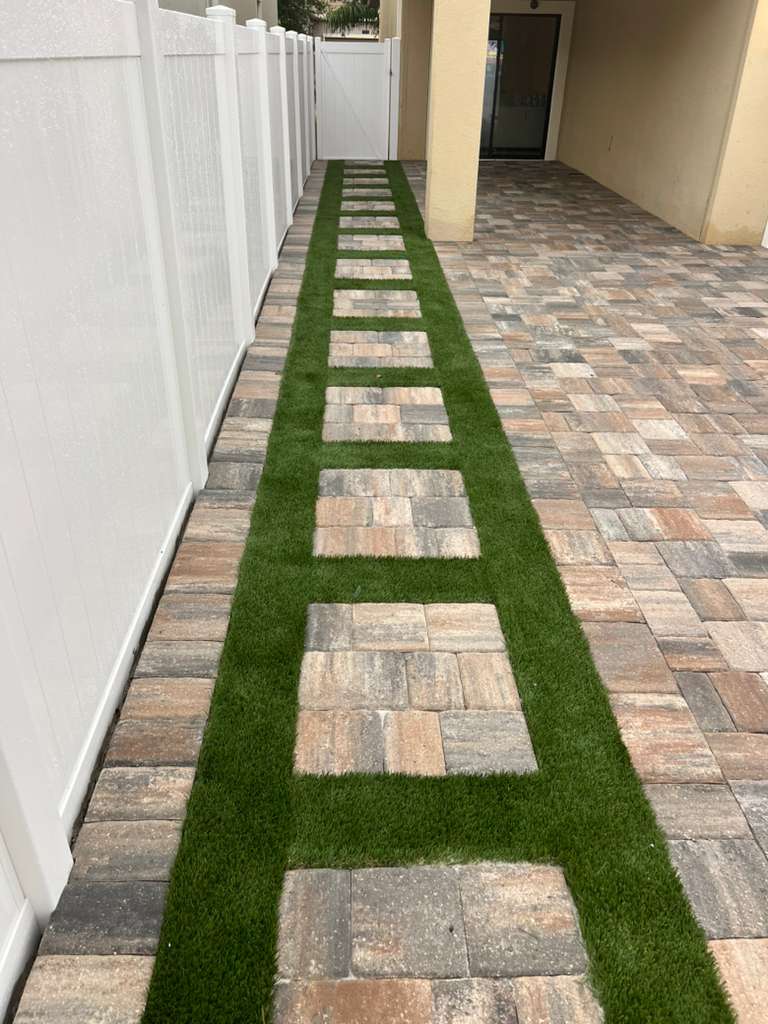
Four local conditions do the aging work here, and they are not the same four that matter in Arizona or the Carolinas.
- UV hours: the straightforward one. Central Florida delivers a high annual UV dose, and it attacks fiber color and flexibility continuously rather than seasonally. This is what resin level stabilization exists to answer.
- Humidity and moisture cycling: the underrated one, and the reason backing choice matters more here than in a dry climate. Daily wet and dry cycling for months on end is the stress that shortens latex backing life.
- Organic debris and biological growth: pollen, leaf litter and grass clippings blow in, settle into the infill and decompose. In a humid climate that organic layer holds moisture against the backing and supports mold and algae growth in shaded sections. Turf under an oak canopy ages differently than turf in open sun, and it is not because of the shade.
- Storm debris and standing water: hurricane season delivers branch impact and short periods of standing water. Well drained turf on a proper base sheds it. Turf on a compacted or under prepared base holds water, and held water accelerates everything above.
Two of those four are installation and site decisions rather than product decisions, which is worth sitting with. The base preparation under the turf and the drainage plan around it are doing as much work on your lifespan as the yarn specification, and unlike the yarn they cannot be upgraded later without pulling the lawn up.
The Maintenance That Buys Years for Almost No Money
Turf is low maintenance, not no maintenance, and the gap between those two phrases is measured in years of service life. High quality turf reaches 15 to 20 years with proper care, and the care in question is genuinely simple.
- Cross brush monthly: use a stiff synthetic bristle push broom or a power broom and brush against the direction the blades lean. Fibers flattened by feet, furniture and dogs need lifting back up, and consistent brushing is what decides whether a lawn looks three years old or ten. Skipped long enough, matting becomes permanent set and brushing stops recovering it.
- Top off and redistribute infill every few years: infill compacts and migrates out of high traffic paths over time, and infill is what holds the fibers upright. Once it thins, the blades have nothing supporting them and they mat faster. Sand infill costs roughly $0.25 to $0.75 per square foot and rubber granule around $0.50 to $1.25, so a top off across a typical yard is a modest expense that directly protects the fibers.
- Rinse and clear debris: blow or rake off leaf litter and pollen before it decomposes into the infill, and rinse the surface periodically. In shaded sections this is the single action that prevents the moisture and growth problem described above.
- Move heavy furniture occasionally: a planter or a grill left in one spot for two years produces a permanent depression. Shifting them a foot at a time prevents it.
Do those four and you are buying the top of your product's bracket rather than the bottom. Skip them and a 15 year turf performs like a 10 year turf, which is the most common way homeowners end up disappointed by a product that was actually fine. Structured upkeep is exactly what our maintenance plans are built around, and it is the cheapest lifespan extension available on any hardscape or landscape surface.
Warranty Length Is Not Lifespan, and the Gap Is Deliberate
Most quality turf products carry a manufacturer warranty of roughly 8 to 15 years covering UV degradation, excessive fading and fiber loss under normal use. Separately, your installer should carry a workmanship warranty covering seams, base settling and fastening.
A warranty is a legal promise, not a forecast of when the lawn starts looking worn. Those are two different numbers and they can point in opposite directions. A 15 year warranty on latex backed turf is a promise about fiber performance sitting on top of a backing with an 8 to 12 year practical ceiling. A 10 year warranty on polyurethane backed turf with resin level UV stabilization will very likely outlive it in the yard.
So read warranties for what they exclude and for what the manufacturer is willing to put in writing about UV, rather than for the headline number of years. And keep the two warranties separate in your file. When a seam opens in year three, that is the installer's document. When fibers shed in year nine, that is the manufacturer's.
How to Tell Whether Your Turf Needs Brushing or Replacing
Most turf that looks finished is not. Work through this in order before concluding anything.
- Flat and tired in the paths you walk most: this is matting, and it is a brushing problem, not a replacement problem. Cross brush against the lean and top off the infill in those paths. If the fibers stand back up, the turf is fine.
- Fibers stand back up but fall over within days: the infill has thinned below the level that supports them. Redistribute and add infill rather than replacing turf.
- Blades snap when you bend them between your fingers: this is UV embrittlement and it does not reverse. Brushing a brittle lawn breaks more fibers than it lifts. This one points at replacement.
- Color faded unevenly, pale in sun and normal in shade: UV degradation. Check your warranty, because excessive fading is specifically what the manufacturer warranty covers.
- Seams lifting or edges pulling free: workmanship or backing. If it is early, it is the installer's warranty. If it is late and the backing crumbles when you handle the edge, the backing has reached end of life and the lawn is done.
- Soft or spongy underfoot, or water pooling after rain: the base has settled or the drainage has failed. This is a base problem underneath the turf, and it needs addressing regardless of turf condition, because held water shortens whatever is on top of it.
One clean diagnostic rule from the trade: if serious problems show up before year 10, the original installation cut corners somewhere. Either the product was below spec, the base was under prepared, or the drainage was never designed. That matters for the replacement decision, because putting good turf back on a bad base repeats the outcome.
Where Lifespan Fits Into the Cost Decision
Lifespan is the denominator of every turf cost comparison, which is why getting it right changes the answer. A turf lawn that lasts 15 years and one that lasts 9 years have the same installed price and a 67 percent difference in cost per year of service, and nothing about the install day tells you which one you bought. The full ten year cost comparison against a maintained sod lawn, including water and mowing, is worked through in our guide to artificial turf versus sod in Florida.
Two use cases shift the specs meaningfully. Homes with dogs put concentrated wear and liquid load on specific areas, which changes both the infill and the drainage decision, and that is covered in our guide to pet friendly artificial turf. Commercial and HOA installations take traffic closer to the sports field bracket of 8 to 10 years, so the product specification has to be heavier to reach residential lifespans, which is the subject of our commercial artificial turf breakdown.
KS Solutions installs and services artificial turf across Central Florida, and we will name the backing type, the UV stabilization method and the face weight on the quote rather than leaving them off. We work throughout the region, including Orlando, Kissimmee, Lakeland and Port Orange. If you have turf already installed and want to know which bracket it is in, a look at the edge and a bend test on the fibers answers it in about five minutes.