Call (321) 353-7445 for professional artificial turf installation in Orlando, FL from KS Solutions.
Why Orlando Homeowners Are Switching to Artificial Turf
If you've been looking into artificial turf installation in Orlando, FL, the reasons probably hit close to home. Maybe you're tired of mowing every single week in the summer heat. Maybe your water bill keeps climbing because your lawn needs constant irrigation just to stay alive between rain events. Maybe you've got a shady side yard under a massive oak where natural grass refuses to grow no matter how many times you reseed it. Or maybe your dog has turned the backyard into a mud pit that tracks into the house every time it rains. Whatever brought you here, KS Solutions can help you make the switch to a lawn that looks green year-round without the work, water, or frustration that natural grass demands in Central Florida.
Orlando's climate is both a blessing and a challenge for lawns. The growing season never really stops, which sounds great until you realize it means you're mowing, edging, fertilizing, and treating for pests 12 months a year. Summer temperatures average 91 degrees in August. Humidity hangs above 70 percent for months at a time. Annual rainfall hits 50 to 60 inches, mostly in intense afternoon thunderstorms that can flood a yard in minutes and wash away fertilizer before it even soaks in. UV exposure is among the most intense in the continental United States, bleaching and stressing natural turf from March through November. Then winter brings cold snaps that turn St. Augustine grass brown overnight, leaving you staring at a dead-looking lawn until spring green-up. It's a constant battle.
Artificial turf eliminates all of that. No mowing. No irrigation. No fertilizer runoff flowing into Orange County's lakes and waterways. No brown patches in January or flooded lawns in July. No chinch bugs eating your St. Augustine from the roots up. And thanks to Florida Statute 125.572, which took effect in July 2025, homeowners on properties under 1 acre can install synthetic turf regardless of what their HOA says, as long as the product is green, lifelike, lead-free, and flame retardant. That law leveled the playing field for homeowners in Orlando's many planned communities who previously faced pushback from HOA boards that insisted on natural grass only.
Orlando also has a natural advantage when it comes to turf drainage. The city sits on the Orlando soil series, very deep, well-drained sandy soil that extends 80 or more inches below grade. The water table stays below 72 inches in most areas. Water passes through artificial turf's backing, through the base aggregate, and into the sandy subsoil where it disappears quickly. You won't get the standing water problems that plague turf installations in clay-heavy regions of the country. That rapid drainage keeps the turf clean, prevents odor buildup in pet areas, and eliminates the muddy, waterlogged conditions that natural lawns suffer through during Orlando's rainy season.
Across neighborhoods like Lake Nona, Windermere, Thornton Park, and Dr. Phillips, more homeowners are making this switch every year. And it's not just front lawns. We install turf for backyards, side yards, dog runs, playgrounds, putting greens, rooftop areas, and commercial properties across the entire Orlando metro. Call (321) 353-7445 to learn how artificial turf can work for your Orlando property.
Residential and Commercial Turf Applications
KS Solutions installs artificial turf for a wide range of residential and commercial uses across Orlando. Each application has different performance requirements, and we match the right turf product, infill type, and base system to every project for the best possible result.
Front and backyard lawns
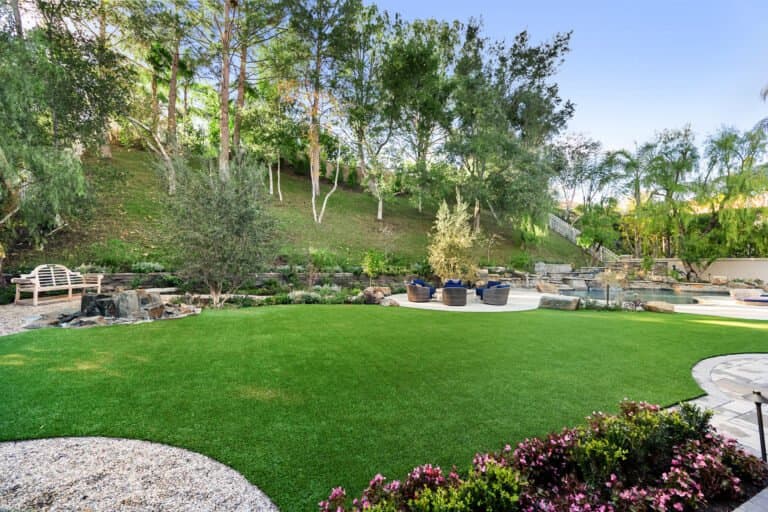
are our most common residential installation. Orlando homeowners want a yard that looks manicured without the weekly maintenance grind. We install turf with a natural-looking blade height, usually 1.5 to 2 inches, with a blend of green shades and brown thatch fibers that replicate the appearance of healthy St. Augustine or Bermuda grass. The result is a lawn that looks freshly cut 365 days a year. No irrigation system needed. No fertilizer applications. No mowing crew showing up every Thursday. We've installed residential lawns across College Park, Baldwin Park, Audubon Park, and dozens of other Orlando neighborhoods. Visit our residential artificial turf installation page for more details on what we offer for homes.
Commercial properties
benefit from artificial turf in ways that go well beyond aesthetics. Office parks, retail centers, hotels, apartment complexes, and HOA common areas across Orlando spend thousands of dollars monthly on landscape maintenance for natural grass. Irrigation, mowing, fertilization, pest control, and seasonal overseeding add up to a massive annual expense. Switching common areas, medians, courtyards, and entrance landscapes to synthetic turf cuts those costs dramatically while maintaining a polished, professional appearance year-round. We've installed turf at commercial properties throughout Orange County, and the return on investment typically pays back within 3 to 5 years. After that, the ongoing savings go straight to the bottom line. See our commercial artificial turf installation services.
Pet-friendly turf
is a specialty we've developed specifically for Orlando's many dog and cat owners. Natural grass and dogs don't coexist well. Urine kills grass in concentrated spots. Heavy foot traffic from daily play wears paths down to bare dirt. And bare dirt turns to mud during Orlando's rainy season, which gets tracked into the house on paws, shoes, and everything else. Our pet turf products feature antimicrobial backing that inhibits bacteria growth, enhanced drainage rates that handle liquid waste quickly without pooling, and non-toxic infill that's safe if pets ingest small amounts during play. The turf surface rinses clean with a garden hose, and the antimicrobial treatment prevents odor buildup even in Orlando's hottest summer months. Explore our pet-friendly turf installation options.
Playground turf
provides a safe, clean, cushioned surface for children's play areas. We install playground turf with shock-absorbing padding underneath that meets ASTM F1292 fall attenuation standards for specified critical fall heights. The surface stays cooler than rubber mulch or poured-in-place rubber in Orlando's sun, and it doesn't harbor insects, mold, or splinters the way wood mulch does. It also eliminates the constant replenishment cycle that wood mulch requires as it decomposes and compacts. Schools, daycare centers, churches, parks, and residential properties across Orlando use our playground turf installation service.
Sports fields and putting greens
round out our turf applications. We install short-pile sports turf for batting cages, agility courses, multi-use athletic areas, and training facilities. And our putting greens use specialty nylon turf with a true ball roll that lets you practice your short game just steps from your back door. Putting green installations require precise grading and contouring to create breaks and slopes that simulate real course conditions. We build them with the same attention to detail as any professional practice facility. Check out our sports field turf installation page for more information.
No matter the application, every turf project we complete in Orlando starts with a site visit, soil assessment, and detailed written proposal. We don't guess at quantities or estimate from satellite images. We measure on the ground, evaluate the conditions, and build to spec.
One question we get from a lot of Orlando homeowners: can you install turf in a shaded area? Absolutely. In fact, shaded areas are where artificial turf really outshines natural grass. Most natural grass varieties in Orlando, especially St. Augustine, need at least 4 to 6 hours of direct sunlight to stay healthy. Under large oaks, along north-facing walls, and between buildings, natural grass thins out, develops disease, and eventually dies no matter how much you water or fertilize. Artificial turf looks the same whether it gets 12 hours of sun or zero. It's the perfect solution for those problem areas on your property where nothing else will grow.
Turf Materials: Nylon, Polyethylene, and Polypropylene Compared
Not all artificial turf is created equal. The fiber material determines how the turf looks, feels, performs under foot traffic, and holds up over time in Orlando's demanding conditions. KS Solutions installs turf from top manufacturers using all three major fiber types, and we help Orlando clients pick the right one based on their specific application and performance goals.
Polyethylene
is the most popular fiber for residential lawns and the material we recommend most often for Orlando yard installations. It's soft to the touch, resilient enough to bounce back after foot traffic, and holds its color well under UV exposure when properly stabilized. Modern polyethylene turf blends use multiple shades of green with brown and tan thatch fibers woven in at the base, creating an incredibly realistic appearance that's difficult to distinguish from natural grass even up close. Walk across it barefoot and it feels like a well-maintained lawn. Polyethylene handles Orlando's heat reasonably well, though surface temperatures on any artificial turf will run higher than natural grass on peak summer afternoons. For front lawns, backyards, general landscaping, and pet areas, polyethylene delivers the best balance between performance, realistic aesthetics, and reasonable pricing.
Nylon
is the strongest and most resilient turf fiber available. It holds its shape under heavy pressure and springs back faster than polyethylene or polypropylene after being compressed. That makes nylon the preferred material for putting greens, where a consistent, firm surface is absolutely necessary for true ball roll and accurate practice. Nylon is also excellent for high-traffic commercial areas, sports applications, and workout surfaces where the turf takes constant, concentrated use. The trade-off is that nylon costs more per square foot and feels firmer underfoot than polyethylene, so it's not the best choice for a residential lawn where you want a soft, natural feel for lounging and barefoot walking. But for specialized applications where durability and performance consistency matter most, nothing outperforms nylon fiber. Some premium turf products blend nylon with polyethylene to get the strength of nylon with the softness of polyethylene, and these blended products work well for Orlando backyards that see heavy use from kids and pets.
Polypropylene
is the most budget-friendly turf fiber. It's lighter weight and less durable than polyethylene or nylon, which limits its useful application range. Polypropylene works for decorative areas with minimal foot traffic, like narrow landscape strips between a sidewalk and curb, around mailboxes, or as accents in garden beds. It doesn't hold up as well under Orlando's intense UV over time, and heavy foot traffic will flatten the fibers faster than the other two options. We typically recommend polypropylene only for accent areas, temporary installations, or situations where budget is the overriding concern and the area won't see regular use.
Beyond the fiber type, there are other specifications that matter for Orlando installations. Face weight measures the amount of fiber per square yard and directly correlates with density and durability. Higher face weight means a denser, more resilient turf that handles traffic better and maintains its upright blade position longer. For Orlando residential lawns, we recommend a minimum face weight of 50 ounces per square yard. Pet areas and high-traffic zones should target 60 ounces or higher. Pile height determines how tall the blades stand. For a natural lawn look, 1.5 to 2 inches is ideal. Putting greens use a much shorter pile of 0.5 to 0.75 inches for fast, accurate ball roll. Backing material affects drainage rate and dimensional stability. We use turf with polyurethane or dual-layer polypropylene backing that provides drainage rates of 30 inches per hour or more, which is essential for handling Orlando's heavy thunderstorm rainfall without any surface pooling.
Every turf product we install is lead-free and flame retardant, meeting the requirements of Florida Statute 125.572 for HOA-protected installations. Call (321) 353-7445 to see samples and discuss which product fits your Orlando project.
We also want to address a common concern about turf temperature. Yes, artificial turf does get warmer than natural grass in direct sunlight. On a 91-degree Orlando summer afternoon, turf surface temperatures can reach 120 to 150 degrees in full sun exposure. But there are ways to manage this. Lighter-colored turf products absorb less heat. Infill options like zeolite and cooling infill blends reduce surface temperatures by 10 to 15 degrees compared to standard silica sand. Shade from trees and structures brings temperatures down significantly. And in the cooler morning and evening hours when most Orlando families actually use their yards, the temperature difference is minimal. We'll help you select the right product and infill combination to keep your specific installation as comfortable as possible.
Florida's HOA Turf Law and What It Means for Orlando Homeowners
One of the biggest barriers to artificial turf adoption in Orlando used to be HOA restrictions. Many planned communities, and the Orlando metro has hundreds of them, prohibited synthetic lawns outright or made the approval process so cumbersome and adversarial that homeowners gave up before they ever got started. That changed with Florida Statute 125.572, which took effect in July 2025 and reshaped the landscape for turf installation across the state.
The law is straightforward in its intent and application. HOAs and community associations in Florida cannot prohibit homeowners from installing artificial turf on residential properties under 1 acre. The turf must meet specific standards to qualify for this protection: it has to be green and lifelike in appearance, lead-free, and flame retardant. The Florida Department of Environmental Protection is also adopting quality standards for synthetic turf products to give HOAs and homeowners a clear, objective benchmark for acceptable materials. As long as your product meets these requirements, your HOA cannot block the installation, levy fines against you for having it, or force you to remove it and replace it with natural grass.
This law has been a genuine turning point for neighborhoods across Orlando. In Baldwin Park, Lake Nona, and the communities around Windermere, HOAs historically maintained strict natural-grass-only landscaping rules. Homeowners who were spending $200 to $400 a month on lawn maintenance, irrigation water, fertilizer, and pest control now have a legal pathway to replace that natural grass with synthetic turf that requires almost zero ongoing upkeep. And they can do it without fighting their HOA board for months or risking fines and legal threats.
There are a few things the law doesn't cover that Orlando homeowners should understand. The statute protects your right to install turf, but your HOA can still enforce reasonable rules about installation quality, edging, and integration with existing landscaping. They can require that the installation looks professional and well-maintained. That's why working with an experienced installer matters so much. A poorly installed turf lawn with visible seams, wrinkles, uneven edges, or cheap, unrealistic-looking materials will draw complaints and potentially trigger an HOA enforcement action on grounds unrelated to the turf material itself. The quality of the installation is your responsibility, and it reflects on your property value and your standing with your community.
KS Solutions installs exclusively with turf products that meet every requirement of Statute 125.572. All our residential turf is green, lifelike, lead-free, and flame retardant. We keep product certification and testing documentation on file for every product we install, so if your HOA questions the material, we provide the data sheets to back it up. We've helped dozens of Orlando homeowners work through the HOA notification and compliance process smoothly, and we can do the same for you. We know what Orlando HOA boards look for, what documentation satisfies their architectural review process, and how to present a turf installation proposal that gets approved without friction.
If you've been hesitant about turf because of your HOA, the law is now on your side. Call (321) 353-7445 to discuss your options and get started.
(321) 353-7445Get Immediate Service
The Installation Process on Orlando's Sandy Soil
A proper turf installation is a multi-step process, and every step matters for the finished result. Cut corners on base prep, and the surface will develop dips, wrinkles, and drainage problems within the first year. Rush the seaming, and you'll see visible lines that ruin the natural look. Skip the weed barrier, and you'll have weeds pushing through the turf within months in Orlando's year-round growing season. KS Solutions follows a proven method that accounts for Orlando's specific soil conditions, rainfall intensity, and climate demands.
Step 1: Site evaluation
We visit your property, measure the area precisely, and assess the existing ground conditions. We note drainage patterns, shade coverage, sun exposure angles, existing irrigation lines that may need to be capped or rerouted, tree roots that could cause future problems, and any grade changes that need to be addressed. If your property is in an HOA community, we review the covenants and prepare any documentation needed for architectural review submission.
Step 2: Existing turf and soil removal
We strip the existing grass, sod, roots, and topsoil to a depth of 3 to 4 inches across the entire installation area. All organic material has to come out completely. If you leave organic matter beneath the artificial turf, it decomposes over time and creates voids that cause dips and unevenness in the finished surface. It can also generate heat and odor as it breaks down under the turf in Orlando's warm, humid conditions. We haul away all debris and leave a clean, stable subgrade ready for base work.
Step 3: Base preparation
This is where Orlando's sandy soil becomes a genuine asset. We spread a 2 to 3 inch layer of decomposed granite or crushed aggregate over the cleared subgrade. This layer provides a stable, well-draining foundation for the turf that won't shift or settle under foot traffic. We grade the base to maintain proper drainage pitch, typically directing water away from your home's foundation and toward designated drainage areas on your property. Then we compact the base with a plate compactor or heavy roller to achieve a smooth, firm, and uniformly level surface. Because Orlando's native soil is already sand with rapid permeability, the drainage system works naturally from the turf surface all the way down. Water passes through the turf backing, through the compacted base, through the native sand, and into the ground. No drainage tiles, French drains, or supplemental drainage systems are needed for most Orlando installations, which keeps costs lower than in regions with clay-heavy or poorly draining soils.
Step 4: Weed barrier
We lay commercial-grade weed barrier fabric over the compacted base. This prevents any seeds or root fragments remaining in the native soil from pushing up through the turf. In Orlando's year-round growing season, weed pressure is constant and aggressive. Nutsedge, in particular, is notorious for penetrating through thin or cheap weed barriers. We use heavy-duty fabric rated for below-turf applications that blocks growth effectively over the full lifespan of the installation.
Step 5: Turf layout and seaming
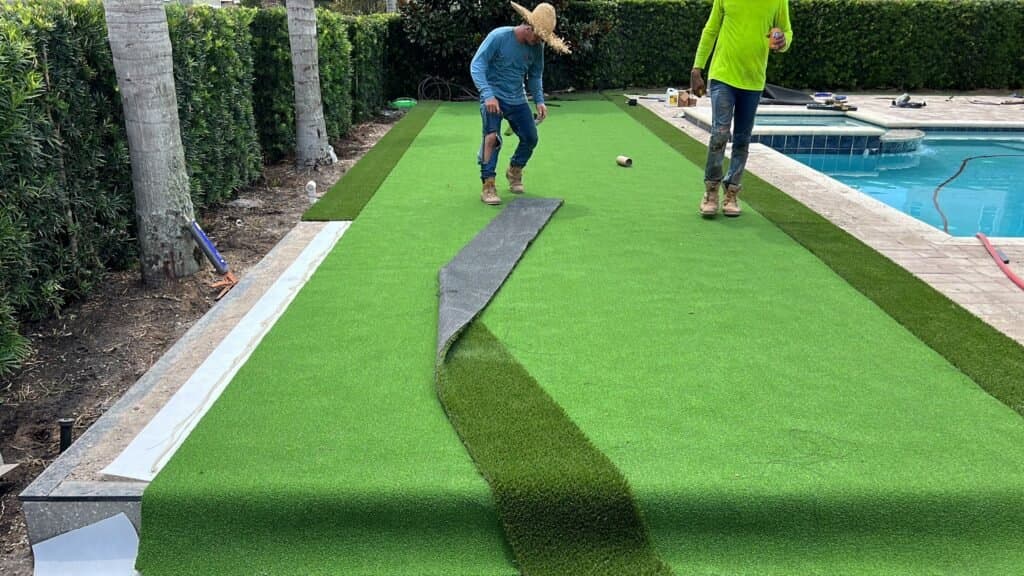
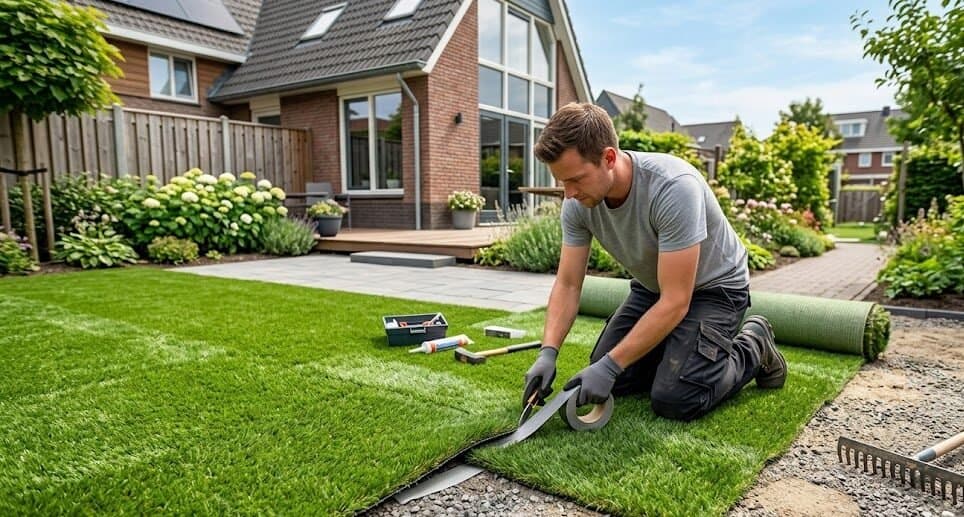
We roll out the turf panels across the prepared area, orienting all blade directions the same way for a uniform appearance. Where panels meet, we create invisible seams using specialized seaming tape and outdoor adhesive. The turf is trimmed precisely around edges, curves, trees, landscape borders, and hardscape features using sharp cutting tools for clean lines. Sloppy seams and rough edges are the most visible signs of amateur installation, and they're the things that make HOA boards and neighbors take a second look. We don't tolerate either.
Step 6: Securing and infill
The turf perimeter is secured with galvanized landscape spikes driven every 4 to 6 inches around the edges and along all seams. Then we spread infill material across the entire surface. For most Orlando residential installations, we use a blend of silica sand and rounded infill that's comfortable underfoot. Pet areas get enhanced antimicrobial infill for bacteria and odor control. The infill weighs down the turf, supports the blade structure so fibers stand upright, cushions the surface for walking comfort, and gives the lawn its natural feel. We brush the infill into the fibers using a power broom to distribute it evenly and work it down to the base of the blades.
Step 7: Final grooming and inspection
We power-brush the entire surface one final time to stand all blades upright and give the lawn its finished, manicured appearance. We inspect every seam, every edge, and every transition point against hardscape, landscape, and property boundaries. Then we walk you through the completed installation and cover care instructions specific to Orlando's climate. Most residential turf projects take 1 to 3 days depending on area size and site complexity.
Water Savings, Costs, and Long-Term Value in Orlando
The financial case for artificial turf in Orlando is strong, and it gets stronger every year as water rates climb, lawn maintenance costs increase, and homeowners place more value on their time. Here's the real math that Orlando property owners are running when they make the switch.
Water savings
are the most immediate financial benefit. A typical Orlando lawn needs 1 to 1.5 inches of water per week during the growing season to stay green and healthy. For a 1,000-square-foot lawn, that's roughly 620 to 930 gallons per week from your irrigation system. Over a full year, you're looking at 25,000 to 40,000 gallons of irrigation water for a modest front yard. At Orlando's current water and sewer rates, that adds $400 to $700 annually to your utility bill just for the lawn. Multiply that savings by 15 to 20 years, the typical lifespan of quality artificial turf, and the water savings alone can exceed $10,000 over the life of the installation. And that calculation doesn't account for the near-certain rate increases that Orlando Utilities Commission will implement over that same time period. Water isn't getting cheaper in Central Florida.
Maintenance elimination
saves both money and time in significant amounts. A professional lawn service in Orlando charges $120 to $250 per month for weekly mowing, edging, blowing, and basic weed management. Add in quarterly fertilization, seasonal pest control for chinch bugs and grubs, fungicide treatments, and periodic overseeding or sod replacement, and you're spending $1,800 to $3,500 per year to keep natural grass alive and looking decent. That's $27,000 to $52,500 over 15 years. Artificial turf requires occasional rinsing to remove dust and pollen, periodic brushing to keep blades upright in high-traffic areas, and infill top-off every few years. Total annual maintenance cost runs under $100 if you do it yourself, or under $300 if you hire it out. The difference over the life of the turf is dramatic.
Installation costs
for artificial turf in Orlando typically run $8 to $16 per square foot for residential projects, depending on the turf product selected, base requirements, accessibility, and overall project size. A 500-square-foot front lawn runs $4,000 to $8,000 installed. A 1,000-square-foot backyard is $8,000 to $16,000. Putting greens cost more per square foot because of the specialty nylon turf and precision grading involved, typically $14 to $22 per square foot. Pet turf installations with antimicrobial infill fall in the $10 to $18 range. Larger projects bring the per-square-foot cost down because fixed costs like mobilization and equipment spread across more area.
Return on investment
depends on your current lawn costs, but most Orlando homeowners break even within 4 to 7 years when you factor in water savings, eliminated maintenance, and avoided sod replacement costs. After the break-even point, every year is pure savings. And the intangible value matters too. No more Saturday mornings lost to mowing in 90-degree heat. No more brown patches after a January cold snap. No more mud tracked into the house during the rainy season. No more fighting with St. Augustine grass that refuses to grow under your oak trees or along your shady side yard. No more worrying about whether the lawn will look presentable when guests arrive. The turf looks the same every single day of the year.
KS Solutions provides a detailed cost breakdown for every project, including material, labor, base prep, infill, and any applicable permits. We also offer financing options to spread the investment over time so you can start saving on water and maintenance immediately. Our artificial turf maintenance plan keeps your lawn in peak condition with scheduled grooming, infill level checks, and professional deep cleaning. It's the hands-off approach to lawn ownership that attracted you to artificial turf in the first place.
Whether you're in College Park, SODO, Ivanhoe Village, Audubon Park, or Mills 50, KS Solutions is the team Orlando trusts for artificial turf installation done right. Call (321) 353-7445 to schedule your free estimate and see how much you could save by making the switch.