KS Solutions installs residential, pet-friendly, and play-area artificial turf in Maitland, FL. Call (321) 353-7445 for your free on-site estimate.
Why Artificial Turf Wins on Maitland's Lake-Chain Lots
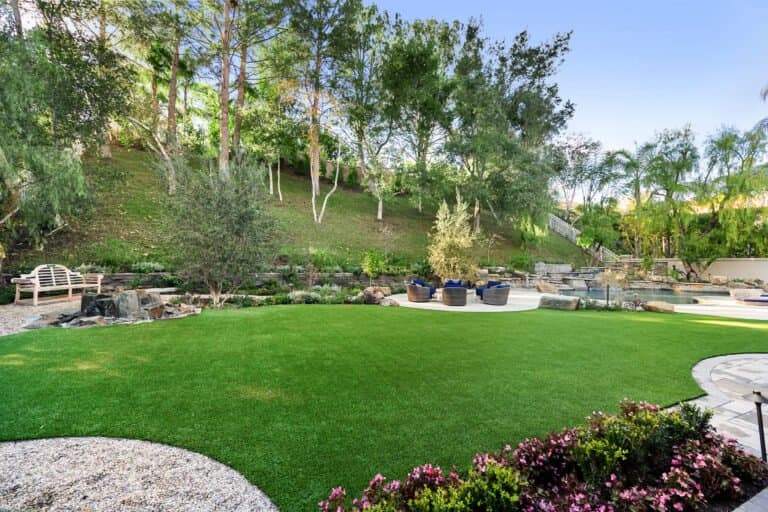
Maitland is one of the few Orange County cities where artificial turf is genuinely the better landscaping choice for most yards, not just the easier one. The reasons are stacked: a lake-chain water table that punishes natural lawn drainage, mature oak canopy in established neighborhoods that blocks the sun real grass needs, and an HOA mix where back-yard turf is now legally protected by Florida HB 1203. The result is a city where a properly engineered turf install outperforms St. Augustine or zoysia on five out of six lots.
Maitland sits on a chain of named lakes, including Lake Maitland, Lake Lily, Lake Sybelia, and Lake Catherine, with roughly 19,500 residents and a meaningful share of lakefront, lake-view, or lake-adjacent parcels. On those lots, natural grass fights three problems at once: high water table during the summer rainy stretch, salt-and-mineral spray from lake winds, and shade from mature oaks that the original developer planted decades ago. Artificial turf removes all three problems in one install.
What turf actually solves on a Maitland lot:
- No watering schedule: St. Johns River Water Management District watering rules cap residential irrigation in the Maitland service area, and turf eliminates the constraint entirely.
- No fertilizer runoff into the lake chain: Reducing fertilizer load on parcels draining toward Lake Maitland or Lake Lily is genuinely better for water quality, not just for the homeowner.
- No mowing on a lakefront slope: Lakefront yards in Maitland often have a real grade change toward the water; mowing those slopes wet is how injuries and ruts happen.
- No bald spots under oaks: Mature oak canopy in Dommerich Estates and around Lake Lily means most natural lawns end up with shade-thinned patches by the third year.
- Year-round green: Florida winters dry St. Augustine to a tan dormancy in January and February; turf stays green through the cool stretch.
That is the case for turf in Maitland specifically. The case against is real too: hot surface temperature in direct July sun, higher up-front cost than seed-and-sod, and the visual signal in front yards of a neighborhood like Dommerich Estates where natural grass is part of the look. We address all three at the design stage rather than after the install.
Drainage Engineering for Yards That Slope Toward the Lake
Drainage is the single most important variable on a Maitland turf install, and it is where most cheap installs fail. Turf is permeable through the backing, but the layers underneath the turf decide where the water actually goes. On a lakefront lot in Maitland, that water is heading toward a public water body, and getting that flow right is both a code requirement and a real environmental responsibility.
Soil profiles vary across the city. Upland Maitland lots, away from the shoreline, sit on the sandy soils common across inland Orange County (Candler, Tavares, and Apopka soils). Sand drains fast and forgives a few engineering shortcuts. Move toward the lake chain and the soil flips: clay lenses, organic muck pockets, and a seasonal high water table can sit only a few feet below the surface in summer. Treating both lot types the same way is exactly how a turf yard ends up squelchy in August.
Here is the layered system KS Solutions builds under every Maitland turf install, adjusted for the actual lot:
- Subgrade evaluation first: we open the soil and confirm what we are building on. Muck pockets get over-excavated to mineral soil before any base material goes in.
- Geotextile fabric on lakefront and clay-lens lots, between subgrade and base, to stop fines from migrating up through the system.
- Crushed concrete or limerock base, typically 3 to 4 inches on sandy upland lots, 4 to 6 inches on lakefront lots, compacted in lifts.
- Decomposed granite or fine sand bedding layer, 1 inch screeded flat to set the turf surface true.
- Turf with proper drainage perforations (most pet-grade turfs run 4 to 6 holes per square meter through the backing).
- Slope: minimum 1 to 2% pitch toward landscape drains, dry wells, or French drains, never as direct sheet flow into the lake.
- Edge containment: bender board or composite edging on every yard with a grade change to keep the base from migrating out under load.
Built this way, a Maitland turf yard takes a full summer downpour and drains it correctly, the surface stays firm under foot traffic, and runoff hits a controlled drainage path before it reaches the lake.
Pet-Friendly Turf Systems for Lakefront Families
Pet-friendly turf is a significant share of what we install in Maitland, especially on the lakefront and in HOA communities where dogs share the back yard with pool decks and patios. The right system handles three things: drainage of urine through the turf to the base, infill that does not hold odor, and a backing that does not delaminate when a 70-pound retriever sprints back and forth in the same line for two years.
What separates a real pet-grade Maitland install from a generic field-and-forget turf:
- High-flow backing with 4 to 6 drainage holes per square meter, sized so urine flows through to the base instead of pooling on the surface.
- Antimicrobial infill (zeolite or coated sand blends) that absorbs ammonia and reduces odor between rinses.
- Permeable base layer built specifically to drain liquid through to the subgrade, with the same lakefront drainage rules as the rest of the yard.
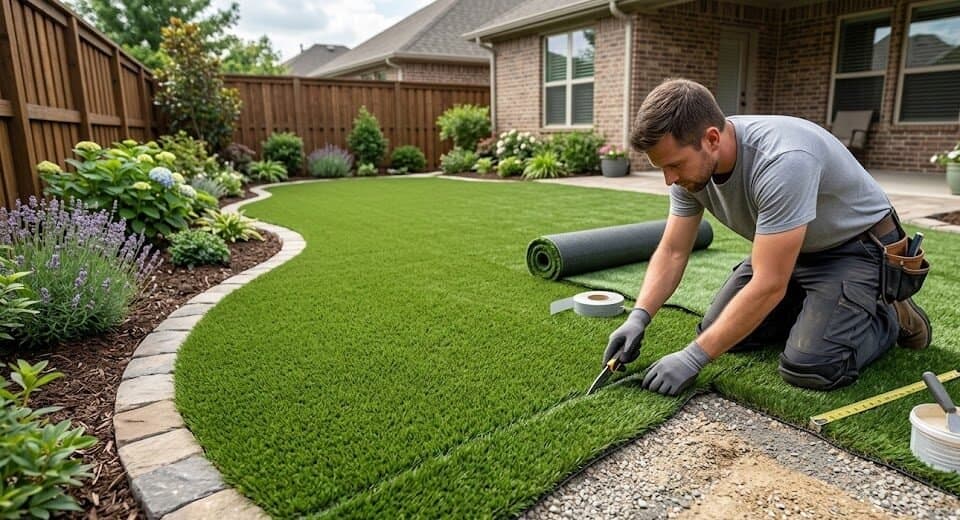
- Turf seam tape and seam glue rated for pet traffic; budget seams fail at the property line where dogs run patrol.
- Optional rinse system for households with multiple pets: a hose bib or low-flow drip line stubbed into the turf area for periodic flush-throughs.
Maintenance is real but light. We tell every Maitland pet-turf client to plan on a weekly hose-down in the high-use zones during the summer rainy stretch, brush-up the fiber direction every quarter, and freshen infill every 12 to 18 months. None of that is the same workload as mowing, fertilizing, and re-sodding pet-damaged St. Augustine.
Turf Under Dommerich Estates' Mature Oak Canopy
Dommerich Estates is one of Maitland's signature neighborhoods, with the original Dommerich Estates 1st, 2nd, 3rd, and 4th Add subdivisions platted starting in 1957. The streets are lined with mature live oak canopy, the lots are generous mid-century ranches, and the Dommerich Beach and Civic Association still anchors the community. Florida Audubon Society was founded at a Dommerich home back in 1900, which gives a sense of how long this part of Maitland has been settled.
What that history means for natural lawns is brutal. Live oaks throw deep shade, drop a year-round leaf and twig load, and run aggressive surface roots that out-compete grass for water and nutrients. By the third or fourth year, almost every traditional St. Augustine or zoysia lawn under a Dommerich oak canopy is patchy, thin, and embarrassed. Replacing the sod every other year is the workaround most homeowners eventually try, and it is expensive.
Artificial turf under Dommerich's oaks works because turf does not photosynthesize. Less than 4 hours of direct sun per day kills natural grass; turf does not care. The install does have to respect the canopy, though. Augering post holes or trenching irrigation lines through major surface roots is exactly how a 70-year-old oak ends up failing two years later.
How KS Solutions stages turf installs in Dommerich:
- Map every significant oak inside the proposed turf footprint and flag its dripline before any excavation.
- Hand-excavate inside the dripline of significant trees instead of using power equipment.
- Where a major surface root crosses the install footprint, build the base layer over the root rather than cutting through it.
- Use a slightly thicker bedding sand layer in localized areas to bridge minor root undulations without disturbing the root system.
- Stage materials and equipment outside the dripline of significant trees so soil compaction does not spread to the root zone.
Turf options that fit Dommerich's mid-century character are usually the medium-blade, mid-density landscape grades in a natural green tone, never the bright neon shades that read as obviously artificial against 1957 ranches and oak canopy.
(321) 353-7445Get Immediate Service
HOA Approval in Maitland Preserve, Trelago, and Lake of the Woods (Plus What HB 1203 Changed)
HOA rules around artificial turf in Maitland changed materially on July 1, 2024, when Florida HB 1203 took effect. The bill amended the Florida Homeowners' Association Act (Chapter 720, Florida Statutes) and explicitly limited HOA authority to ban artificial turf on parcels where the turf is not visible from the parcel's frontage, an adjacent parcel, an adjacent common area, or a community golf course. In plain English, an HOA in Maitland can no longer outright prohibit artificial turf in a back yard that the public cannot see from the street.
What is and is not protected by HB 1203 for a Maitland homeowner:
- Protected: back yards screened from the street and from neighbor sightlines.
- Protected: side yards behind a fence or wall that blocks visibility from the frontage.
- Still subject to ARC: front yards visible from the street.
- Still subject to ARC: any turf area visible from a community common area or golf course.
- Still subject to ARC: material spec, color, and pile height when the turf is in a visible location.
For ARC-controlled communities like Maitland Preserve, Trelago, and Lake of the Woods, the visibility rule does not eliminate the architectural review process for visible installations; it just removes the outright ban for non-visible ones. Most homeowners who want a full-yard turf install still go through ARC, because the front-yard portion remains discretionary for the committee.
The clean ARC submission flow we follow in Maitland:
- Pull the community's current ARC application form and material guidelines from the HOA portal.
- Compile the packet: site plan, turf material spec sheet (blade height, density, color), drainage plan, edge restraint detail.
- For non-visible back-yard installs, include a written reference to HB 1203 / Section 720.3045 in the cover note.
- Submit to the HOA's ARC liaison or property manager and confirm receipt in writing.
- Respond to any committee questions or revision requests within the same business week.
- Receive written approval and schedule the install start.
Approval timelines typically run 2 to 4 weeks depending on when the committee meets. KS Solutions prepares and submits the architectural review packet for any ARC-controlled community in Maitland, and we frame the HB 1203 argument correctly when the install is in a non-visible area.
Turf Costs and Project Timelines in Maitland
Pricing for residential artificial turf in Maitland generally runs in line with the rest of Central Florida, with the variables that move price the most being lakefront drainage correction, oak-canopy hand-excavation, and pet-grade material upgrades. We do every Maitland estimate on-site so the lot's actual soil profile, slope, and tree canopy drive the quote, not a square-foot rule of thumb.
Standard residential turf
Mid-density landscape turf for back yards, side yards, and full-yard installs without pet or play-area upgrades. Same drainage layer system as every other install, just without the antimicrobial infill or rinse system.
- Day 1: layout, demo of existing sod or hardscape, subgrade evaluation.
- Day 2: base build (3 to 6 inches depending on lot soil), compaction in lifts.
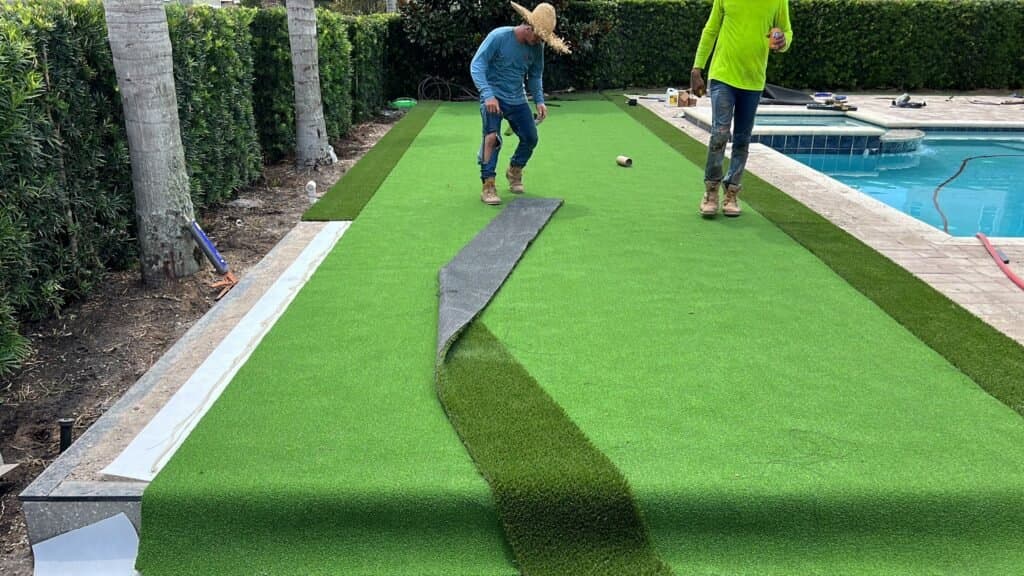
- Day 3: bedding sand screeded flat, turf rolled out and seamed.
- Day 4: infill broomed in, edge restraints set, final brush-up.
Pet-friendly turf system
High-flow backing, antimicrobial zeolite infill, optional rinse stub-out. Adds a day on most installs because of the extra base detailing for liquid drainage.
- Day 1 to 2: layout, demo, subgrade prep with extra attention to drainage.
- Day 3: base build with permeable layer, geotextile on lakefront lots.
- Day 4: bedding, turf installation with pet-grade seams.
- Day 5: zeolite infill, brush-up, rinse stub-out wired to existing hose bib.
Play-area and shade installs
Under oak canopy in Dommerich Estates or in screened back yards in Lake of the Woods. Hand-excavation inside the dripline adds time but protects the trees.
- Day 1 to 2: layout, hand-excavation inside oak driplines, materials staged outside the canopy.
- Day 3: base build over and around protected surface roots.
- Day 4 to 5: bedding, turf, infill, edge restraints.
For most Maitland turf projects, on-site work runs 2 to 4 days, plus 2 to 4 weeks for HOA architectural review if the property is in Maitland Preserve, Trelago, or Lake of the Woods, and the install is in a visible area. Non-visible back-yard installs in those communities are now protected under HB 1203, although we still recommend the ARC packet for documentation.