KS Solutions provides professional brick paver installation in Maitland, FL. Call (321) 353-7445 for your free on-site estimate.
Maitland's Lake-Chain Lots and What That Means for Paver Bases
Brick paver installation in Maitland is shaped by something almost no other Orange County city has to deal with at this concentration: water. Maitland sits on a chain of lakes, including Lake Maitland, Lake Lily, Lake Sybelia, and Lake Catherine, and a meaningful share of the city's roughly 19,500 residents live on a lakefront, lake-view, or lake-adjacent parcel. That single fact changes the way a paver base has to be engineered, because soil conditions can flip from "perfect for pavers" to "high water table and clay" within the same block.
On the upland side of Maitland, away from the shoreline, lots typically sit on the sandy soil series common across inland Orange County (Candler, Tavares, and Apopka soils). Sand drains fast, compacts well, and holds a paver base with very little drama. Move closer to the lake chain, though, and crews start running into clay lenses, organic muck pockets, and a seasonal high water table that can sit only a few feet below the surface during the summer rainy stretch. Treating both lots the same way is exactly how driveways and patios fail prematurely.
Here is how KS Solutions adjusts the base build to the actual lot, not a one-size template:
- Sandy upland lots: 4 inch crushed concrete base over compacted subgrade, with a standard 1 inch bedding sand layer.
- Lakefront and lake-adjacent lots with clay lenses: 6 to 8 inch crushed concrete base, geotextile fabric between subgrade and base to stop fines from migrating up, and edge restraints set deeper than usual.
- Lots with organic muck pockets (common near older shorelines): over-excavate the muck down to clean mineral soil before any base material goes in, then build back up in compacted lifts.
- Any lot, every time: minimum 1/4 inch per foot drainage slope away from the house, lanai, or pool deck, regardless of which soil profile we hit.
Done this way, a paver driveway or patio in Maitland flexes with seasonal ground movement instead of cracking like a rigid concrete slab. That matters even more on lake lots, where the water table can rise and fall noticeably between dry season and the June through September rainy stretch.
Maitland Has Its Own Building Office (Not Orange County Fast Track)
This is the single most common mistake homeowners and even some contractors make when they start a paver project in Maitland: assuming the City of Maitland uses the Orange County Fast Track permitting system. It does not. Maitland is incorporated, has its own Building Safety and Permitting office, and reviews every paver, fence, and hardscape permit in-house. Submitting through Orange County will simply slow the project down, because the application has to be redirected.
The City of Maitland's permitting team can be reached directly at (407) 539-6150, and applications are filed through the city's online gateway at itsmymaitland.com. Fence permits, for example, carry a flat $46 fee, and any project over $5,000 in value triggers a Notice of Commencement that has to be filed with the county clerk before work starts. Setbacks and use rules live in the Maitland Land Development Code, Chapter 21, with the schedule of district regulations in Section 21-6. Hardscape that pushes lot impervious surface coverage past city limits is reviewed against those same rules.
The clean step-by-step we follow on every Maitland paver job:
- Pull a current scaled property survey, which the city requires in the permit packet.
- Draft the site plan showing existing structures, the proposed paver footprint, and the impervious surface calculation.
- Submit the application through itsmymaitland.com along with the survey, site plan, and contractor licensing.
- Pay the applicable permit fee (for example, $46 for a fence permit) at submission.
- For any contract over $5,000, file the Notice of Commencement with the Orange County Clerk before the first day of work.
- Schedule the city's required inspections (typically subgrade, base, and final) at the milestones the permit specifies.
- Close the permit out at final inspection so the file is not left open against the property.
Because we run this loop on every project, our clients in Maitland do not have to chase the city, file the Notice of Commencement themselves, or troubleshoot a rejected application. KS Solutions handles the full packet through itsmymaitland.com.
Dommerich Estates Driveway Replacement Playbook
Dommerich Estates is one of Maitland's signature neighborhoods, with the original Dommerich Estates 1st, 2nd, 3rd, and 4th Add subdivisions platted starting in 1957. The homes are mostly mid-century ranches on generous lots, the streets are lined with mature oak canopy, and the Dommerich Beach and Civic Association still anchors the community. Florida Audubon Society was actually founded at a Dommerich home back in 1900, which gives a sense of how long this part of Maitland has been settled.
What that history means for paver work is specific. Many of the original concrete or asphalt driveways are now 60 plus years old, and the ground underneath them is rarely as clean as a new-construction lot. We routinely find buried builder debris, fill that was dropped in to level the lot in the late 1950s, and organic muck pockets that were never fully excavated before the original driveway was poured. Removing the old surface is the easy part. Restoring a clean, structural base is where the work happens.
The other constraint is the canopy. Dommerich's mature oaks are part of why the neighborhood looks the way it does, and a careless demo crew can damage critical surface roots in a single afternoon. We hand-excavate inside the dripline of significant trees, route equipment around protected roots, and stage materials away from trunks.
Common issues we plan for on Dommerich Estates driveway replacements:
- Buried 1950s and 1960s builder debris (broken concrete, old fill rock, partial pipe runs) that has to be removed before the new base goes in.
- Organic muck pockets that look like normal soil from the surface but compress under load, requiring over-excavation to mineral soil.
- Mature oak surface roots that cross the driveway footprint and need to be protected, not severed.
- Original asphalt or thin concrete that broke up because the underlying base was inadequate by modern standards.
- Tight side-yard access between the home and the lot line, which limits equipment size and requires staged hauling.
The result, when it is done correctly, is a paver driveway that fits the architectural character of a 1957 ranch, respects the canopy, and finally gives the home a base system engineered for Maitland soil instead of inherited from the original builder.
Lakefront Patios and Pool Decks Around Lake Maitland, Lake Lily, and Lake Sybelia
Lakefront work in Maitland is its own category. The patio or pool deck is the visual centerpiece of the backyard, the lake views set the design language, and the drainage requirements are stricter because runoff is heading directly toward a public water body. The Audubon Center for Birds of Prey on Lake Sybelia, opened in 1979, is a reminder that these lakes are ecologically active and not just scenic.
Three things drive every lakefront paver design we do in Maitland. First, drainage has to be intentional. Patios and pool decks need a minimum 1/4 inch per foot slope away from the house, and on lakefront lots we typically pitch additional flow toward landscape swales or dry wells rather than running it as sheet flow straight into the lake. Second, shoreline setbacks have to be respected. The combination of city setback rules in Chapter 21 and any HOA shoreline rules dictates how close a hard surface can sit to the water. Third, slip resistance matters more around a pool than almost any other variable, because wet feet plus smooth stone is how injuries happen.
Material picks we recommend most often for Maitland lakefront patios and pool decks:
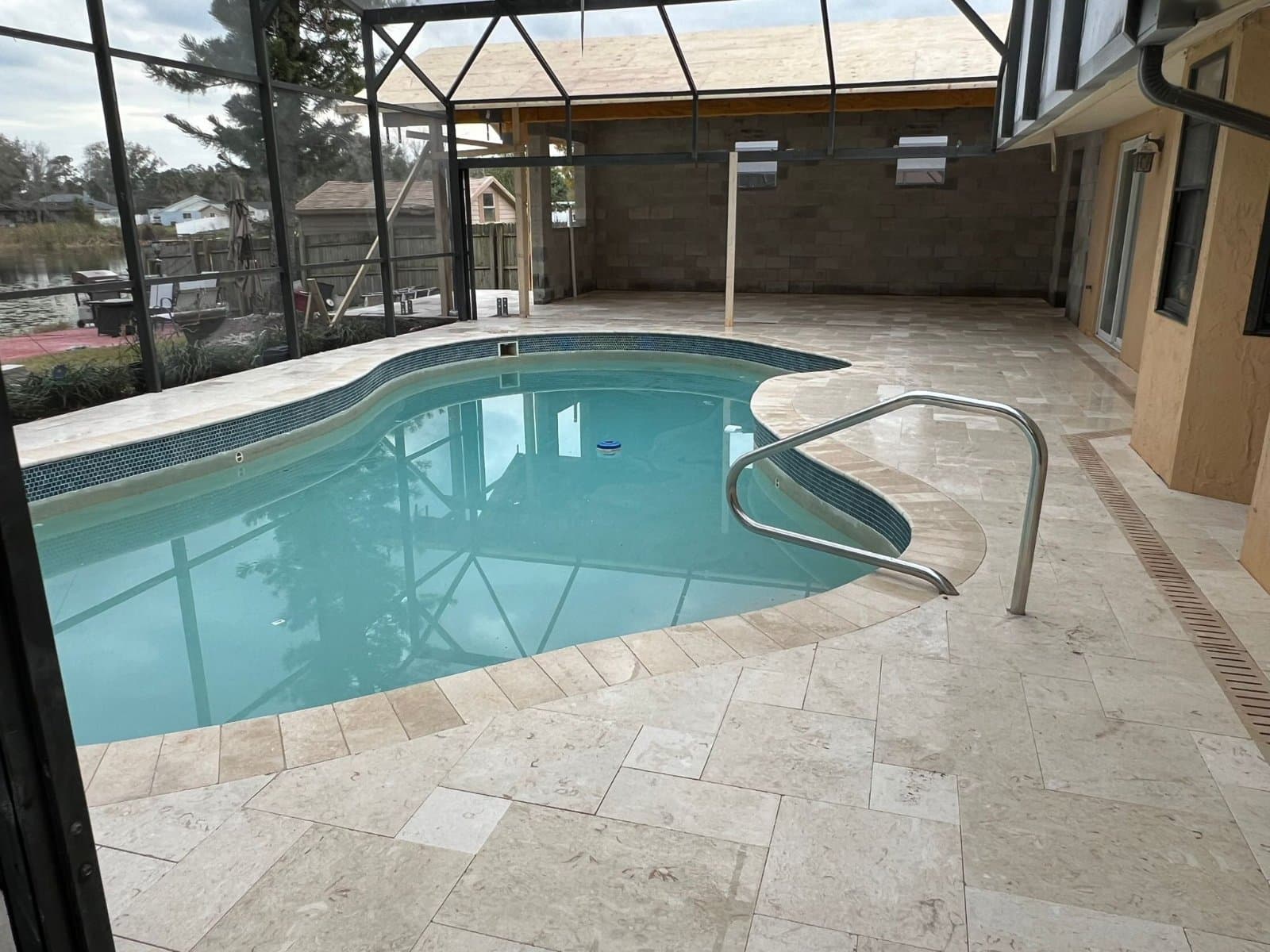
- Light-toned travertine for pool decks: stays cooler under bare feet in July, naturally textured surface, classic look against lake views.
- Tumbled concrete pavers in sand, ivory, or cream for patios: budget-friendly, very stable on the standard base build, blend well with mature landscaping.
- Permeable paver systems for lots where impervious coverage is tight or where reducing direct runoff into the lake is a priority.
- Textured (not polished) finishes on every horizontal surface a swimmer will step onto wet.
- Dark accent bands only as borders or pattern breaks, never as the main field on a sun-exposed pool deck, because dark surfaces hold heat.
Designed this way, a lakefront paver patio on Lake Maitland or a pool deck near Lake Lily Park can sit comfortably in the landscape, drain correctly during a summer downpour, and stay safe to walk on barefoot.
(321) 353-7445Get Immediate Service
Maitland Preserve, Trelago, and Lake of the Woods HOA Architectural Review
Maitland has a real mix of HOA structures. The newer planned communities, including Maitland Preserve and Trelago, run full HOAs with architectural review committees that approve material, color, and footprint changes before any exterior work starts. Lake of the Woods is gated and lakefront, with its own ARC. By contrast, the Lake Lily area runs a voluntary historic neighborhood association with minimal fees and far less prescriptive rules. Knowing which bucket your property sits in is the difference between a 2 to 4 week head start on the project and a stop-work surprise after demo.
For ARC-controlled communities, KS Solutions prepares and submits the architectural review packet as part of the install. Approval timelines typically run 2 to 4 weeks depending on when the committee meets. The clean ARC submission flow looks like this:
- Pull the community's current ARC application form and material guidelines from the HOA portal.
- Compile the packet: site plan, paver material spec sheet, color samples, drainage plan, and contractor license.
- Submit to the HOA's ARC liaison or property manager and confirm receipt in writing.
- Respond to any committee questions or revision requests within the same business week.
- Receive written approval, then file the city building permit through itsmymaitland.com referencing the ARC approval.
- Schedule the install start only after both the city permit and the HOA approval are in hand.
That sequence is boring on purpose. Boring is how a paver project in Maitland Preserve, Trelago, or Lake of the Woods stays on schedule and avoids fines.
Paver Costs and Project Timelines in Maitland
Pricing for paver work in the Maitland market generally falls in the same range as the rest of inland Orange County, roughly $19 to $25 per square foot installed for standard concrete pavers, with premium materials and complex layouts running higher. The variables that move price the most in Maitland specifically are: how much over-excavation the lot needs (lakefront and older Dommerich lots cost more), whether an HOA ARC submission is required, and whether the project triggers a Notice of Commencement.
Driveway replacements
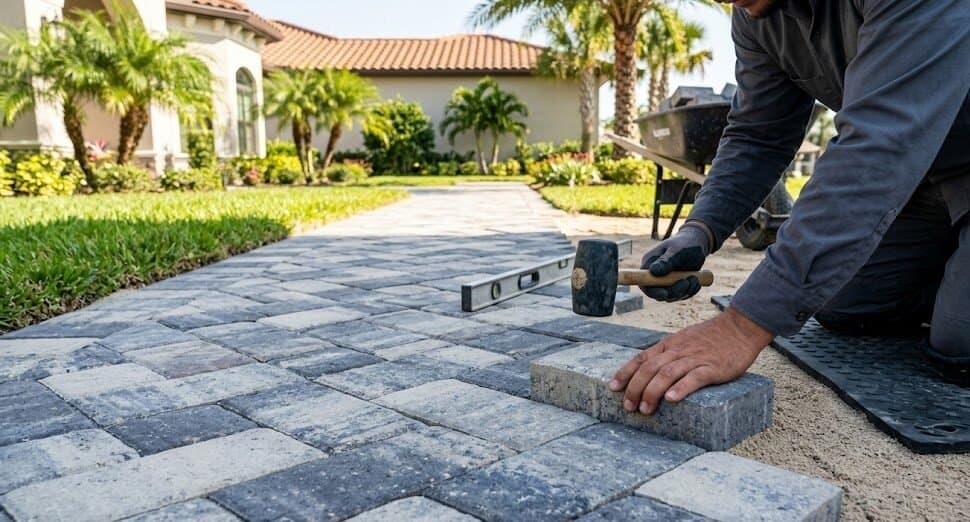
Replacing an old concrete or asphalt driveway in Maitland with interlocking pavers is the most common project we run. Demo, base correction, and finished pavers on a typical two-car driveway take about a week of on-site work, plus permit time on the front end.
- Day 1: site protection, demo of existing surface, and haul-off.
- Day 2: subgrade evaluation and over-excavation of any organic or debris pockets.
- Day 3: geotextile (where required), base lifts compacted in stages.
- Day 4: bedding sand, paver field installation, and edge restraints.
- Day 5: cuts, polymeric sand application, final compaction, and city final inspection scheduling.
Patios
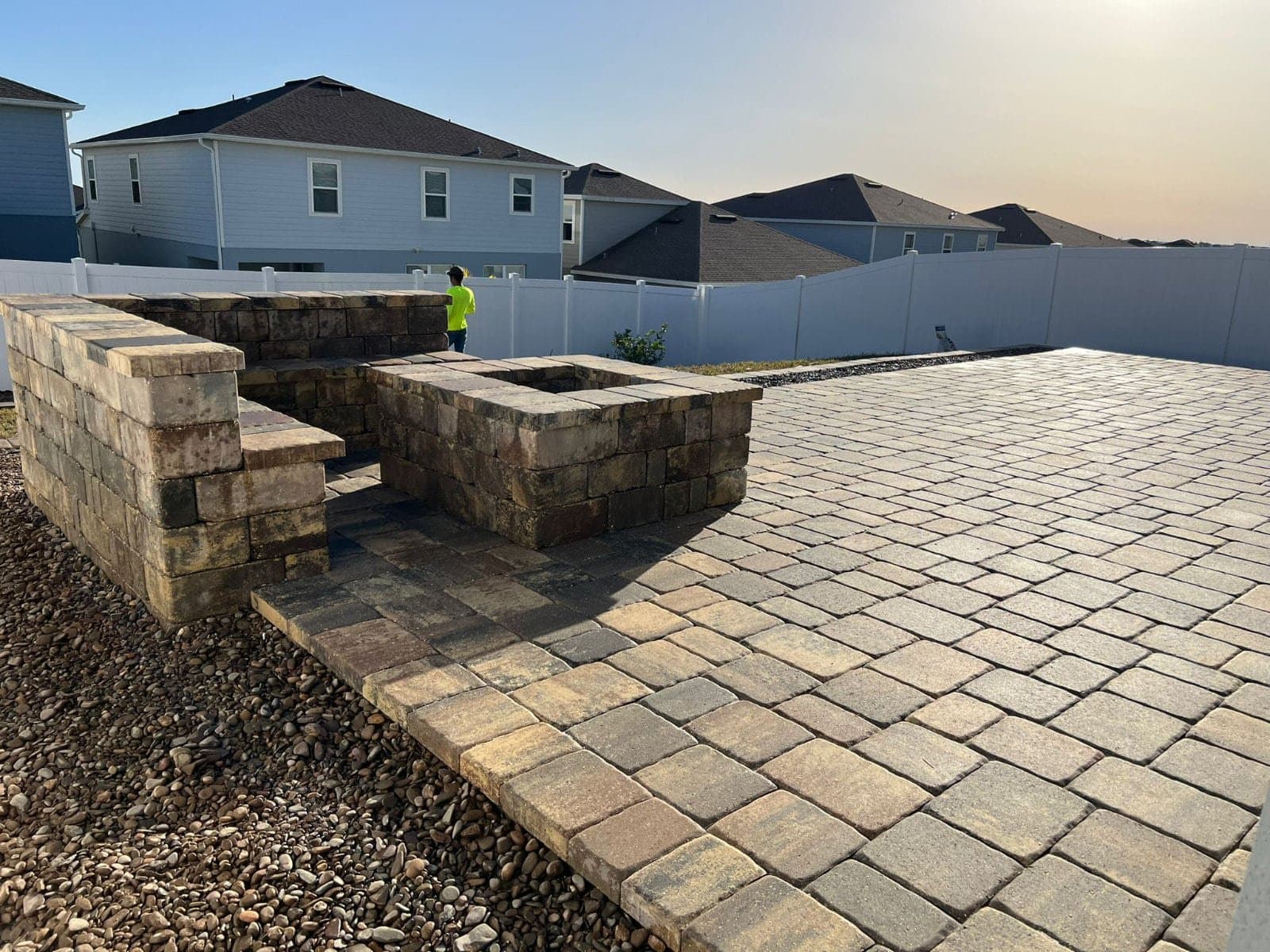
Patios are usually faster than driveways because the loads are lower and the footprint is often more uniform. Material choice (concrete pavers vs travertine) and integrated features (fire pit pad, outdoor kitchen base) drive both price and timeline.
- Day 1: layout, excavation, and subgrade prep.
- Day 2: base build and compaction.
- Day 3 to 4: paver field, borders, and any integrated features.
- Day 4 to 5: polymeric sand, final compaction, cleanup.
Pool decks
Pool decks are the most detail-sensitive of the three because every surface around the pool has to drain correctly, stay cool underfoot, and hold up to chlorine and saltwater splash. Coordination with the pool deck cantilever and existing coping adds steps.
- Day 1 to 2: removal of existing deck (if any) and subgrade prep.
- Day 3: base build with proper slope away from coping and toward landscape drains.
- Day 4 to 5: paver installation around coping with tight cuts.
- Day 6: polymeric sand, sealing (if specified), and final walk-through.
Polymeric sand always gets installed during a window with humidity below 80% and zero rain forecast within 24 hours, because that is what the manufacturer requires for the joints to set correctly. In Maitland's June through September rainy stretch, that sometimes means scheduling the final sand pass a day or two later than the rest of the project, and we tell clients that up front.