KS Solutions installs vinyl, aluminum, wood, and Florida pool-code fencing in Maitland, FL. Call (321) 353-7445 for your free on-site estimate.
Fencing Around Maitland's Lake Chain: Setbacks, Sightlines, and Shoreline Rules
Fence work in Maitland is shaped by the same lake geography that drives the rest of the city. Maitland sits on a chain of named lakes, including Lake Maitland, Lake Lily, Lake Sybelia, and Lake Catherine, and a meaningful share of the city's roughly 19,500 residents own a parcel that is lakefront, lake-view, or lake-adjacent. That puts three real constraints on fence design that most inland Orange County crews never have to think about.
The first is the shoreline setback. Building near a public water body is governed by both city setback rules in the Maitland Land Development Code, Chapter 21, and any community shoreline rules layered on top. A fence run that looks fine on a flat sketch can quietly violate setback if the property line ends well short of where the lawn meets the water. We confirm both the surveyed lot line and any HOA shoreline easement before staking a single post.
The second is sightline. On most Maitland lakefront lots, the lake view is the single most valuable feature of the property, often more valuable than additional yard footage. A 6 ft solid privacy fence run straight toward the shore will almost always cut off that view from the patio, the master bedroom, or the kitchen window. The right answer is usually a hybrid: privacy fencing where the lot meets the neighbor or the street, and an open-style aluminum or chain-link near the shoreline that satisfies safety and pet containment without blocking the view.
The third is the soil. Lakefront and lake-adjacent lots in Maitland often hit clay lenses, organic muck pockets, or a seasonal high water table within the first few feet of soil. Concrete-set fence posts on those lots have to go deeper than the standard 24 to 30 inches, and we reach mineral soil before the concrete goes in. Skipping that step is how a fence ends up leaning in three years.
Where each fence type fits on a Maitland lake lot:
- Aluminum (open picket): ideal at the shoreline edge. Preserves the lake view, satisfies pool-barrier code when used as a perimeter, and resists corrosion in Florida humidity.
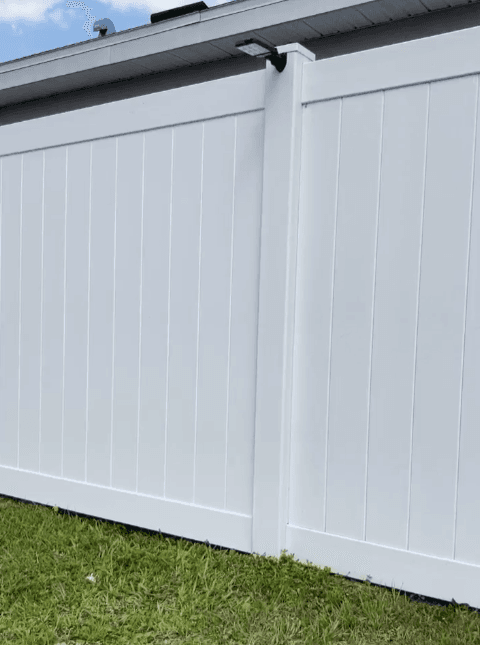
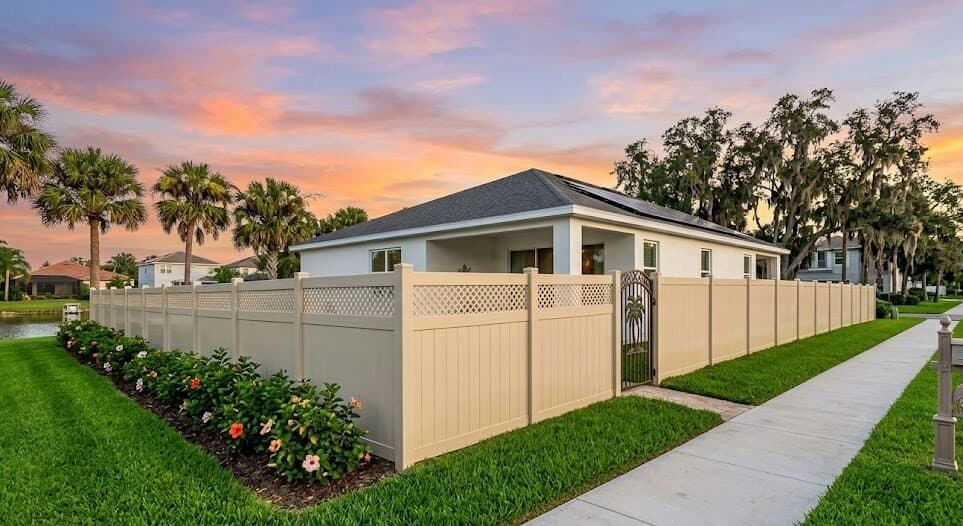
- Vinyl privacy: ideal between the home and the neighbor or between the home and the street. Six feet of solid panel for true privacy without blocking the lake view from the back of the house.
- Wood (board-on-board cedar or pressure-treated pine): works for HOA communities that require natural-material fencing. Needs sealing on a Florida moisture cycle.
- Chain-link (black vinyl-coated): the budget-friendly choice for back lot lines or pet runs where view and privacy are not the priority.
Designed this way, a Maitland fence respects the lake view, the shoreline setback, and the soil profile of the actual lot rather than forcing one fence type onto every yard.
The Maitland Fence Permit Path (Not Orange County): itsmymaitland.com
This is the most common mistake on Maitland fence projects: assuming the City of Maitland uses Orange County's Fast Track permitting system. It does not. Maitland is incorporated and runs its own Building Safety and Permitting office in-house. Submitting a Maitland address through Orange County only delays the project, because the application has to be redirected.
Fence permits in Maitland are filed through the city's online gateway at itsmymaitland.com. The permit fee is a flat $46. The permit specialist line is (407) 539-6150. Setback, height, and material rules live in the Maitland Land Development Code, Chapter 21, with the schedule of district regulations in Section 21-6, and the Fence and Wall Standards inside the use-specific standards.
The clean step-by-step we follow on every Maitland fence job:
- Pull a current scaled property survey, which the city requires in the permit packet.
- Draft the site plan showing existing structures, the proposed fence run, gate locations, and post spacing.
- Confirm the fence height fits the zoning district and the front, side, and rear setback rules in Chapter 21.
- Submit the application through itsmymaitland.com along with the survey, site plan, material spec, and contractor licensing.
- Pay the $46 permit fee at submission.
- For any contract over $5,000, file the Notice of Commencement with the Orange County Clerk before the first day of work.
- Schedule the city's required inspection (typically a final on the completed fence) at the milestone the permit specifies.
- Close the permit out at final inspection so the file is not left open against the property.
Because we run this loop on every project, our clients in Maitland do not have to chase the city, file the Notice of Commencement themselves, or troubleshoot a rejected application. KS Solutions handles the full submission through itsmymaitland.com.
Pool Safety Barriers and the Florida Residential Swimming Pool Safety Act
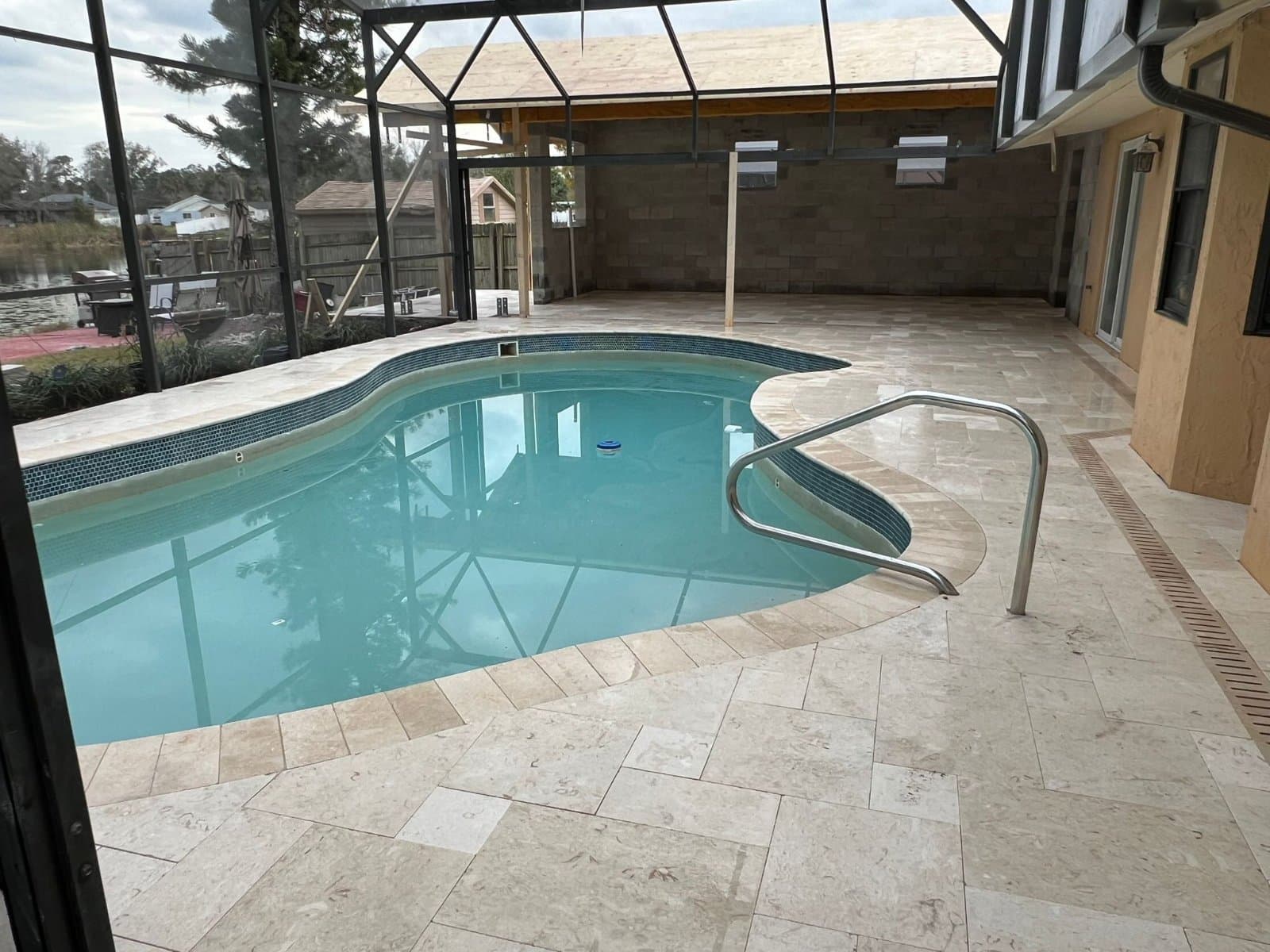
Any fence that doubles as a pool barrier in Maitland has to satisfy the Florida Residential Swimming Pool Safety Act, codified in Florida Statutes Chapter 515. The Act, also known as the Preston de Ibern/McKenzie Merriam Residential Swimming Pool Safety Act, took effect October 1, 2000, and it sets the floor that every pool-area fence in the state has to meet. Failure to install a compliant barrier (or another approved safety device) is a second-degree misdemeanor under state law.
What the statute actually requires for a perimeter fence used as a pool barrier:
- 4 ft minimum height measured from the outside of the barrier.
- No gaps a young child could crawl under, squeeze through, or climb over. That includes horizontal rails close enough together to function as a ladder.
- Gate opens outward, away from the pool.
- Self-closing hinges and a self-latching locking device.
- Latch on the pool side of the gate, placed so a young child cannot reach it over the top or through any opening.
- Sufficient distance from the water so a child or medically frail adult who manages to breach the barrier does not fall directly into the pool.
The aluminum picket fence is the most common pool-code answer in Maitland because spacing between vertical pickets can be specified to 4 inches max (well inside the no-climb, no-squeeze rules), the open profile keeps the lake view, and powder-coated aluminum holds up to chlorine, salt water, and Florida humidity for decades. Vinyl pool fence is the next most common pick when an HOA wants a softer profile or a specific color match.
Beyond the perimeter fence, Florida law also recognizes alternative pool safety devices (approved pool covers, exit alarms on doors that open into the pool area, self-closing/self-latching devices on those doors). Most Maitland homeowners still build the perimeter fence because it is the simplest path to compliance, the most enforceable in practice, and the one that most lakefront HOA documents already assume.
Routing Fence Posts Around Dommerich Estates' Mature Oak Canopy
Dommerich Estates is one of Maitland's signature neighborhoods, with the original Dommerich Estates 1st, 2nd, 3rd, and 4th Add subdivisions platted starting in 1957. The streets are lined with mature live oak canopy, the lots are generous mid-century ranches, and the Dommerich Beach and Civic Association still anchors the community. Florida Audubon Society was founded at a Dommerich home back in 1900, which gives a sense of how long this part of Maitland has been settled.
What that history means for fence work is specific. Run a fence line through Dommerich without thinking about the canopy and it is easy to sever critical surface roots, kill a 70-year-old oak, and trigger problems with both the city and the civic association. Live oaks throw most of their feeder roots inside the dripline, in the top 12 to 18 inches of soil. A standard auger that drops a 24-inch hole every 8 ft can cut through dozens of those roots in one afternoon.
How KS Solutions stages fence installs in Dommerich:
- Map every significant oak inside the proposed fence corridor and flag its dripline before any work starts.
- Hand-dig post holes inside the dripline of significant trees instead of augering.
- Where a post would land on a major surface root, shift the post location by 6 to 12 inches rather than cutting the root.
- Where shifting is not possible (gate hinge posts, corners), use a smaller post diameter and concrete only the bottom of the hole, leaving the upper soil profile undisturbed for root function.
- Stage materials and equipment outside the dripline of significant trees so soil compaction does not spread.
Aesthetically, fence picks that fit Dommerich's mid-century character are usually black aluminum, dark vinyl in a wood-grain texture, or natural cedar. Tall solid white vinyl reads as out of place against 1957 ranches with mature oak canopy, and most longtime Dommerich homeowners feel the same way.
(321) 353-7445Get Immediate Service
HOA Fence Approvals in Maitland Preserve, Trelago, and Lake of the Woods
Maitland has a real mix of HOA structures. The newer planned communities, including Maitland Preserve and Trelago, run full HOAs with architectural review committees that approve fence material, color, height, and exact run before any work starts. Lake of the Woods is gated and lakefront, with its own ARC. By contrast, the Lake Lily area runs a voluntary historic neighborhood association with minimal fees and less prescriptive rules, and Dommerich Estates is governed by the civic association rather than a planned-community HOA.
Florida HB 1203, signed in 2024, preempted certain HOA restrictions on visible structures, but ARC review of fence material, color, and placement is still firmly inside what associations are allowed to approve or reject. Skipping the ARC and pulling only the city permit is how a finished fence ends up with a written demand to remove it. We do not skip ARC.
The clean ARC submission flow looks like this:
- Pull the community's current ARC application form and material guidelines from the HOA portal.
- Compile the packet: site plan, fence material spec sheet, color samples, gate location, and contractor license.
- Submit to the HOA's ARC liaison or property manager and confirm receipt in writing.
- Respond to any committee questions or revision requests within the same business week.
- Receive written approval, then file the city building permit through itsmymaitland.com referencing the ARC approval.
- Schedule the install start only after both the city permit and the HOA approval are in hand.
Approval timelines typically run 2 to 4 weeks depending on when the committee meets. KS Solutions prepares and submits the architectural review packet for any ARC-controlled community in Maitland.
Fence Pricing and Project Timelines in Maitland
Pricing for fence work in Maitland generally falls in the same range as the rest of inland Orange County. Statewide market data places the average vinyl fence install at roughly $3,626 for a typical residential run, with material, height, and gate count driving most of the spread. The variables that move price the most in Maitland specifically are: lakefront soil correction, oak canopy hand-digging, and HOA ARC requirements.
Vinyl privacy fence
Vinyl is the most common pick for Maitland yards that want full privacy between the home and the neighbor. UV-resistant white, almond, and tan are the standard colors; wood-grain textured vinyl is increasingly popular in HOA communities that want a softer profile.
- Day 1: layout, marking utilities, and demo of any existing fence.
- Day 2: post holes, concrete set, cure time begins.
- Day 3: panels and gates installed once posts have cured.
- Final inspection through itsmymaitland.com once the run is complete.
Aluminum (open picket)
Aluminum is the standard pick for pool barriers, lakefront sightline preservation, and any HOA that wants an estate-look black or bronze fence. Powder-coated finish, rackable panels for grade changes, and 4 inch picket spacing for pool-code compliance.
- Day 1: layout, post-hole digging (hand-dug inside oak driplines), concrete set.
- Day 2: panels installed once posts have cured.
- Day 3: gates set with self-closing hinges and self-latching hardware (pool-code projects).
Wood (board-on-board cedar or pressure-treated pine)
Wood is the right answer when an HOA requires natural material or when the home's architecture calls for a warmer profile. Florida moisture means wood needs sealing on a regular cycle, which we explain at the estimate.
- Day 1 to 2: layout, post holes, concrete set, cure time.
- Day 3 to 4: rails and pickets installed.
- Optional: stain or sealer applied within 30 days of install once the wood has dried.
For most Maitland fence projects, on-site work runs 2 to 4 days, plus permit time on the front end (filed through itsmymaitland.com), plus 2 to 4 weeks for HOA architectural review if the property is in Maitland Preserve, Trelago, or Lake of the Woods.