KS Solutions installs custom fencing in Apopka. Call (321) 353-7445 for your free estimate.
Black Bears Cross Apopka Backyards: Why Standard Fencing Fails Near the Wekiva Corridor
Fence installation in Apopka, FL carries a responsibility that no other Orange County city faces at this scale: keeping Florida black bears out of residential yards. Apopka's northwest quadrant borders the Wekiva River Protection Area and Wekiwa Springs State Park, a combined 75,000+ acres of preserved habitat supporting one of Central Florida's densest bear populations. These bears don't stay in the forest. They follow drainage channels, golf course edges, and undeveloped parcels directly into residential neighborhoods along Kelly Park Road, Lester Road, and the SR 429 corridor, searching for garbage, pet food, bird feeders, and fruit trees.
A standard 6-foot vinyl privacy fence will not stop an adult black bear. Males weigh 250 to 450 pounds and climb vertical surfaces as easily as a ladder. They push through lightweight panels without slowing down. A bear that finds food in your yard once will return nightly until the food source disappears, and each visit risks property damage, pet encounters, and the eventual confrontation that leads to the bear being trapped or destroyed.
KS Solutions installs bear-deterrent fencing for Apopka properties in the Wekiva buffer zone following Florida Fish and Wildlife Conservation Commission guidelines: metal posts that resist snapping, no exterior horizontal rails providing climbing footholds, double-rail reinforcement resisting lateral push-through, and a minimum 6-foot height with smooth surfaces offering no grip points. These modifications transform a standard residential fence into a barrier that makes bears choose an easier route away from your property.
Bear-Proof Trash Enclosures: The Single Most Effective Deterrent for Apopka Homeowners
Most bear-human conflict in Apopka starts at the garbage can. Bears have a sense of smell seven times stronger than a bloodhound, detecting food waste inside sealed containers from over a mile downwind. Once a bear learns a particular address has accessible garbage, it returns on a schedule roughly matching your trash pickup day. The bear isn't visiting because it likes your fence. It's visiting because your trash can is an all-you-can-eat buffet that restocks every week.
Florida Fish and Wildlife recommends enclosed trash storage as the single most effective residential bear deterrent. KS Solutions builds custom bear-resistant trash enclosures using heavy-gauge galvanized chain link with a lockable top panel and a concrete pad base. The enclosure surrounds your garbage cans on all four sides and above, making it physically impossible for a bear to access the contents. The lock uses a carabiner-style closure that human hands operate easily but bear paws cannot manipulate.
A standard two-can enclosure measures 4 feet wide by 3 feet deep by 5 feet tall and costs $800 to $1,400 installed on a 4-inch concrete pad. Three-can enclosures for larger households run $1,100 to $1,800. Combining a bear-deterrent yard fence with a locked trash enclosure typically eliminates bear activity within 2 to 4 weeks. Once bears stop finding food rewards, they redirect their foraging routes to easier targets and your property drops off their nightly circuit.
Nursery Soil Post Problems: How Apopka's Foliage Heritage Affects Fence Stability
Apopka earned the "Indoor Foliage Capital of the World" title because hundreds of commercial nurseries operated on land that now holds subdivisions. When developers converted nursery acreage to residential lots, they graded using the existing nursery soil, a dark organic mix unlike the sandy mineral soil native to Orange County. This soil grows plants beautifully but anchors fence posts poorly.
Organic soil compresses under load. A concrete fence post footing set in nursery soil slowly sinks as the organic material beneath it decomposes and compresses over months and years. The post drops a quarter inch here, a half inch there, and within 3 to 5 years the fence line develops an uneven, rolling top profile. On newer lots where the fill soil is less than 5 years old, settling can pull fence rails out of their post brackets entirely.
KS Solutions addresses Apopka's nursery soil by boring post holes through the organic layer into the native sand below. On former nursery properties, we dig 36 to 42 inches deep rather than the standard 24 to 30 inches, ensuring the concrete footing bears on stable mineral soil beneath the compression zone.
The dark nursery soil also stains white fence panels during heavy rainstorms when mud splashes upward. Organic tannins in the decomposed plant matter bond with vinyl surfaces and are harder to remove than mineral soil splashes. For white vinyl on former nursery lots, we install a 6-inch concrete mow strip beneath the fence to prevent mud contact. Tan, clay, or dark-colored vinyl hides splash staining better and is the more practical choice for these Apopka properties.
Privacy and Pool Fencing for 57,000 Residents Across 35 Square Miles
While bear-country fencing defines northwest Apopka, the rest of this 35-square-mile city has the same privacy and pool safety needs as any growing Central Florida community. With nearly 57,000 residents and the demographic mix that makes Apopka one of Orange County's most diverse cities (44% White, 23% Black, 32% Hispanic/Latino), fence design preferences span a wide range of styles and materials.
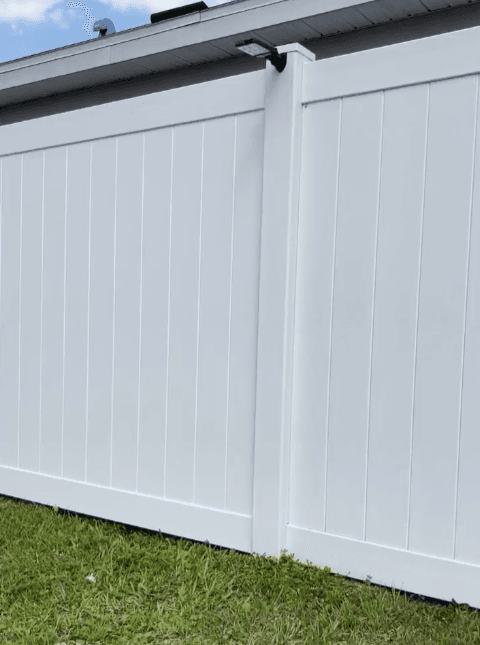
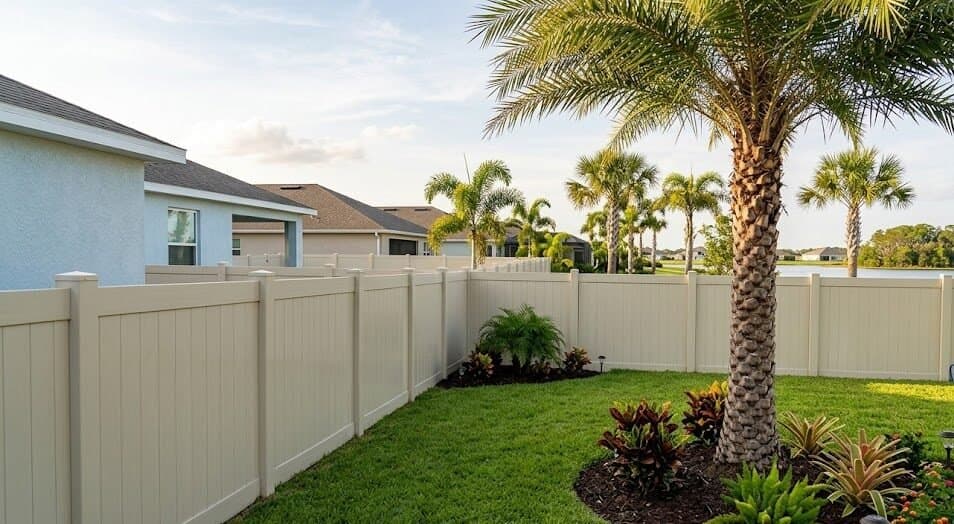
Vinyl privacy fencing dominates in Apopka's newer HOA communities along the SR 429 corridor and Kelly Park Road. White and tan are standard, but woodgrain-textured vinyl replicating cedar is gaining popularity. The zero-maintenance advantage appeals to working families in a city where the median household income of $66,057 means discretionary spending goes to things more enjoyable than fence staining.
Pool barrier compliance follows Florida law: minimum 4-foot height, self-closing and self-latching gates with latches 54 inches above grade on the pool side, no openings larger than 4 inches. Black powder-coated aluminum is the standard pool fence material in Apopka, providing code compliance, visibility, and corrosion resistance without maintenance.
Apopka's rapid growth has produced hundreds of HOA communities, each with architectural review requirements for fencing. New subdivisions along the western and northern growth corridors typically have stricter material and style restrictions than older neighborhoods near downtown. KS Solutions identifies both city and HOA requirements during our consultation and submits applications to both simultaneously, running approvals in parallel to minimize wait time.
(321) 353-7445Get Immediate Service
Apopka's City Permits and Wekiva Environmental Overlay
Apopka operates its own Building Division separate from Orange County government. Fence permits go through City Hall at 120 East Main Street. The city's zoning code sets fence height at 6 feet maximum in rear and side yards with lower limits in front yards that vary by zoning district. Corner lots have visibility triangle requirements at intersections.
Properties in the Wekiva River Protection Area overlay zone may face additional environmental review. The city's growth management department reviews these overlays separately from the building permit, especially if the fence alignment falls near designated wildlife corridors or wetland buffers. This environmental overlay can add 5 to 15 business days to the approval timeline beyond the standard 5 to 10 day permit processing.
Apopka's growth has also produced a patchwork of HOA regulations across the city. New developments along Kelly Park Road, Lester Road, and the SR 429 corridor typically require architectural review for any fence installation. Older neighborhoods near downtown often have no HOA governance at all, giving homeowners more freedom in material and style selection.
KS Solutions handles all Apopka permitting including environmental overlay review for properties near the Wekiva protection zone. We carry the required Apopka contractor registration and submit applications through the city's online portal the day the contract is signed to start the processing clock immediately. Standard processing runs 5 to 10 business days for residential fencing. HOA review adds 10 to 45 days depending on the board's meeting schedule. We submit city and HOA applications on the same day so both reviews run in parallel rather than sequentially, which can save 3 to 6 weeks compared to handling them one at a time.
Apopka Fence Pricing: Standard Residential Plus Bear-Country Upgrades
Base fence costs in Apopka match standard Orange County residential pricing. Wildlife-deterrent modifications and deeper post settings for nursery soil add project-specific costs that vary by property location and the species present in the area.
Vinyl privacy fence
costs $28 to $45 per linear foot installed on standard lots. Former nursery properties requiring deeper post footings add $3 to $6 per linear foot. Concrete mow strips for mud splash prevention add $8 to $12 per linear foot. A 150-foot backyard enclosure on standard soil runs $4,200 to $6,750. The same enclosure on former nursery soil with mow strip runs $5,850 to $9,450.
Bear-deterrent fencing
with metal posts, double-rail construction, and smooth exterior surfaces costs $45 to $70 per linear foot installed. A 200-foot perimeter in bear-deterrent specification runs $9,000 to $14,000. Bear-resistant trash enclosures add $800 to $1,800 depending on size. The combined package for a northwest Apopka property typically runs $10,000 to $16,000.
Wood privacy fence
in pressure-treated pine costs $18 to $35 per linear foot. Cedar runs $28 to $50. Aluminum pool fence costs $30 to $55 per linear foot. KS Solutions provides itemized quotes separating standard installation costs from wildlife-specific and nursery-soil upgrades so you see exactly what each feature adds. Call (321) 353-7445 for your free Apopka fence estimate.