DIY vs Professional Paver Installation: The Real Question
Laying pavers looks like the perfect weekend project. The pavers are sold by the pallet at every home center, the videos make it look like a long Saturday, and the professional quote for a patio can be several times the cost of the material. So it is fair to ask whether paying a crew is worth it.
The honest answer is that the pavers are the easy part. What decides whether a patio stays flat for twenty years or grows dips and ruts by the second rainy season is everything you never see: how deep the base goes, what it is made of, how it was compacted, where the water goes and what holds the edges. In Central Florida's sandy soil, those hidden steps are exactly where weekend projects fail. This guide walks through what a DIY install really involves, what it really costs, where it goes wrong in Florida, and a simple way to decide which projects you can do yourself and which ones you should not.
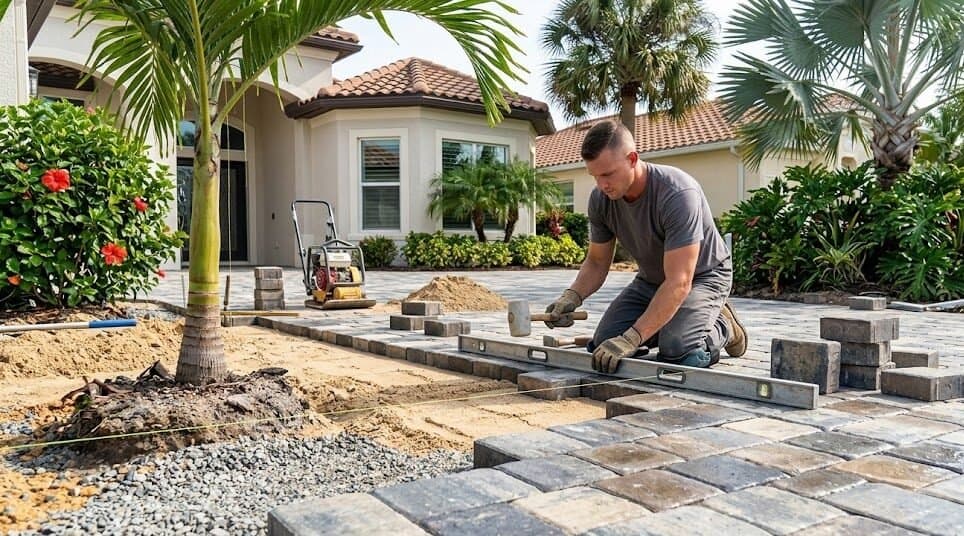
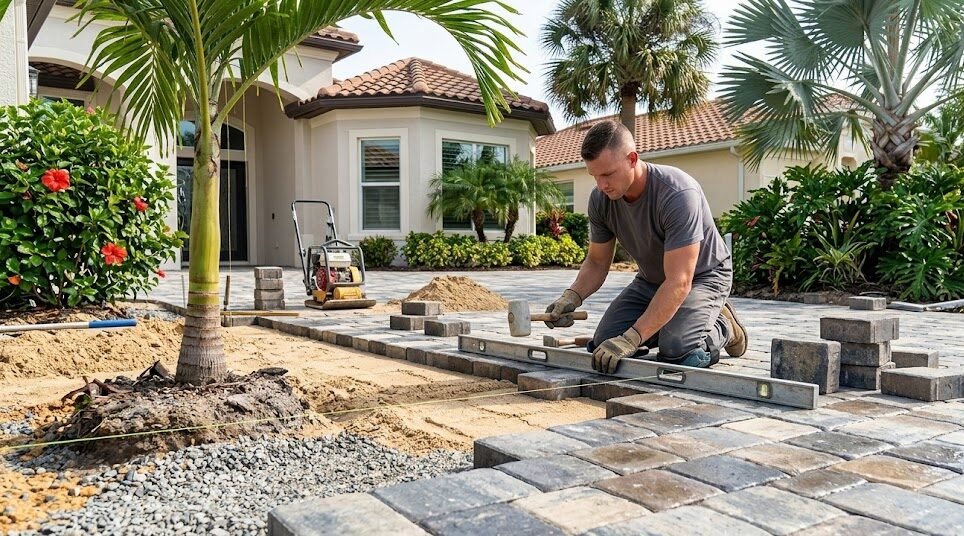
What a Paver Installation Actually Involves
A paver surface is a flexible pavement. It does not get its strength from the pavers. It gets it from a layered system, and each layer has a job. The specification most quality installers build to comes from the Interlocking Concrete Pavement Institute (ICPI):
- Excavation: removing enough soil to fit the base, the bedding sand and the paver, plus any organic topsoil that would rot and settle.
- Compacted base: a minimum of 4 to 6 inches of compacted crushed stone for patios and walkways, and up to 10 inches for driveways and other vehicle areas.
- Compaction in lifts: the base is compacted in thin layers, roughly 2 inches at a time, with a mechanical plate compactor. One thick layer compacted once looks the same on day one and keeps settling for years.
- Bedding sand: about 1 to 1.5 inches of washed concrete sand meeting ASTM C33, screeded to a uniform depth. It is a leveling course, not a base.
- Edge restraint: a restraint around the perimeter, anchored into the compacted base, that keeps the field from spreading.
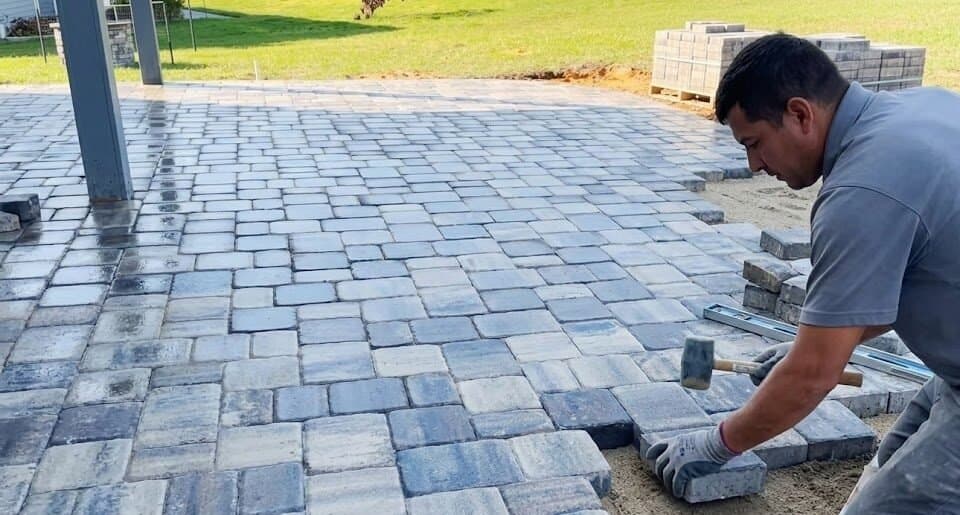
- Laying, compacting and jointing: setting the pattern, cutting the edges, running the plate compactor over the pavers and sweeping in jointing sand.
A homeowner can do every one of these steps. The question is whether you can do all of them correctly, with the right equipment, in the Florida heat, before the afternoon storm turns your open excavation into a pond.
Where Weekend Projects Fail in Florida's Sandy Soil
We get called to fix DIY patios every season, and the failures repeat. Almost none of them are about the pavers themselves.
- Sand instead of stone: the most common shortcut is using three or four inches of sand as the base because Florida soil is already sandy. Sand alone shifts and washes out. The dips show up after the first heavy rains.
- Base too thin: two inches of base under a patio, or patio depth under a driveway extension. The surface looks fine until it carries weight.
- Compacted once: six inches of base dumped in one pass and compacted from the top. The bottom never gets dense, and it consolidates slowly into a wavy surface.
- No slope: a dead-flat patio holds water, and water is the main enemy of a paver base. A slight fall away from the house, commonly about 1/4 inch per foot, keeps water moving.
- Water pointed at the patio: a downspout or a neighbor's yard draining across the new surface undermines the base no matter how well it was built.
- Weak edges: restraint spiked into loose sand instead of compacted base. The border row creeps outward and the joints open across the field.
- Jointing sand mistakes: polymeric sand applied on damp pavers or over-watered leaves a white haze that is hard to remove. Our guide to polymeric sand in Florida covers why it happens and which products hold up in humidity.
Florida also adds conditions northern how-to videos never mention: a rainy season that can soak an open excavation every afternoon from June to September, a high water table in many neighborhoods, and summer heat that makes eight hours of hauling stone a real health risk. If you want to plan around the weather, our post on the cheapest time to install pavers in Florida lays out the seasons.
What DIY Really Costs: A 200 Square Foot Patio
The professional price in Florida typically runs between $10 and $25 per square foot installed, as we explain in our 2026 brick paver cost guide. Concrete pavers themselves cost roughly $3 to $4 per square foot. That gap is what makes DIY tempting, so here is what a 12 by 16 foot patio, about 200 square feet, really involves:
- Pavers: about $600 to $800 for concrete pavers at $3 to $4 per square foot, plus a few percent extra for cuts and breakage.
- Digging: with 6 inches of base, 1 inch of bedding sand and a standard 2 3/8 inch paver, you excavate about 9.5 inches. Over 200 square feet that is close to 6 cubic yards of soil, which weighs several tons and has to go somewhere.
- Base stone: 6 inches of compacted base over 200 square feet is about 3.7 cubic yards of material, roughly 5 tons at typical densities, usually delivered in bulk. Price it from a local yard with delivery included.
- Plate compactor: roughly $50 to $90 per day for a residential size, and a first-timer often needs it for more than one day.
- Bedding sand, edge restraint and jointing sand: smaller line items, but they add up, and they are not the place to economize.
- Tools: a wet saw or a cut-off saw with a masonry blade, screed rails, a level, string line, shovels and a wheelbarrow, bought or rented.
Put together, a careful DIY patio usually still saves real money on the bill. What it does not save is time. A first-timer should plan on several full days of work spread over at least two weekends, and most of that time is digging, hauling and compacting, not laying pavers. The savings only hold if the patio stays flat. Rebuilding a failed base means pulling every paver, so a DIY install that fails costs more than doing it right the first time.
(321) 353-7445Get Immediate Service
Before Anyone Digs: 811, Permits and HOA Approval
Whoever does the work, three steps come before the shovel.
- Call 811: Florida law requires anyone digging, homeowners included, to contact Sunshine 811 at least two full business days before excavating so buried utility lines can be marked. A patio excavation of 9 to 10 inches is deep enough to reach shallow lines.
- Check the permit and zoning rules: most patios are not a building-permit question, but driveways that connect to the road, impervious surface limits and setbacks are. Since July 1, 2026, HB 803 also exempts many small projects under $7,500 from building permits. Our guide to paver patio permits in Florida goes county by county.
- Get HOA approval in writing: many Central Florida communities regulate paver color, pattern and footprint. An unapproved patio can be a fine, or an order to remove it.
Projects You Can Reasonably Do Yourself
DIY makes sense when the stakes are low and the area is small. Good candidates:
- Garden paths and stepping areas: foot traffic only, small footprint, easy to fix if a section settles.
- A small patio on high, dry ground: under about 150 to 200 square feet, away from the house foundation, with natural drainage away from it.
- A fire pit pad or grill landing: a simple square or circle with no complex cuts.
- Repairs to a sound base: re-leveling a small settled spot, as long as the base underneath is good. Our guide to paver repair in Florida explains how to tell a surface problem from a base problem.
If you go ahead, the rules that matter most: stone base, never sand; compact in thin lifts; build in a slope; anchor the edges into compacted base; and use a protective pad when you run the compactor over the pavers so the steel plate does not chip the faces.
When to Hire a Professional
Some projects are not good weekend jobs, because the cost of a failure is much higher than the cost of the install.
- Driveways: vehicles need up to 10 inches of compacted base, heavier equipment and a connection to the road that may need a permit. A rutted driveway is a full rebuild.
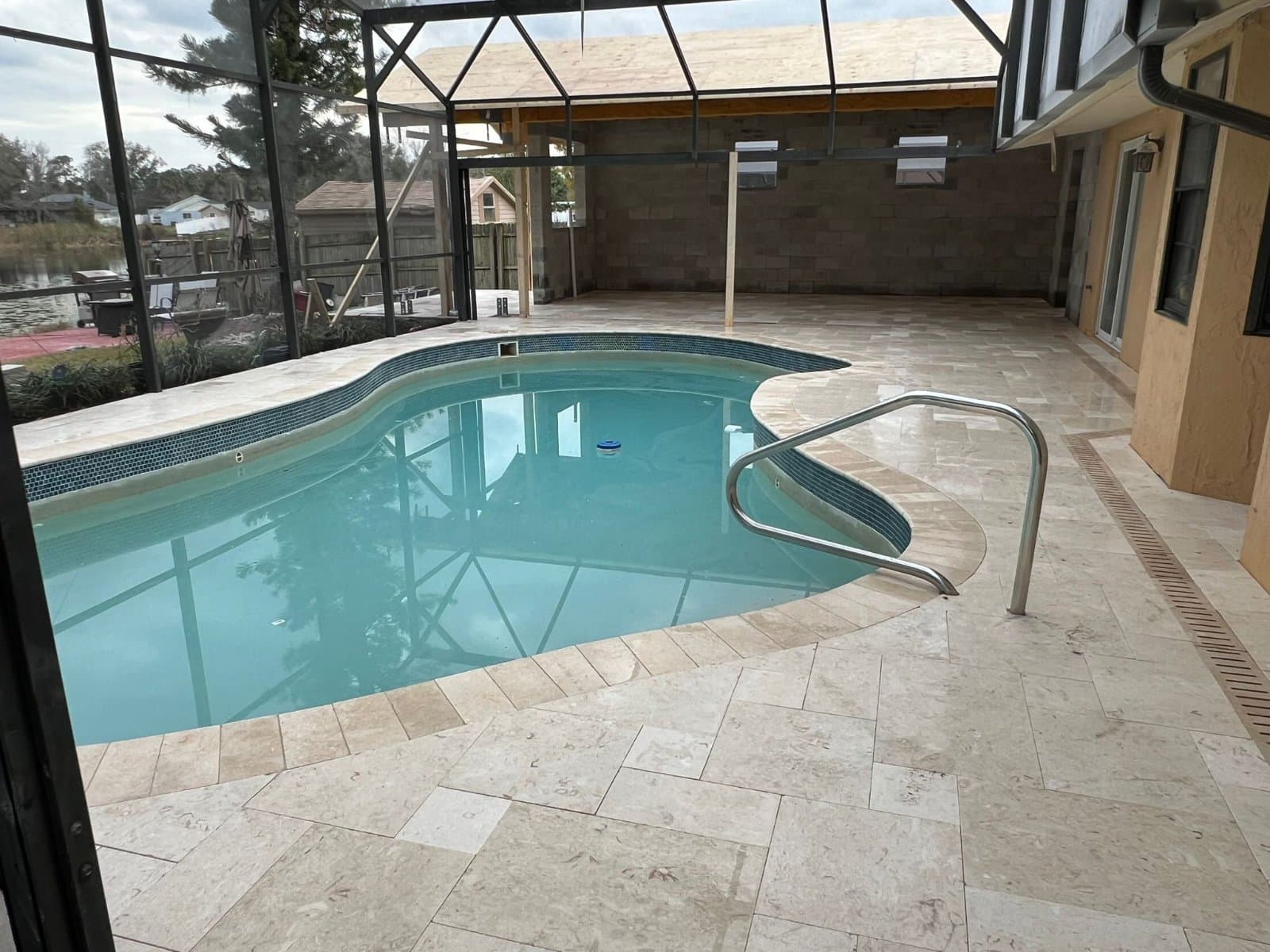
- Pool decks: they sit next to a structure you cannot afford to undermine, they need slip-resistant materials and careful drainage, and they often tie into coping. See our pool deck paver installation service for how we handle them.
- Large patios and outdoor kitchens: above a few hundred square feet, the excavation, hauling and compaction become a crew-sized job, and gas or electrical lines bring their own permits.
- Low, wet or sloped lots: a high water table, poor drainage or a grade change can call for a deeper base, drainage work or a retaining wall.
- Areas against the house: anything that changes how water moves near the foundation deserves a professional plan.
What a Professional Crew Does Differently
A good paver contractor is not faster at laying pavers so much as better at the parts you cannot see. On a typical project, KS Solutions excavates to the full depth for the use, builds the base in compacted lifts, sets the slope and drainage before the first paver goes down, anchors the edge restraint into compacted base and finishes the joints with a product chosen for Florida humidity. The crew also has the equipment to haul tons of material in and out in a day or two, which keeps an open excavation from sitting through a week of afternoon storms.
That is also why professional quotes vary so much. When you compare bids, ask each installer how deep the base will be, what material it is, how it will be compacted and what edge restraint they use. A low bid that skips any of those is not cheaper, it is a delayed repair. Our guide on how to choose a fence or paver contractor in Florida lists the other things to verify before you sign.
The Hybrid Option: Split the Work
Some homeowners want to save money without risking the base. A middle path that works: have a professional handle the excavation, base and compaction, then do the laying, cutting and jointing yourself. Another is the reverse on small areas: do the layout and demolition yourself, and have the crew build the base and set the surface. Not every contractor offers split work, so ask up front, and be clear about who is responsible if the surface settles later.
Making the Call for Your Central Florida Yard
Here is the short version. If the project is a small path or patio on dry ground, you have two weekends, a strong back and you are willing to rent a compactor, DIY can work and save real money. If it is a driveway, a pool deck, a large patio, a wet lot or anything against the house, the risk of rebuilding a failed base outweighs the savings.
KS Solutions builds paver patios, driveways and pool decks across Central Florida, from brick paver installation in Orlando to paver projects in Lakeland and Kissimmee. If you are weighing DIY against a professional install, start with a free estimate for our brick paver installation service and compare it with your own numbers. If you already have pavers that need care, our maintenance plans cover cleaning, re-sanding and sealing.