KS Solutions provides professional brick paver installation in Port Orange, FL. Call (321) 353-7445 for your free on-site estimate.
Port Orange Soil: Coastal Sand, the Halifax River, and What Pavers Demand Underneath
Brick paver work in Port Orange is shaped by a coastal soil profile that almost no inland Central Florida city has to deal with. Port Orange sits on the western edge of the Halifax River, which is a brackish tidal lagoon rather than a freshwater river, with the Atlantic Ocean a few miles east beyond Daytona Beach Shores and Ponce Inlet. Roughly 63,000 residents live in this footprint, and the soil under their lots changes meaningfully across just a few miles between the river and the inland pine flats.
Most Port Orange lots sit on the deep sandy soils typical of the Atlantic Coastal Ridge: well-drained, easy to compact, and forgiving for paver work in the dry season. Closer to the Halifax River, the picture changes. The seasonal high water table climbs, organic muck pockets show up on lots that used to be marshland before the city was platted, and salt and brackish moisture drift inland on east winds. Treating a riverfront lot like an inland sand lot is exactly how a paver driveway ends up sinking unevenly within three years.
How KS Solutions adjusts the base build to the actual lot in Port Orange:
- Inland sandy lots (most of west Port Orange): 4 inch crushed concrete base over compacted subgrade with a 1 inch bedding sand layer.
- Halifax River-adjacent lots and former marshland: 6 to 8 inch crushed concrete base, geotextile fabric between subgrade and base to stop fines from migrating up, and over-excavation of any organic muck pockets to mineral soil before any base goes in.
- Coastal-influenced lots within roughly a mile of the river: stainless or polymer-coated edge restraints rather than budget steel spikes, because brackish moisture corrodes plain metal fast.
- Any lot, every time: minimum 1/4 inch per foot drainage slope away from the house, lanai, or pool deck.
Built this way, a paver driveway or patio in Port Orange flexes with seasonal ground movement instead of cracking like a rigid concrete slab, and the layered system holds up even on the lots where the water table sits closest to the surface.
How Port Orange Paver Permits Actually Get Pulled (SmartGov, Not Volusia County)
Port Orange is incorporated and runs its own Building Department, so paver permits do not go through Volusia County's general permitting flow. The city uses a SmartGov-based public portal at ci-portorange-fl.smartgovcommunity.com, and the Building Department is reached through port-orange.org/264. Permit forms and supplemental documents live at port-orange.org/210. Submitting a Port Orange address to Volusia County only delays the project, because the application has to be redirected.
Pavers in Port Orange are typically reviewed as a Zoning permit (not a full structural building permit), but the packet still has to include the right documents to clear review. Florida law also requires a Notice of Commencement to be filed with the Volusia County Clerk before work starts on any project over $5,000 in contract value, regardless of whether the permit itself is full structural or zoning-only.
The clean step-by-step we follow on every Port Orange paver job:
- Pull a current scaled property survey from the homeowner's closing documents or order a fresh one.
- Draft the site plan showing existing structures, the proposed paver footprint, and impervious surface impact.
- Submit the application through ci-portorange-fl.smartgovcommunity.com along with the survey, site plan, and contractor licensing.
- Pay the applicable permit fee at submission (paver fees scale with project value; we confirm the exact figure for your project before we file).
- For any contract over $5,000, file the Notice of Commencement with the Volusia County Clerk before the first day of work.
- Schedule the city's required inspections (typically subgrade, base, and final) at the milestones the permit specifies.
- Close the permit out at final inspection so the file is not left open against the property.
Because we run this loop on every project, our clients in Port Orange do not have to chase the city, file the Notice of Commencement themselves, or troubleshoot a rejected SmartGov submission. KS Solutions handles the full packet.
Spruce Creek Fly-In Driveway Replacements: What Aviation Lots Demand
Spruce Creek Fly-In is the single most recognizable neighborhood in Port Orange, and probably the most recognizable airpark community in the United States. The Spruce Creek Property Owners Association sits at 212 Cessna Boulevard, the gated entrances are staffed 24/7, and the centerpiece is a private 4,000 foot lighted runway with a parallel taxiway system that wraps through the residential streets. Many lots back directly onto the taxiway, which means the homeowner can roll the airplane out of the hangar, taxi to the runway, and depart without ever touching public road. The community also has an 18-hole championship golf course and a country club with pool and tennis courts.
What that aviation context means for paver work is unique to Spruce Creek and a small handful of similar Florida airparks. The driveway and the taxiway side of the property both have to handle vehicle and aircraft loads, the visual standards of the architectural review committee are strict because aircraft owners care intensely about how their hangars and aprons look, and sub-base failures show up faster on aviation lots because aircraft tow loads concentrate weight on a smaller footprint than a passenger car.
How KS Solutions adapts a paver driveway and apron build for a Spruce Creek Fly-In lot:
- Confirm with the homeowner whether the driveway and the airside (hangar apron, taxiway connector) will share the same paver field or be separated by a control joint.
- For airside paver fields, build a thicker base (typically 6 to 8 inches of compacted crushed concrete) regardless of soil type, because aircraft tow loads exceed standard residential vehicle loads.
- Use a heavier-duty paver thickness rated for vehicular and apron use rather than the standard pedestrian-rated paver.
- Specify polymeric sand and edge restraints rated for the loads, and re-sand on a tighter cycle than a standard residential driveway.
- Coordinate with the SCPOA architectural review packet from day one so the material spec and color match the community's approved palette.
Done correctly, a Spruce Creek Fly-In paver driveway and hangar apron stay flush, drain correctly, and clear the SCPOA architectural review without drama.
Pool Decks and Patios on Halifax River-Adjacent Properties
Riverfront and river-view lots in Port Orange are their own design category. The Halifax River dominates the eastern edge of the city, and the patios and pool decks built on those lots are the visual centerpiece of the home. Drainage rules tighten because runoff is heading toward a tidal lagoon that connects to the Atlantic. Wind-driven salt spray reaches further inland than most homeowners expect. And shoreline setback requirements layer city, county, and state rules on top of any HOA shoreline rule.
Three things drive every Halifax River-adjacent paver design we do in Port Orange. First, drainage has to be intentional. Patios and pool decks need a minimum 1/4 inch per foot slope away from the house, and on river-adjacent lots we typically pitch additional flow toward landscape swales or dry wells rather than running it as sheet flow toward the river. Second, material picks have to handle salt and humidity. Concrete pavers, travertine, and properly sealed clay pavers all hold up; budget materials with thin face treatments do not. Third, slip resistance matters more around a pool than almost any other variable.
Material picks we recommend most often for Port Orange riverfront patios and pool decks:
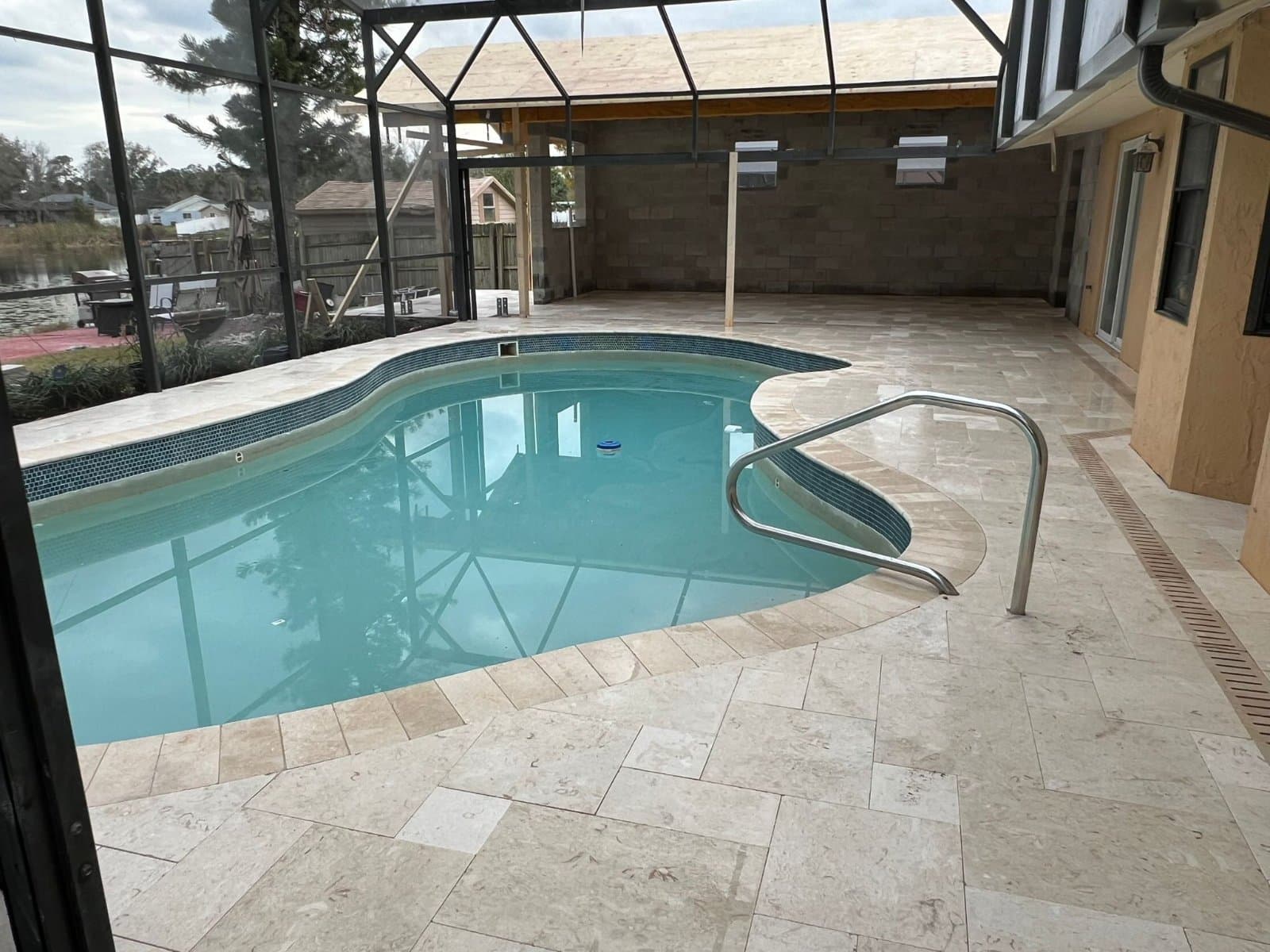
- Light-toned travertine for pool decks: stays cooler under bare feet in July, naturally textured surface, classic look against river views.
- Tumbled concrete pavers in sand, ivory, or cream for patios: budget-friendly, stable on the standard base build, blend with mature landscaping.
- Permeable paver systems for lots where impervious coverage is tight or where reducing direct runoff into the Halifax is a priority.
- Textured (not polished) finishes on every horizontal surface a swimmer steps onto wet.
- Polymer-coated or stainless edge restraints within roughly a mile of the river, because brackish moisture corrodes standard steel spikes faster than inland conditions.
Designed this way, a riverfront paver patio or pool deck in Port Orange drains correctly during a summer downpour, holds its surface against salt-laden east winds, and stays safe to walk on barefoot.
(321) 353-7445Get Immediate Service
HOA Architectural Review in Spruce Creek, Sabal Creek, and Cypresswood
Port Orange has a real mix of HOA structures. Spruce Creek Fly-In runs the SCPOA, with a strict architectural review committee that approves material, color, and footprint changes before any exterior work starts. Sabal Creek is a smaller gated community that is currently self-managed for day-to-day operations, with finances handled by Wimmer Community Management; ARC review still applies to exterior changes. Cypresswood is a golf-course community with its own architectural standards. Knowing which bucket your property sits in is the difference between a 2 to 4 week head start on the project and a stop-work surprise after demo.
For ARC-controlled communities in Port Orange, KS Solutions prepares and submits the architectural review packet as part of the install. Approval timelines typically run 2 to 4 weeks depending on when the committee meets. The clean ARC submission flow looks like this:
- Pull the community's current ARC application form and material guidelines from the HOA portal or property management contact.
- Compile the packet: site plan, paver material spec sheet, color samples, drainage plan, and contractor license.
- Submit to the HOA's ARC liaison or property manager and confirm receipt in writing.
- Respond to any committee questions or revision requests within the same business week.
- Receive written approval, then file the city building or zoning permit through ci-portorange-fl.smartgovcommunity.com referencing the ARC approval.
- Schedule the install start only after both the city permit and the HOA approval are in hand.
That sequence is boring on purpose. Boring is how a paver project in Spruce Creek Fly-In, Sabal Creek, or Cypresswood stays on schedule and avoids architectural review fines.
Paver Costs and Project Timelines in Port Orange
Pricing for paver work in the Port Orange market generally runs in the same range as inland Volusia County, roughly $19 to $25 per square foot installed for standard concrete pavers, with premium materials and complex layouts running higher. The variables that move price the most in Port Orange specifically are: how much over-excavation the lot needs (Halifax River-adjacent and former-marshland lots cost more), aviation-grade base on Spruce Creek Fly-In airside fields, and whether ARC submission is required.
Driveway replacements
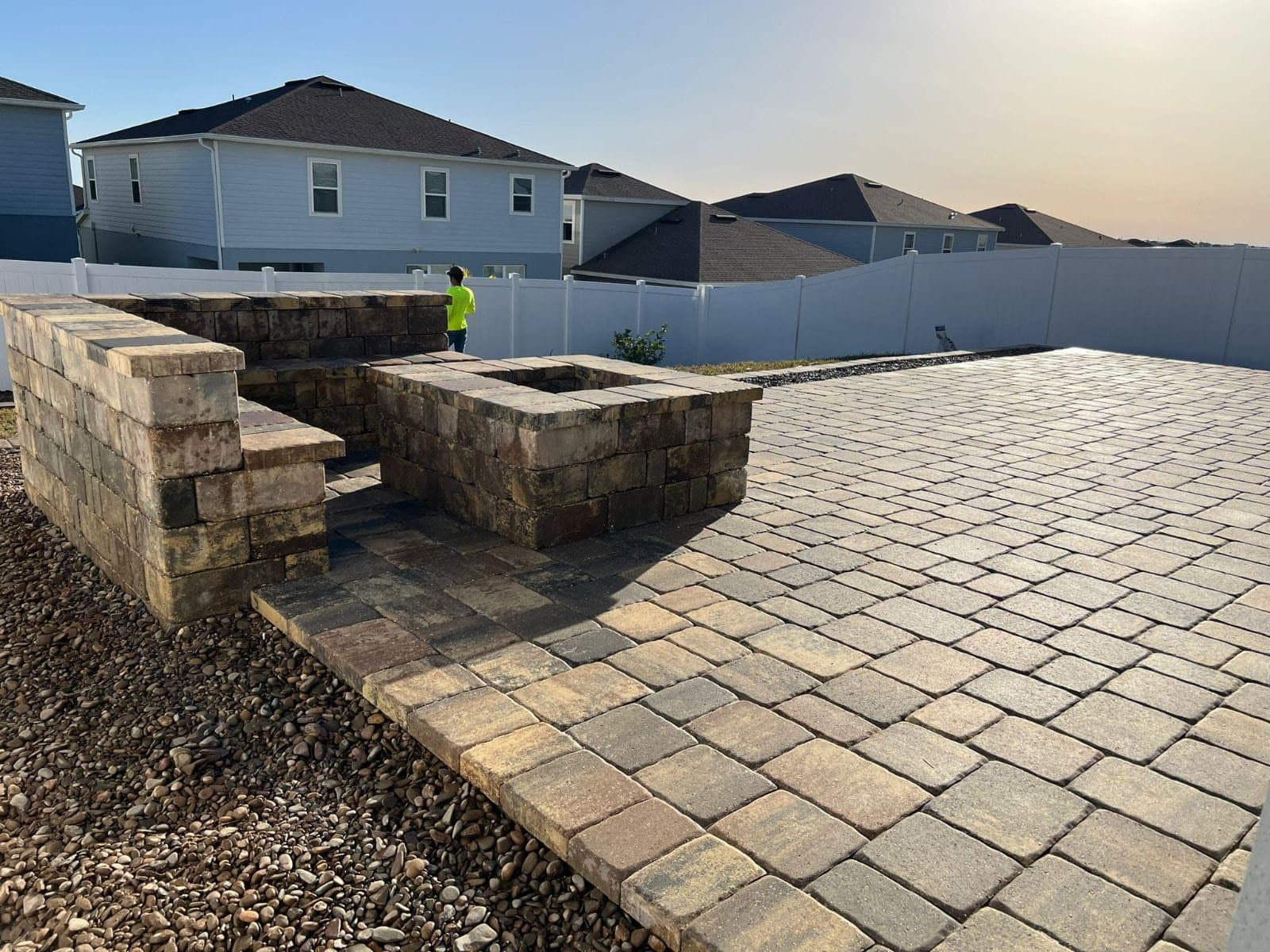
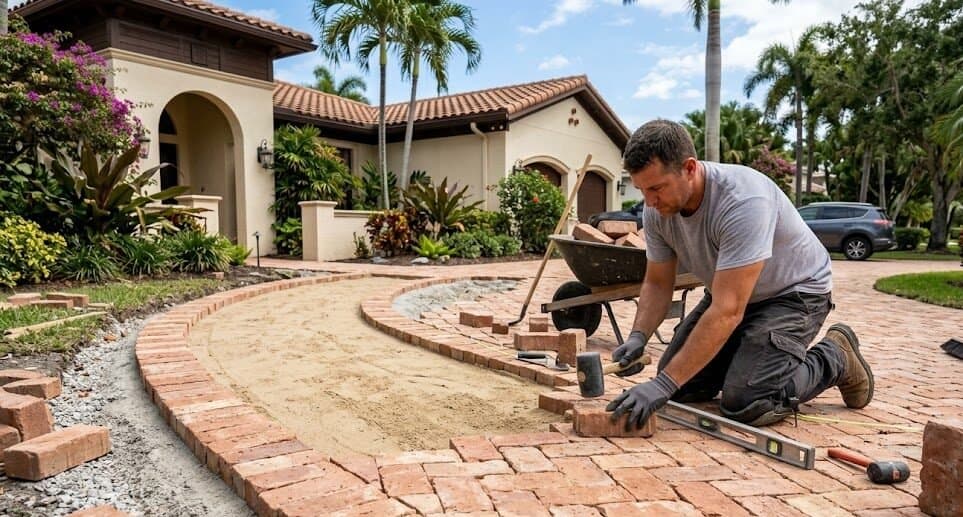
Replacing an old concrete or asphalt driveway with interlocking pavers is the most common project we run in Port Orange. Demo, base correction, and finished pavers on a typical two-car driveway take about a week of on-site work, plus permit time on the front end.
- Day 1: site protection, demo of existing surface, haul-off.
- Day 2: subgrade evaluation and over-excavation of any organic or debris pockets.
- Day 3: geotextile (where required), base lifts compacted in stages.
- Day 4: bedding sand, paver field installation, edge restraints (polymer-coated near the river).
- Day 5: cuts, polymeric sand, final compaction, city final inspection scheduling.
Patios
Patios are usually faster than driveways because the loads are lower and the footprint is often more uniform. Material choice (concrete pavers vs travertine) and integrated features drive both price and timeline.
- Day 1: layout, excavation, subgrade prep.
- Day 2: base build and compaction.
- Day 3 to 4: paver field, borders, integrated features.
- Day 4 to 5: polymeric sand, final compaction, cleanup.
Pool decks
Pool decks are detail-sensitive because every surface around the pool has to drain correctly, stay cool underfoot, and hold up to chlorine and saltwater splash. Coordination with pool deck cantilever and existing coping adds steps.
- Day 1 to 2: removal of existing deck (if any) and subgrade prep.
- Day 3: base build with proper slope away from coping and toward landscape drains.
- Day 4 to 5: paver installation around coping with tight cuts.
- Day 6: polymeric sand, sealing (if specified), final walk-through.
Polymeric sand always gets installed during a window with humidity below 80% and zero rain forecast within 24 hours, because that is what the manufacturer requires for the joints to set correctly. In Port Orange's June through October rainy and tropical season, that sometimes means scheduling the final sand pass a day or two later than the rest of the project, and we tell clients that up front.