KS Solutions provides brick paver installation in Deltona. Call (321) 353-7445 for your free estimate.
Brick Paver Installation in Deltona: Upgrading 60 Years of Concrete on Volusia County's Largest City's Family Homes
Brick paver installation in Deltona, FL serves Volusia County's largest city, a community of nearly 97,000 residents that traces its origins to the 1960s Mackle brothers development that carved a master-planned suburb from the Central Florida landscape with grid-pattern streets, consistent lot sizes, and thousands of affordable single-family homes designed for the working families streaming into the I-4 corridor. Six decades later, those original concrete driveways and patios have absorbed every year of Florida weather the calendar delivered, and the surviving surfaces show the cumulative damage that thermal cycling, thunderstorm rainfall, and the expanding root systems of trees planted during the Kennedy administration produce on concrete that was already an economy specification when it was poured.
Deltona's population is remarkably diverse: over 40 percent Hispanic with a significant Puerto Rican community that has helped shape the city's cultural character. Median household incomes around $77,000 and strong homeownership rates produce a homeowner base that invests in property improvements strategically, choosing materials and contractors based on value rather than on the lowest bid or the flashiest marketing. These homeowners want durable work at honest pricing from a contractor who shows up when promised, does what was agreed, and stands behind the result after the truck leaves.
KS Solutions installs brick pavers throughout Deltona for homeowners replacing decades-old concrete across the city's established neighborhoods from Deltona Lakes to the Saxon Boulevard corridor to the Enterprise Road area. Deltona operates its own municipal government with city building permits. Some newer Deltona subdivisions have HOA requirements. We verify all applicable regulations and handle every administrative submission so the homeowner manages material choices rather than paperwork.
Mackle-Era Concrete Replacement: Addressing 50 to 60-Year-Old Driveways Built to 1960s Standards
The Mackle brothers' development model prioritized volume and affordability, delivering thousands of homes quickly at price points that young families of the 1960s and 1970s could reach. The concrete driveways poured during this era used the minimum viable specification: 3,000 PSI mix at 3.5 to 4-inch thickness on subgrade preparation that consisted of whatever the grading crew left behind after setting the house pad. These driveways served their purpose for the first 20 years, began showing cracks by year 25, and by year 40 or 50 have deteriorated past the point where patching provides anything more than a temporary cosmetic band-aid over structural failure.
The specific failure patterns on Mackle-era Deltona driveways include: perimeter cracking within 6 inches of every edge where the slab's thin edge bears vehicle wheel loads without adequate base support; mid-slab cracking at control joints that widened beyond cosmetic concern decades ago; settlement of entire slab sections where the original subgrade compacted unevenly beneath the slab's weight over 50 years; and the surface spalling that five decades of UV exposure and moisture penetration produce on concrete that was never sealed after pouring.
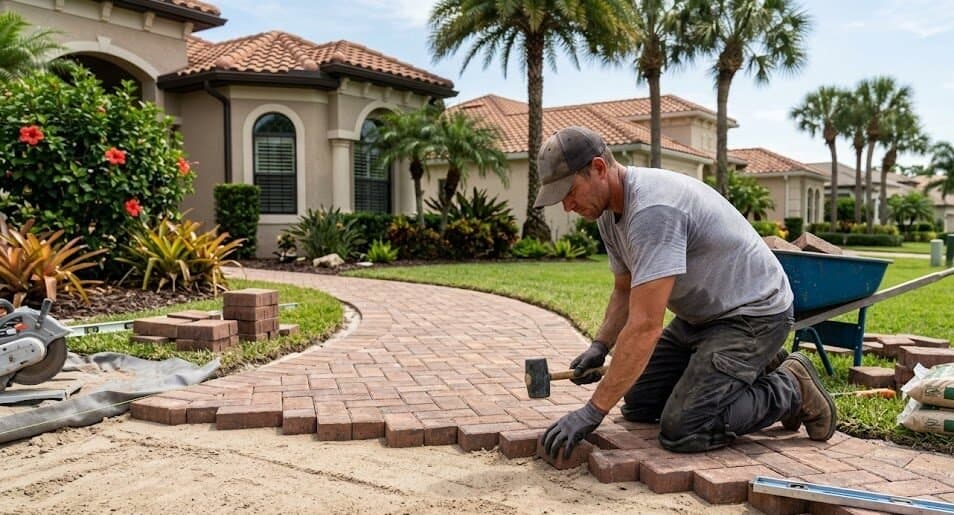
Replacing these failed driveways with interlocking pavers on a properly engineered aggregate base addresses both the visible deterioration and the invisible base failure that caused it. The paver base goes down at 6 to 8 inches of compacted crushed stone in two lifts, providing the structural foundation the Mackle-era builder skipped. And the interlocking pavers above handle the same ground movement that cracked the rigid concrete because each paver shifts independently within the flexible joint-sand system rather than concentrating stress at control joints the way the monolithic slab did.
KS Solutions has replaced Mackle-era concrete on hundreds of Deltona properties and understands the specific failure mechanisms these 60-year-old surfaces present. The demolition reveals the subgrade conditions the original builder left behind, and in many cases those conditions explain why the concrete failed where it did: a soft pocket where the builder dumped construction debris beneath the slab, a root intrusion from a tree that was a seedling in 1968 and now spans the entire yard, or a buried utility line that the original crew ran through the driveway zone without providing the structural bridging the slab needed above it.
Backyard Gathering Patios for Deltona's Multi-Generational Family Households
Deltona's family-oriented culture, shaped significantly by the Puerto Rican and broader Hispanic community that constitutes over 40 percent of the population, produces outdoor entertaining patterns that standard suburban patio design doesn't anticipate. Family gatherings in these households regularly bring 15 to 30 people into the backyard for weekend cookouts, birthday celebrations, holiday observances, and the spontaneous Sunday-afternoon events that happen when extended family lives within driving distance and the backyard is where everyone gravitates. A builder's 10 by 10 concrete slab designed for a table and four chairs can't support a gathering of 25 people with three generations eating, talking, and moving between the grill, the serving table, and the seating areas that a real family event requires.
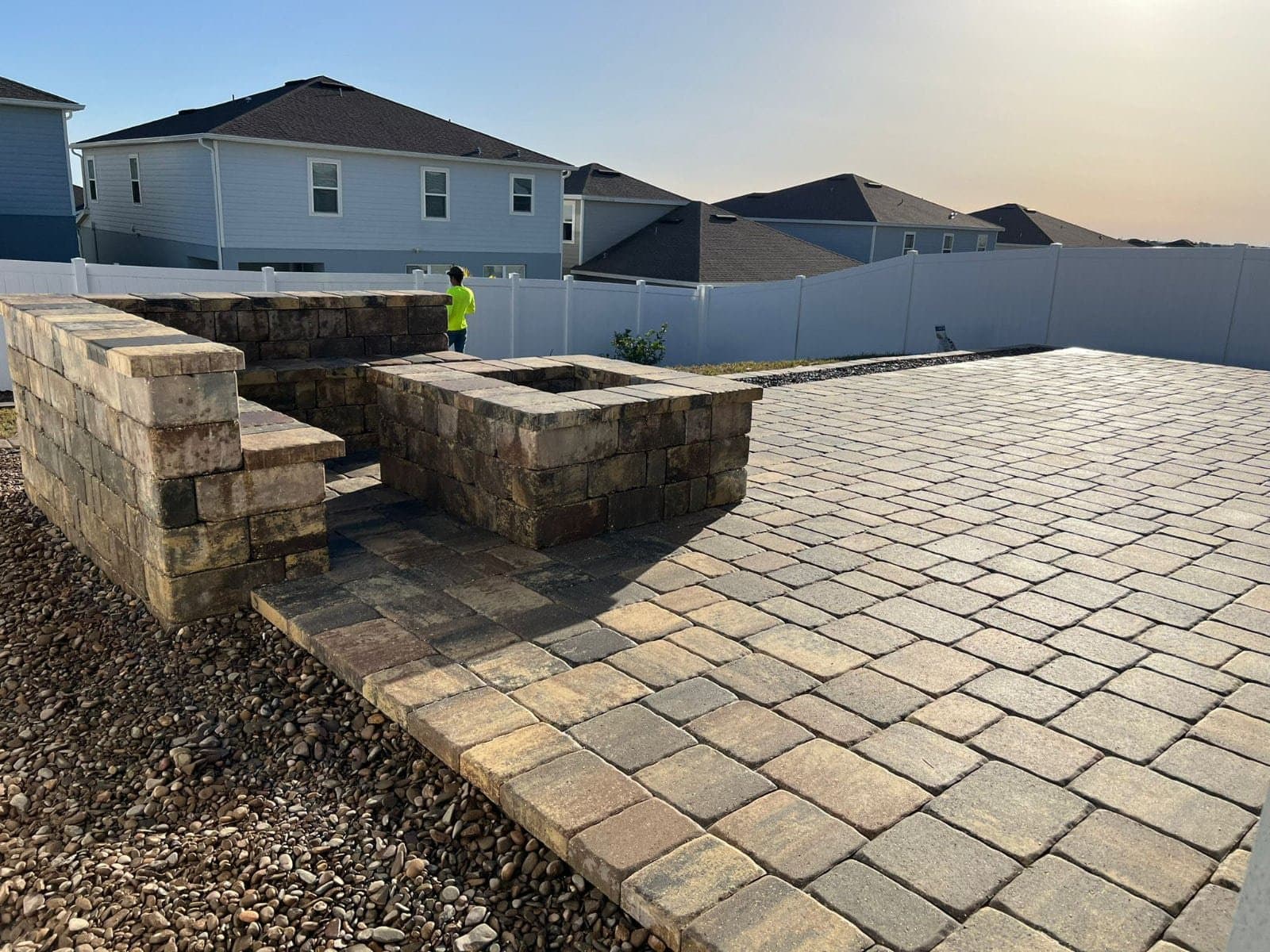
We design Deltona family patios at 400 to 600 square feet to accommodate the gathering sizes this community's social patterns produce. The grill station occupies one end with counter space for food prep and serving. A dining zone with room for a table seating 8 to 10 sits in the center. And a conversation zone with seating walls or chairs fills the far end where the older family members settle while the younger ones circulate between the food and the kids playing in the yard beyond the patio edge. The three-zone layout keeps traffic flowing without bottlenecks and gives each generation a base within the same outdoor space.
Tumbled concrete pavers in earth tones handle the intensive use these gathering patios receive: food spills that happen when 25 people eat outdoors, drink condensation rings on every horizontal surface, the scuffing from chairs pulled across the surface 50 times during a single event, and the general wear that commercial-intensity social use creates on what the building code considers a residential surface. The tumbled texture hides minor staining and scuff marks that smooth-face pavers would display immediately, maintaining a presentable appearance between the hosting events that define this surface's primary use.
KS Solutions discusses the gathering patterns specific to each Deltona household during the patio consultation because the design must match how the family actually uses the space rather than how a catalog photograph suggests a patio should look. A family that hosts 30 people twice monthly needs different zone proportions than a couple that entertains 6 guests quarterly. The conversation about real use patterns takes 10 minutes and produces a patio layout the family uses enthusiastically rather than a surface that looks nice but doesn't serve the gatherings it was built for.
Lake-Adjacent Deltona Properties Near Monroe, Lytle, and Dupont
Deltona's residential zones include properties near several named lakes, including Lake Monroe on the city's southern edge, and the smaller lakes like Lytle and Dupont that dot the residential interior. Properties adjacent to these lakes experience the higher seasonal water table that lake proximity creates, which affects paver base performance during the June-through-October wet season when accumulated rainfall raises lake levels and pushes surrounding groundwater upward into the zone where standard aggregate bases sit.
We increase base depth on Deltona's lake-adjacent properties to 8 to 10 inches of aggregate rather than the 6 inches that properties away from water need. The additional depth keeps the structural zone of the base above the wet-season groundwater peak so the pavers rest on dry, stable stone even when the lowest portion of the aggregate column contacts rising moisture from below. The cost adds $2 to $3 per square foot in aggregate material but prevents the soft-spot settling that undersized bases develop when groundwater saturates the aggregate during the wettest weeks of the rainy season.
Lake Monroe's connection to the St. Johns River means its water levels respond not just to local rainfall but to the broader river system's drainage patterns. Heavy rain in the St. Johns watershed upstream of Deltona can raise Lake Monroe's level even during periods when Deltona itself received normal rainfall. This external influence on local lake levels makes the water table beneath Monroe-adjacent Deltona properties less predictable than the water table near smaller, isolated lakes whose levels respond only to local precipitation.
KS Solutions references both local and upstream watershed data when specifying base depth for Lake Monroe-adjacent Deltona properties because the river system's broader influence can push the local water table higher than Deltona's own rainfall would predict. A dry month in Deltona doesn't guarantee a low water table on a Monroe-adjacent lot if the St. Johns system upstream received heavy rain that raised the lake's level from the river rather than from local precipitation.
(321) 353-7445Get Immediate Service
Grid-Street Driveway Logistics and Neighbor Communication on Deltona's Consistent-Lot Blocks
Deltona's Mackle-era grid street layout places homes on uniform lots with consistent setbacks, producing streetscapes where every driveway sits the same distance from the neighbors' driveways on both sides. The typical driveway-to-driveway distance on a Deltona grid block is 15 to 25 feet, close enough that a concrete demolition project on one driveway sends debris, dust, and equipment noise into the immediately adjacent properties. A jackhammer breaking up a 50-year-old concrete driveway at 7 AM on a Saturday rattles dishes in the kitchen of the house 20 feet away, and the dump truck blocking the street while debris loads affects every household on the block.
We notify Deltona neighbors on both sides and directly across the street before every driveway replacement begins, providing the project timeline, the expected noise hours, and the days when street access may be temporarily restricted for material delivery or debris hauling. This neighbor notification isn't a city requirement. It's a professional courtesy that prevents the surprise-and-frustration response that unannounced construction generates on blocks where residents have lived next to each other for decades and expect the mutual respect that Deltona's community character has maintained since the Mackle brothers sold the first lots.
Material staging on Deltona's standard lots uses the driveway footprint itself rather than spilling onto the lawn, the sidewalk, or the neighbor's property edge. Aggregate gets delivered directly into the excavation from the truck rather than stockpiled on the yard. Paver pallets sit on the approved driveway staging area the permit designates. And concrete debris loads onto the dump truck directly from the jackhammer zone without intermediate piling that would spread dust and fragments beyond the work area.
KS Solutions executes Deltona driveway replacements with the logistical discipline that close-set grid blocks demand. The project footprint stays within the homeowner's property boundaries. The noise stays within the city's permitted construction hours. And the street access returns to normal at the end of each work day rather than remaining blocked overnight. The neighbors who watched the project from their windows become the referrals who call us next because they saw how the work was managed as much as how the finished driveway looked. Call (321) 353-7445 for your free Deltona paver estimate.
Paver Costs for Deltona's Family-Oriented Residential Properties
Brick paver installation in Deltona costs $11 to $20 per square foot depending on material, project type, and whether lake-adjacent base engineering affects the specification. The city's moderate property values and the practical, value-oriented mindset of Deltona's homeowner base mean that material recommendations should deliver maximum performance and visual impact per dollar rather than pursuing premium products whose cost the property's market segment can't justify.
Mackle-era driveway replacements with concrete demolition cost $14 to $20 per square foot. A standard two-car Deltona driveway of 400 to 550 square feet runs $5,600 to $11,000. Family gathering patios at 400 to 600 square feet cost $11 to $18 per square foot. A 500 square foot patio with fire pit pad and seating wall runs $5,500 to $9,000 plus $1,500 to $2,500 for the fire and wall features.
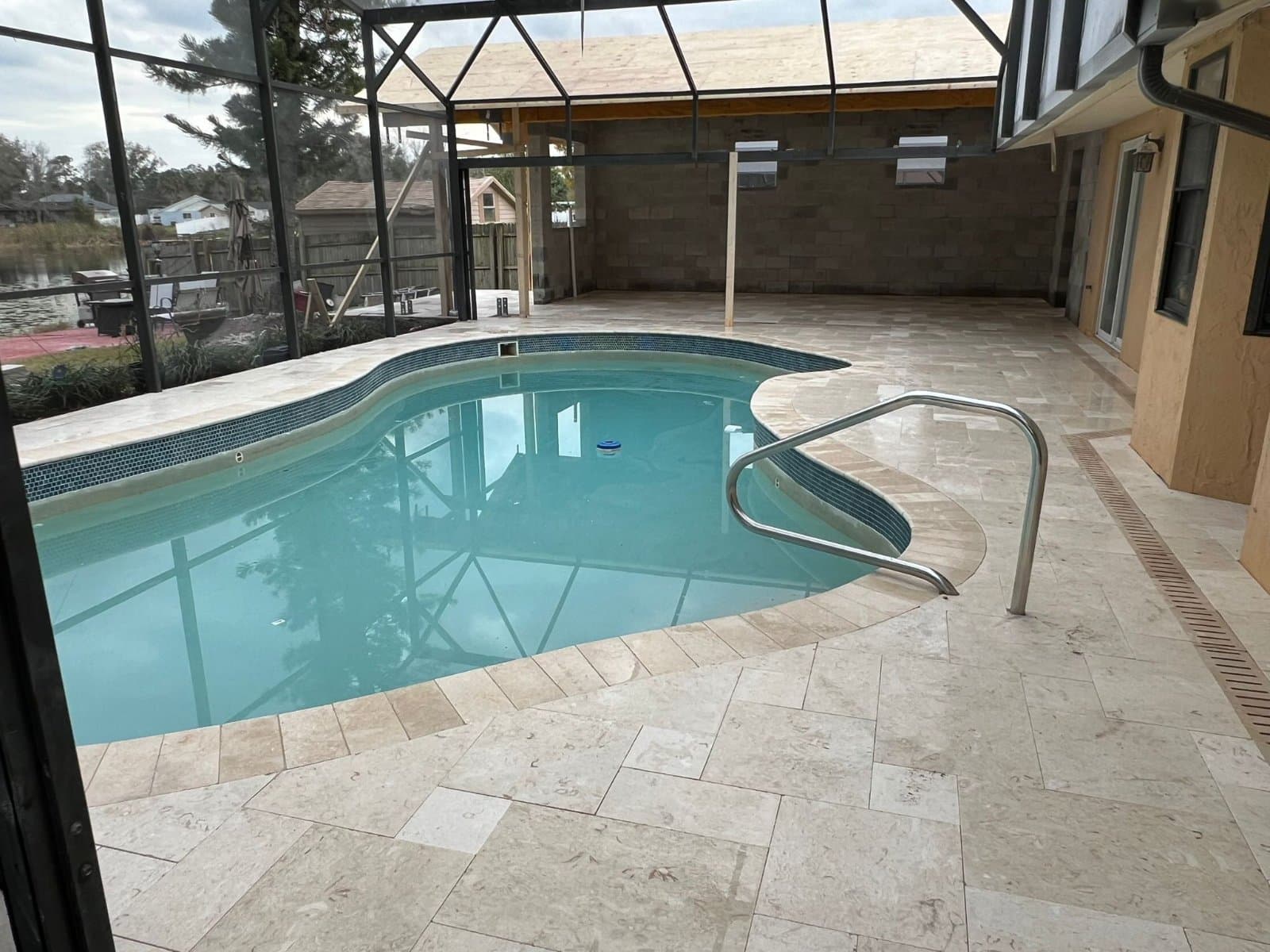
Pool decks cost $12 to $18 per square foot. Lake-adjacent base upgrades add $2 to $3 per square foot for the increased aggregate depth near Monroe, Lytle, and Dupont. Walkways cost $11 to $16 per square foot. Thin overlay pavers on structurally sound concrete cost $8 to $14 per square foot.
Deltona city permits apply for applicable projects. Some newer subdivisions have HOA requirements. Lake-adjacent lots may face environmental considerations. We handle all administrative submissions. Installation runs 3 to 5 days for driveways, 2 to 4 for patios, 4 to 6 for pool decks. Call (321) 353-7445 for your free Deltona paver estimate.