KS Solutions provides brick paver installation in Daytona Beach. Call (321) 353-7445 for your free estimate.
Brick Paver Installation in Daytona Beach: Salt-Air-Rated Hardscaping for Volusia County's Coastal Properties
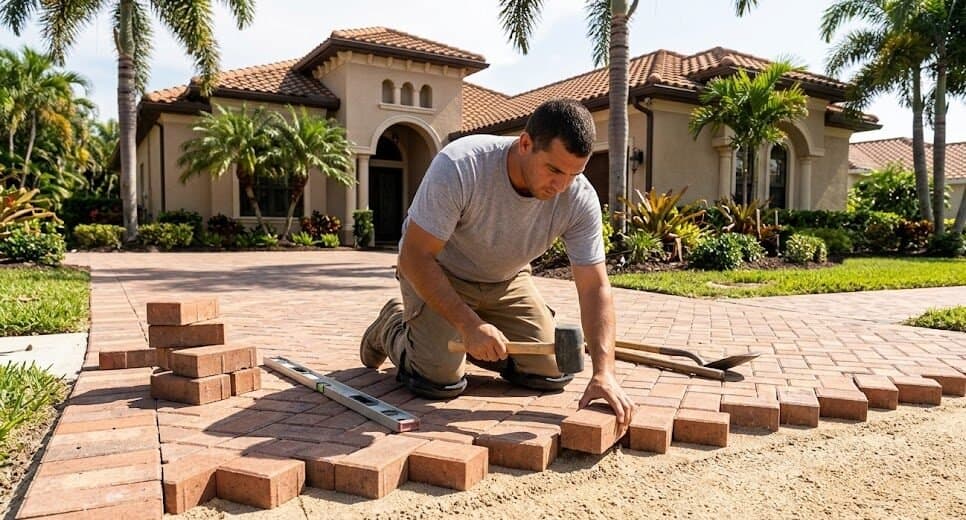
Brick paver installation in Daytona Beach, FL must account for the salt-air environment that no inland Florida community faces. This Atlantic coast city of roughly 75,000 residents in Volusia County sits directly on the ocean, and the salt-laden breeze that blows off the water corrodes metal hardware, attacks concrete surfaces, and accelerates the deterioration of every outdoor material that wasn't specified for coastal exposure. A paver installation in Daytona Beach using the same materials and methods that work perfectly in landlocked Polk or Osceola County will show salt damage within 3 to 5 years because the coastal conditions exceed what inland specifications are engineered to resist.
Daytona Beach's neighborhoods span from the high-rise beachside strip along A1A to the established mainland communities west of the Intracoastal Waterway, including Pelican Bay, LPGA International, Indigo, and the older Midtown corridor. Each area faces different salt exposure levels: beachside properties within a half mile of the ocean receive direct salt spray that coats surfaces daily, while mainland properties 3 to 5 miles from the shore experience diffused salt presence that still exceeds what inland communities encounter but at lower concentrations. The material specifications for a paver installation should match the salt exposure the specific property's location produces.
KS Solutions installs brick pavers throughout Daytona Beach using salt-rated materials and corrosion-resistant hardware that coastal Florida's conditions demand. The city falls within Daytona Beach's own municipal government with city building permits. Many neighborhoods including LPGA International have HOA requirements that we verify and manage. Beachside properties face additional wind-load and flood-zone considerations that affect base engineering. We handle all regulatory requirements including the coastal-specific permit conditions that the city's building department applies to properties in raised wind zones.
Salt-Air Material Selection: Why Coastal Pavers Need Different Specifications Than Inland Products
Concrete pavers manufactured for general Florida use contain standard rebar, standard aggregate, and standard sealer specifications adequate for inland exposure where salt is absent from the air. On the Daytona Beach coast, the salt particles carried by the ocean breeze penetrate the microscopic pores in concrete paver surfaces and initiate a corrosion process in the internal steel mesh some products use for reinforcement. The corrosion expands the steel inside the concrete, creating internal pressure that eventually cracks the paver from the inside out. The homeowner sees the surface spalling and assumes the paver is defective when the actual cause is using an inland product in a salt environment it wasn't designed for.
We specify Daytona Beach paver installations with products rated for coastal exposure. These products use higher-density concrete mixes with lower porosity ratings that resist salt penetration, non-ferrous reinforcement or no internal reinforcement at all, and integral color that extends through the paver's full thickness rather than surface-only pigment that erodes away under salt attack. The coastal-rated products cost $1 to $3 more per square foot in material than standard inland pavers, but the additional cost prevents the premature failure that salt produces on unrated products within 5 to 8 years of coastal installation.
Edge restraints, fasteners, and any metal hardware in a Daytona Beach paver installation must be stainless steel or hot-dip galvanized rather than the standard zinc-coated hardware that inland installations use. Standard zinc coating degrades within 2 to 3 years in salt air, allowing the base steel to corrode and stain the adjacent paver surface with rust streaks that cleaning can't remove because the iron oxide has bonded to the concrete. Stainless hardware adds roughly $50 to $100 to a standard driveway project and eliminates the corrosion staining entirely.
KS Solutions sources every Daytona Beach paver installation's hardware from the stainless steel product lines that coastal contractors use and that inland contractors typically don't stock because the cost isn't justified away from salt exposure. The material difference between a Daytona Beach installation and an identical project in Winter Haven or Lakeland isn't the pavers themselves but the supporting hardware and the sealer specification that protect the installation from the corrosive environment the coast produces.
Coastal Sandy Soil and Deep-Base Construction on Daytona Beach's Loose Atlantic Shore Subgrade
Daytona Beach's soil profile is coastal sand deposited by centuries of Atlantic wave action. This sand is looser, finer-grained, and more uniformly sorted than the inland sands found in Polk and Lake County because the ocean's sorting action produces grains of very consistent size without the clay and silt particles that inland soils contain. The uniform grain size means the sand compacts to lower maximum density than mixed-particle inland soils, providing less structural support per inch of base depth. A standard 6-inch base specification adequate for inland sand may allow settling on Daytona Beach's looser coastal sand because the bearing capacity per inch is lower.
We build Daytona Beach driveway bases at 8 to 12 inches of compacted aggregate depending on the property's distance from the shore and the specific subgrade density the first test hole reveals. Beachside properties within a mile of the ocean sit on the loosest sand and need the deepest bases. Mainland properties west of the Intracoastal sit on slightly denser material that's mixed with more organic content from the terrestrial environment. The base depth specification comes from the on-site soil evaluation rather than from a city-wide standard because Daytona Beach's soil density varies meaningfully between the beachside and the mainland.
Geotextile separation fabric at the base of every Daytona Beach excavation prevents the coastal sand from migrating upward through the aggregate layer. The fine, uniform coastal sand particles are especially prone to capillary migration because their consistent size creates uniform capillary channels that draw particles upward more efficiently than the variable channels in mixed-particle inland soil. The fabric blocks this migration at $0.50 per square foot and maintains the aggregate's structural integrity for the installation's full lifespan.
KS Solutions probes the subgrade at multiple points across every Daytona Beach paver site because the coastal sand density can vary within a single lot. A driveway that starts on relatively firm mainland sand near the street may cross onto looser fill sand near the house where the builder added material to raise the pad elevation. The probe identifies these density transitions so the base depth adjusts accordingly rather than applying one depth across variable conditions.
Hurricane Wind-Load Considerations for Daytona Beach Hardscape Design
Daytona Beach sits in a coastal wind zone where hurricane-force winds above 100 mph are part of the building code's design criteria for permanent structures. While pavers themselves are wind-resistant because they sit at ground level with no wind-catching profile, the retaining walls, planter walls, and outdoor kitchen structures that paver patios incorporate do catch wind and must resist the forces that the coastal wind zone produces. A 3-foot retaining wall behind a Daytona Beach patio catches wind load that the same wall in landlocked Polk County wouldn't because the coastal wind speeds exceed inland speeds at every storm intensity level.
We engineer Daytona Beach retaining walls and outdoor structure foundations to the wind-load requirements that the city's building code specifies for the property's designated wind zone. Beachside properties in the highest wind zones require deeper footings, thicker walls, and more extensive geogrid reinforcement than mainland properties in lower wind designations. The engineering isn't optional: the city's building inspector reviews the structural specifications against the wind zone requirements before issuing the construction permit.
Paver surfaces themselves perform well during hurricanes because the interlocking units and heavy aggregate base create a ground-level installation that wind can't lift or shift the way it can affect raised structures. Post-hurricane, paver surfaces typically need only debris removal and a polymeric sand refresh in joints where the storm's rainfall washed the binding material. Concrete slabs, by contrast, may develop new cracks from the ground movement that saturated soil creates during multi-day rain events that hurricanes produce.
KS Solutions designs Daytona Beach outdoor structures with the coastal wind code as the baseline rather than the add-on. Every retaining wall, outdoor kitchen foundation, and raised paver feature starts from the wind-load specification the property's zone requires and gets built to that standard from the first block. Retrofitting wind resistance after construction is more expensive and less reliable than building it in from the start, which is why we treat coastal wind engineering as a fundamental design parameter rather than an optional upgrade.
(321) 353-7445Get Immediate Service
Travertine Pool Decks for LPGA International, Pelican Bay, and Mainland Communities
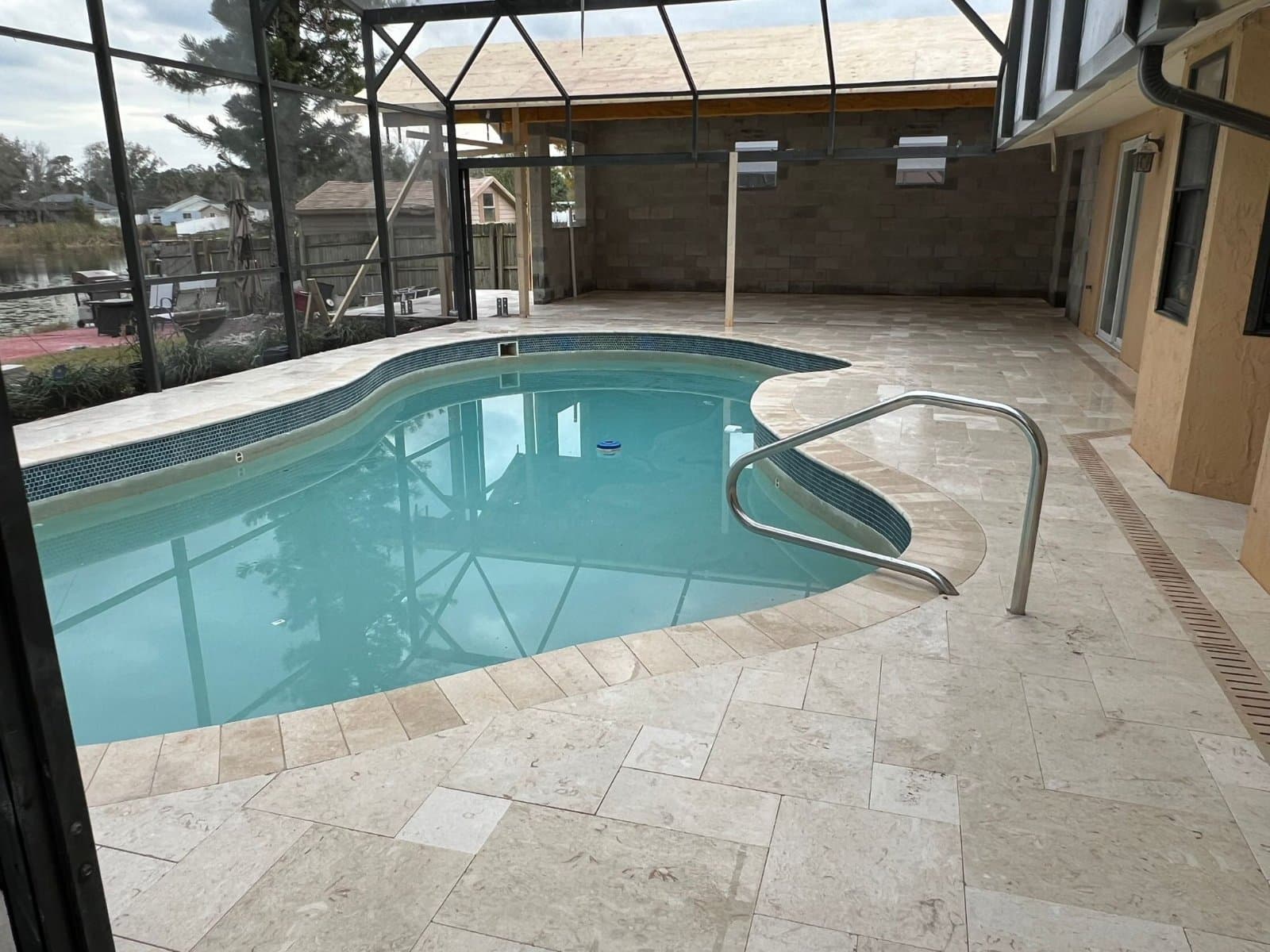
Travertine pool decks are Daytona Beach's most requested paver product because natural travertine's properties align perfectly with what coastal pool areas demand. The stone's natural porosity creates a micro-textured surface that provides excellent wet traction without the abrasive roughness that textured concrete develops as it weathers. The light cream, ivory, and walnut tones reflect solar radiation rather than absorbing it, keeping barefoot surface temperatures 20 to 30 degrees below what dark-colored alternatives produce during the 8-month swimming season that Daytona Beach's subtropical latitude provides.
Travertine handles salt exposure better than many concrete paver products because the stone's calcium carbonate composition doesn't contain the internal steel reinforcement that salt attacks in concrete units. The stone's natural density and porosity profile were established by geological processes over millions of years, and the material has demonstrated its resistance to marine environments through the Mediterranean coastal structures where travertine has served for centuries. A natural stone that survived 2,000 years of Mediterranean salt air handles Daytona Beach's Atlantic exposure without the accelerated degradation that salt produces on less naturally resistant manufactured products.
LPGA International and Pelican Bay homeowners select travertine at the highest rate among Daytona Beach's residential communities because the stone's natural elegance matches the premium property values these neighborhoods command. A travertine pool deck on a $450,000 to $700,000 Daytona Beach home represents the proportional quality investment that the property's market segment expects from exterior improvements. Concrete pavers at a lower price point serve mainland properties at moderate value levels where the cost-to-value ratio favors manufactured products over natural stone.
KS Solutions installs Daytona Beach travertine pool decks with the French pattern that uses four different tile sizes in a repeating random arrangement, producing the organic, non-repetitive appearance that natural stone presents most effectively. Grid patterns with uniform tile sizes create the structured regularity that manufactured materials handle better because manufactured products have consistent dimensions that grids emphasize as a design strength. Natural stone with its inherent dimensional variation looks best in the random-appearing French layout where the variation becomes a design feature rather than a manufacturing inconsistency. Call (321) 353-7445 for your free Daytona Beach paver estimate.
Paver Costs for Daytona Beach's Coastal Residential Properties
Brick paver installation in Daytona Beach costs $14 to $26 per square foot depending on material, salt-exposure rating, and whether the project involves coastal wind-code engineering for retaining walls or outdoor structures. The coastal premium of $2 to $5 per square foot over comparable inland installations reflects the salt-rated materials, stainless hardware, deeper aggregate bases, and the wind-load engineering that Daytona Beach's Atlantic coast position demands.
Driveway replacements with coastal-rated pavers and stainless hardware cost $16 to $24 per square foot. A standard two-car driveway of 400 to 550 square feet runs $6,400 to $13,200. Travertine pool decks in French pattern cost $20 to $26 per square foot. A 500 square foot pool deck runs $10,000 to $13,000. Concrete paver pool decks at coastal rating cost $14 to $20 per square foot.
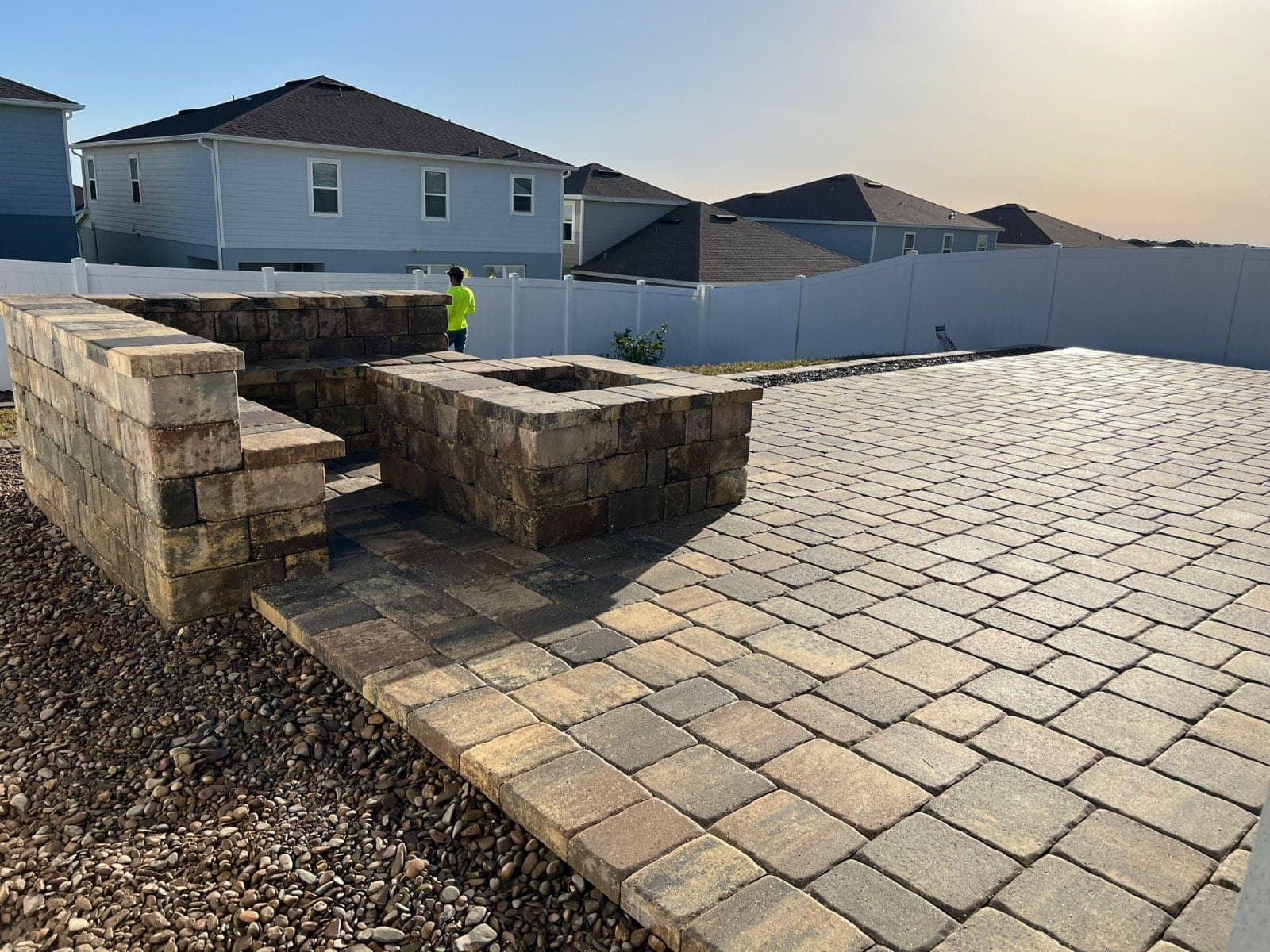
Patios cost $14 to $22 per square foot. A 400 square foot patio with fire pit area runs $5,600 to $8,800 plus $1,500 to $2,200 for the fire ring. Retaining walls with hurricane wind-code engineering cost $30 to $55 per square face foot depending on height and wind zone designation.
Daytona Beach city permits apply. LPGA International, Pelican Bay, and other HOA communities require design approval. Beachside properties face additional flood-zone and wind-zone requirements. We handle all permits and HOA submissions. Installation runs 3 to 6 days for driveways and patios, 5 to 8 for pool decks. Call (321) 353-7445 for your free Daytona Beach paver estimate.