KS Solutions installs residential, pet-friendly, and play-area artificial turf in Port Orange, FL. Call (321) 353-7445 for your free on-site estimate.
Why Artificial Turf Wins on Port Orange's Coastal and River-Adjacent Lots
Artificial turf makes more sense in Port Orange than it does in most inland Florida cities, for reasons specific to the coastal geography. Salt-laden east winds drift across the residential footprint from the Halifax River through most of the storm season. The seasonal water table sits closer to the surface on river-adjacent lots than it does inland. And HOA back-yard turf installations are now legally protected by Florida HB 1203 in any of the city's planned communities. The combined math means a properly engineered turf install outperforms St. Augustine on most Port Orange lots over a 5 to 10 year horizon.
Roughly 63,000 residents live in Port Orange, and the soil under their lots changes meaningfully across the city. Inland west Port Orange sits on the deep sandy soils typical of the Atlantic Coastal Ridge. Closer to the Halifax River, the picture changes: shallower water table, organic muck pockets on lots that used to be marshland, and salt drift that punishes natural lawns more than most homeowners realize. Artificial turf does not care about any of those problems.
What turf actually solves on a Port Orange lot:
- No watering schedule: Volusia County watering restrictions through the St. Johns River Water Management District cap residential irrigation; turf eliminates the constraint entirely for the turf area itself.
- No fertilizer runoff into the Halifax River: Reducing fertilizer load on parcels draining toward the lagoon is genuinely better for water quality.
- No salt-burned grass blades on east-facing lots: Salt deposition from coastal winds yellows St. Augustine on lots within roughly a mile of the river; turf is unaffected.
- No mowing on sandy, sometimes-flooded yards: Inland Port Orange yards drain fast in dry season but flood unevenly during the summer rainy stretch; turf does not need mowing in either condition.
- Year-round green: Florida winters dry St. Augustine to a tan dormancy in January and February; turf stays green through the cool stretch.
The case against turf in Port Orange is real too: hot surface temperature in direct July sun, higher up-front cost than seed-and-sod, and the visual signal in front yards of established neighborhoods. We address all three at the design stage rather than after the install.
Drainage Engineering for Yards Sloping Toward the Halifax River
Drainage is the single most important variable on a Port Orange turf install, and it is where most cheap installs fail. Turf is permeable through the backing, but the layers underneath the turf decide where the water actually goes. On a Halifax River-adjacent lot, that water is heading toward a tidal lagoon connected to the Atlantic, and getting that flow right is both a code requirement and a real environmental responsibility.
Soil profiles vary across the city. Inland west Port Orange lots, away from the river, sit on Atlantic Coastal Ridge sand: drains fast, compacts well, forgives a few engineering shortcuts. Move toward the Halifax and the soil flips: organic muck pockets, clay lenses, and a seasonal high water table. Treating both lot types the same way is exactly how a turf yard ends up squelchy in August.
Here is the layered system KS Solutions builds under every Port Orange turf install, adjusted for the actual lot:
- Subgrade evaluation first: we open the soil and confirm what we are building on. Muck pockets get over-excavated to mineral soil before any base material goes in.
- Geotextile fabric on river-adjacent and clay-lens lots, between subgrade and base, to stop fines from migrating up through the system.
- Crushed concrete or limerock base, typically 3 to 4 inches on sandy inland lots, 4 to 6 inches on river-adjacent lots, compacted in lifts.
- Decomposed granite or fine sand bedding layer, 1 inch screeded flat to set the turf surface true.
- Turf with proper drainage perforations (most pet-grade turfs run 4 to 6 holes per square meter through the backing).
- Slope: minimum 1 to 2% pitch toward landscape drains, dry wells, or French drains, never as direct sheet flow into the Halifax.
- Edge containment: bender board or composite edging on every yard with a grade change to keep the base from migrating out under load.
Built this way, a Port Orange turf yard takes a full summer downpour and drains it correctly, the surface stays firm under foot traffic, and runoff hits a controlled drainage path before it reaches the river.
Pet-Friendly Turf Systems for Florida Coastal Households
Pet-friendly turf is a significant share of what we install in Port Orange, especially on lots where dogs share a back yard with the patio, pool deck, and a view of the Halifax. The right system handles three things: drainage of urine through the turf to the base, infill that does not hold odor, and a backing that does not delaminate when a 70-pound retriever sprints back and forth in the same line for two years.
What separates a real pet-grade Port Orange install from a generic field-and-forget turf:
- High-flow backing with 4 to 6 drainage holes per square meter, sized so urine flows through to the base instead of pooling on the surface.
- Antimicrobial infill (zeolite or coated sand blends) that absorbs ammonia and reduces odor between rinses.
- Permeable base layer built specifically to drain liquid through to the subgrade, with the same Halifax River drainage rules as the rest of the yard.
- Pet-rated seam tape and seam glue rated for sustained pet traffic; budget seams fail at the property line where dogs run patrol.
- Optional rinse system for households with multiple pets: a hose bib or low-flow drip line stubbed into the turf area for periodic flush-throughs, particularly useful in the salt-air environment where odor accumulation can compound.
Maintenance is real but light. We tell every Port Orange pet-turf client to plan on a weekly hose-down in the high-use zones during the summer rainy stretch, brush-up the fiber direction every quarter, and freshen infill every 12 to 18 months. None of that workload compares to mowing, fertilizing, and re-sodding pet-damaged St. Augustine on a salt-touched coastal lot.
Turf on Spruce Creek Fly-In and Other Aviation-Adjacent Lots
Spruce Creek Fly-In is the recognizable centerpiece of Port Orange. The Spruce Creek Property Owners Association is at 212 Cessna Boulevard, both gated entrances are staffed 24/7, the centerpiece is a private 4,000 ft lighted runway, and many lots back directly onto the taxiway system that wraps through the residential streets. The community also has an 18-hole championship golf course and a country club with pool and tennis courts.
Turf in Spruce Creek is a real fit for the back yards adjacent to the taxiway, where mowing and irrigation around aircraft movement is a logistical headache, and for shaded lots where the homeowner has fought a thinning natural lawn for years. The SCPOA architectural review committee approves material, color, and pile height, with the same rigor as for any other exterior change. Common-area visibility matters: turf installs visible from the taxiway, the golf course, or any common area still go through full ARC review under HB 1203, while installs in non-visible back-yard areas now have legal protection.
How KS Solutions approaches turf in Spruce Creek:
- Confirm with the homeowner whether the proposed turf footprint is visible from the taxiway, golf course, or any HOA common area.
- For visible installations, prepare a full SCPOA architectural review packet with site plan, material spec, color samples (natural-tone landscape grades, not bright neon), and drainage plan.
- For non-visible back-yard installations, frame the HB 1203 / Section 720.3045 protection in the cover note while still submitting the packet for documentation.
- Spec heavier-duty edge containment near taxiway-adjacent runs to handle aircraft propwash without lifting.
- Coordinate the install start with both the SCPOA approval and the city permit (where applicable).
(321) 353-7445Get Immediate Service
HOA Approval in Spruce Creek, Sabal Creek, and Cypresswood (Plus What HB 1203 Changed)
HOA rules around artificial turf in Port Orange changed materially on July 1, 2024, when Florida HB 1203 took effect. The bill amended the Florida Homeowners' Association Act (Chapter 720, Florida Statutes) and explicitly limited HOA authority to ban artificial turf on parcels where the turf is not visible from the parcel's frontage, an adjacent parcel, an adjacent common area, or a community golf course. In plain English, an HOA in Port Orange can no longer outright prohibit artificial turf in a back yard that the public cannot see from the street or from the SCPOA taxiway.
What is and is not protected by HB 1203 for a Port Orange homeowner:
- Protected: back yards screened from the street, from the taxiway, and from neighbor sightlines.
- Protected: side yards behind a fence or wall that blocks visibility from the frontage.
- Still subject to ARC: front yards visible from the street.
- Still subject to ARC: any turf area visible from the SCPOA taxiway or golf course, or from a Cypresswood golf-course common area.
- Still subject to ARC: material spec, color, and pile height when the turf is in a visible location.
For ARC-controlled communities like Spruce Creek Fly-In, Sabal Creek, and Cypresswood, the visibility rule does not eliminate the architectural review process for visible installations; it just removes the outright ban for non-visible ones. Most homeowners who want a full-yard turf install still go through ARC, because the front-yard portion remains discretionary for the committee.
The clean ARC submission flow we follow in Port Orange:
- Pull the community's current ARC application form and material guidelines from the HOA portal or property management contact.
- Compile the packet: site plan, turf material spec sheet (blade height, density, color), drainage plan, edge restraint detail.
- For non-visible back-yard installs, include a written reference to HB 1203 / Section 720.3045 in the cover note.
- Submit to the HOA's ARC liaison or property manager and confirm receipt in writing.
- Respond to any committee questions or revision requests within the same business week.
- Receive written approval and schedule the install start.
Approval timelines typically run 2 to 4 weeks depending on when the committee meets. KS Solutions prepares and submits the architectural review packet for any ARC-controlled community in Port Orange.
Turf Costs and Project Timelines in Port Orange
Pricing for residential artificial turf in Port Orange runs in line with the rest of east-central Florida, with the variables that move price the most being Halifax River-adjacent drainage correction, aviation-adjacent edge restraint upgrades on Spruce Creek lots, and pet-grade material upgrades. We do every Port Orange estimate on-site so the lot's actual soil profile, slope, and visibility determine the quote.
Standard residential turf
Mid-density landscape turf for back yards, side yards, and full-yard installs without pet or play-area upgrades. Same drainage layer system as every other install, just without the antimicrobial infill or rinse system.
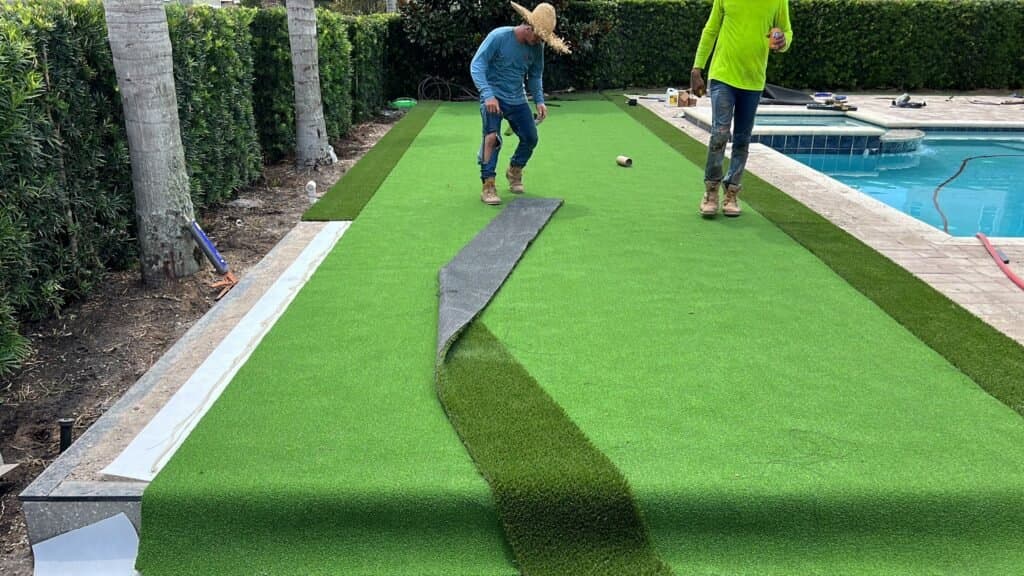
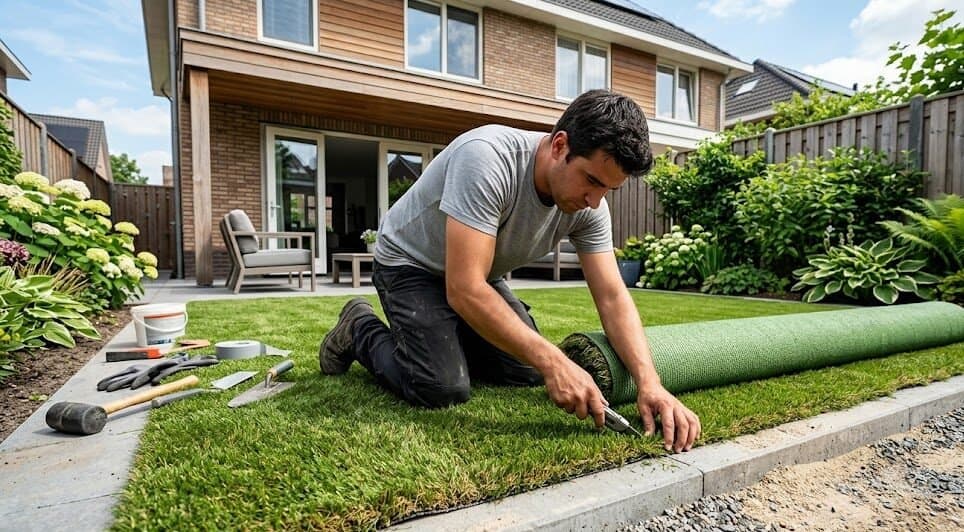
- Day 1: layout, demo of existing sod or hardscape, subgrade evaluation.
- Day 2: base build (3 to 6 inches depending on lot soil), compaction in lifts.
- Day 3: bedding sand screeded flat, turf rolled out and seamed.
- Day 4: infill broomed in, edge restraints set, final brush-up.
Pet-friendly turf system
High-flow backing, antimicrobial zeolite infill, optional rinse stub-out. Adds a day on most installs because of the extra base detailing for liquid drainage.
- Day 1 to 2: layout, demo, subgrade prep with extra attention to drainage.
- Day 3: base build with permeable layer, geotextile on river-adjacent lots.
- Day 4: bedding, turf installation with pet-grade seams.
- Day 5: zeolite infill, brush-up, rinse stub-out wired to existing hose bib.
Aviation-adjacent and play-area installs
For Spruce Creek Fly-In taxiway-adjacent yards or screened back yards in Sabal Creek. Heavier-duty edge containment and natural-tone material picks for ARC compliance.
- Day 1 to 2: layout, subgrade prep, materials staged outside any aircraft movement areas.
- Day 3: base build with reinforced edge detailing.
- Day 4 to 5: bedding, turf, infill, edge restraints rated for propwash.
For most Port Orange turf projects, on-site work runs 2 to 4 days, plus 2 to 4 weeks for HOA architectural review if the property is in Spruce Creek Fly-In, Sabal Creek, or Cypresswood and the install is in a visible area. Non-visible back-yard installs in those communities are now protected under HB 1203, although we still recommend the ARC packet for documentation.