KS Solutions installs artificial turf in Sanford, FL for homeowners across Seminole County's seat city where the brick-paved First Street downtown sets a high bar for property presentation, the Riverwalk's 26-mile Lake Monroe trail system puts waterfront yards on daily public display, and the mix of National Register Historic District homes with newer 417-corridor subdivisions creates a market where year-round green curb appeal directly influences both daily livability and resale positioning. Call (321) 353-7445 for a free estimate.
Year-Round Green in the Gateway City
Artificial turf installation in Sanford addresses the gap between the visual standard the city's public spaces maintain and the five-month dormancy reality that every homeowner's natural-grass yard suffers. The brick-paved downtown along First Street stays polished year-round. The Riverwalk trail stays groomed through every season. Fort Mellon Park's waterfront landscaping never goes brown. But the residential yards across Sanford's neighborhoods turn tan from November through February because St. Augustine sod can't hold its color through the dormancy cycle regardless of how much the homeowner spends trying to prevent it.
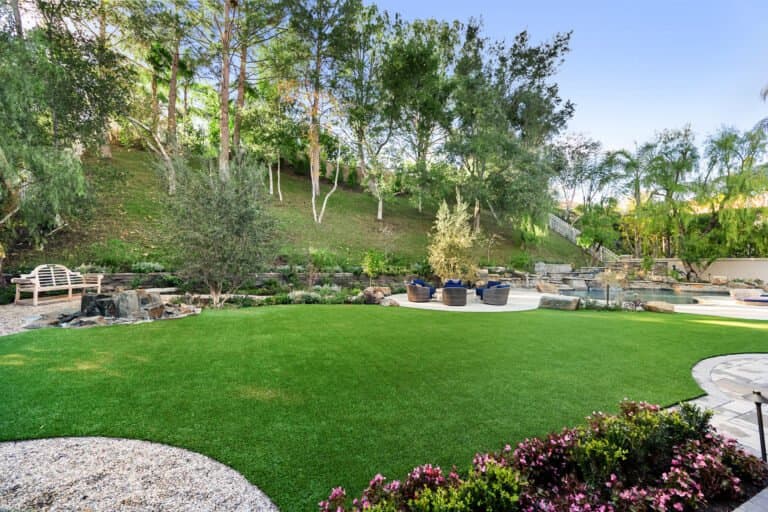
That seasonal contrast matters more in Sanford than in cities without curated public spaces because the comparison happens daily: residents walk the Riverwalk past professionally maintained greenery, then come home to a dormant front yard that looks neglected by comparison. Synthetic turf closes that visual gap permanently. The fiber holds its color in January the same way it holds it in July, matching the year-round quality that the downtown streetscape and the waterfront parks already display.
The financial case runs alongside the visual one. Annual lawn maintenance on a typical Sanford quarter-acre costs $2,400 to $4,000 when mowing service, supplemental irrigation, sprinkler repairs, four fertilizer rounds, two insecticide treatments, and the periodic re-sod that chinch bug damage makes necessary are tallied. Over 15 years, that's $36,000 to $60,000 invested in a surface that disappoints five months out of every twelve. Synthetic turf replaces that entire recurring expense with a one-time installation whose appearance doesn't change with the calendar.
For Sanford homeowners whose backyards face the Riverwalk trail, the turf also addresses a unique public-visibility concern. Joggers, cyclists, and dog walkers passing on the paved path evaluate the rear yard at slow-pass speed, which gives them far more time to notice brown patches, weed clusters, or bare dirt than a passing car on the street allows. A permanently green backyard visible from the Riverwalk makes a year-round impression that dormant natural grass can't deliver during the five months when every lakefront yard on the trail route turns brown together.
Turf Products for Sanford's Architectural Diversity
Residential lawn fiber
in a four-tone green blend with brown thatching covers Sanford front yards and primary backyard zones. The multi-color construction avoids the flat monochrome that budget products show and delivers the visual quality that Sanford's brick-paved downtown and manicured waterfront parks have established as the baseline for property presentation across the city. Properties in the Historic District, the Mellonville Avenue corridor, and the 417-corridor subdivisions all benefit from the same product, though KS Solutions adjusts blade height and color temperature to coordinate with each neighborhood's distinct architectural palette.
Pet relief fiber
with antimicrobial Zeofill infill and 30-inch-per-hour perforated-backing drainage serves Sanford's dog-heavy household base. The Zeofill granules neutralize ammonia before odor develops. The backing processes rinse water almost instantly. On compact Sanford lots where the dog pad sits near the screened lanai or the outdoor dining area, that drainage speed keeps the adjacent gathering space pleasant for evening company rather than sending guests indoors.
Putting green fiber
converts unused side yards or backyard corners into private practice surfaces with consistent ball speed. Sanford's proximity to Seminole County's golf courses and the city's own active-lifestyle demographic (the Riverwalk attracts joggers, the breweries attract socializers, and the golf courses attract competitors) makes backyard putting greens a popular add-on for residents who want to sharpen their short game between rounds without driving to the practice facility.
Shade-tolerant turf
handles the Historic District's century-old live oak canopy where natural grass thins and dies from insufficient sunlight. The synthetic surface holds its color and density under full shade because it doesn't depend on photosynthesis. This product preserves the heritage oaks lining Mellonville Avenue and the residential streets around Fort Mellon Park while delivering a green ground surface beneath them.
Base Construction Near the St. Johns River Floodplain
Sanford's subsurface splits between two distinct conditions depending on proximity to Lake Monroe. Lakefront lots and properties near the St. Johns River floodplain sit on organic soils (peat, decomposed vegetation, muck) that compress under load over time. Building a turf base on top of this organic material produces a surface that settles into the collapsing peat, creating depressions that no surface repair permanently corrects. KS Solutions excavates through the organic horizon on lakefront Sanford lots until the bore reaches stable mineral sand or clay beneath the muck, then builds the aggregate base on the corrected subgrade.
Higher-ground Sanford properties south of downtown and along the 417 corridor sit on standard Seminole County sand that drains fast but provides minimal lateral support for a turf base under foot traffic and furniture weight. KS Solutions strips organic material from the installation zone, compacts the exposed sand with a vibratory plate, rolls out stabilization fabric, and builds two to three inches of crushed limestone in measured lifts above the fabric. Each lift gets vibrated and probe-checked before the next arrives.
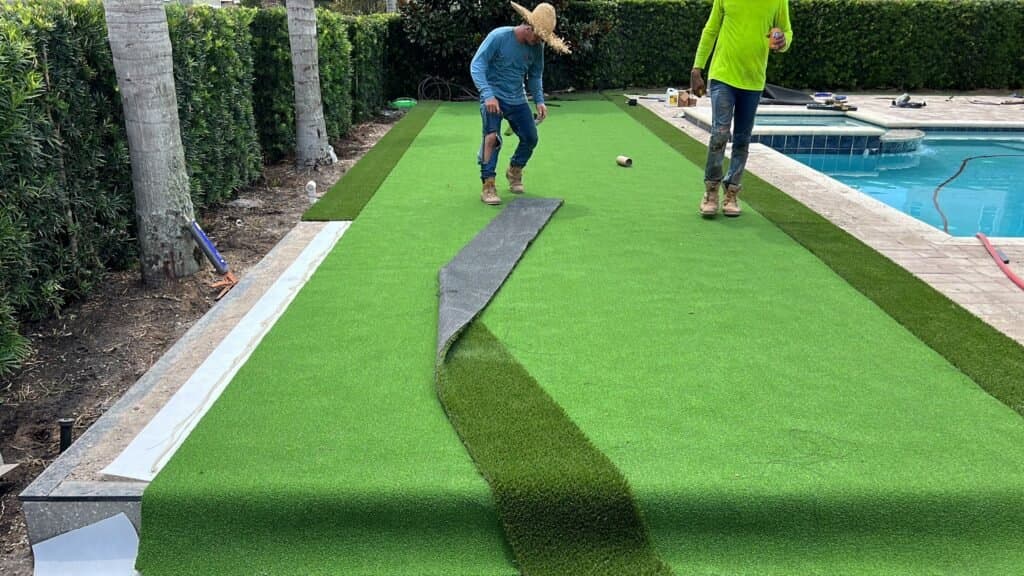
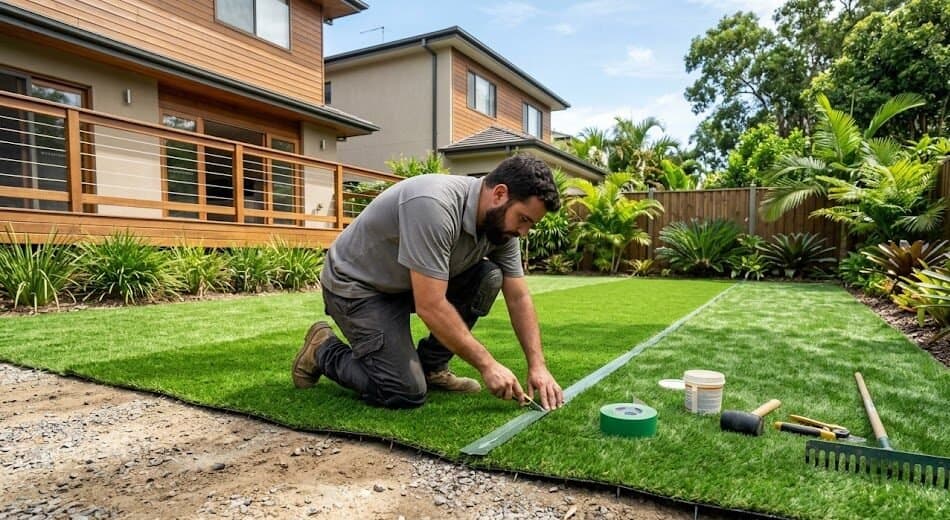
Turf panels roll across the finished aggregate, bond at seam edges with industrial adhesive tape, receive perimeter spike anchoring, and take zone-appropriate infill. On lakefront Sanford lots where the seasonal water table sits close to the surface, a drainage aggregate sublayer beneath the standard limestone channels rising groundwater laterally before it softens the structural base from below.
Water Savings and Lake Monroe Protection
Seminole County tells every Sanford homeowner which days their sprinkler zones may legally operate and enforces fines when code officers catch rotors spinning outside the approved window. During drought declarations (which hit this part of the St. Johns River basin regularly during spring dry spells), the permitted schedule shrinks to nothing. Sod owners watch their investment brown. Turf owners don't notice, because the fiber's color comes from pigment embedded during manufacturing rather than from biological processes that require water to function.
A Sanford quarter-acre of St. Augustine absorbs 20,000 to 30,000 gallons of irrigation water annually. That volume pushes the household's monthly statement into the upper brackets of the county's tiered rate structure. Killing the sprinkler zones that served the converted turf areas pulls total consumption back down the rate ladder, reducing both the total gallons consumed and the per-gallon cost on indoor water still running through the meter.
Chemical runoff matters in a city built on the shore of Lake Monroe at the head of the St. Johns River. Every fertilizer granule and insecticide ounce applied to Sanford sod percolates through the sandy substrate during the next thunderstorm and enters the waterway as dissolved nutrient pollution. Turf needs zero fertilizer, zero pesticide, and zero herbicide. Your Sanford property's chemical contribution to the Lake Monroe and St. Johns River system drops to zero permanently. Call KS Solutions at (321) 353-7445 to discuss turf for your Sanford home.
(321) 353-7445Get Immediate Service
Simple Monthly Care for Active Sanford Residents
Sanford residents who spend their free time on the Riverwalk, at the First Street breweries, or kayaking Lake Monroe didn't buy in the Gateway City to spend Saturday mornings behind a lawn mower. Synthetic turf replaces the weekly mowing routine with a handful of brief monthly tasks that take less total time than walking to the nearest craft brewery on First Street and ordering a flight.
Blow oak pollen, Spanish moss fragments, and wind-carried debris off the surface every week or two with a cordless blower. Brush the daily-use pathways (front door approach, lanai slider, grill station, dog's evening patrol) once monthly with a stiff broom against the blade direction. Fifteen seconds per corridor. Annual infill check: push a fingertip between the fibers at a few spots; if you touch backing before granules, spread a bag of matching product with a drop spreader. Twelve minutes handles the typical Sanford yard.
Dog households: garden-hose rinse on the relief pad every couple of warm-weather days, enzyme cleaner once per quarter. KS Solutions offers annual professional maintenance visits for Sanford clients that cover infill measurement, power grooming, edge inspection, and drainage verification in one appointment.
Permits, Historic Overlay, and Installation Timeline
Most Sanford turf installations don't trigger building permits because the perforated backing qualifies as permeable ground cover. Properties within the Sanford Residential Historic District (National Register since 1976) may need Historic Preservation Board review for landscape modifications that change the lot's established appearance. KS Solutions identifies whether the historic overlay applies to your lot during the consultation and prepares any documentation the Preservation Board requires.
Newer 417-corridor subdivisions with HOA governance may require architectural review before turf conversion proceeds. KS Solutions prepares sample boards with the proposed turf product, color, and blade profile alongside a site plan marking the conversion boundaries. Most Sanford HOA boards approve synthetic turf because it eliminates the dormant-brown lots that drag down winter curb appeal across the subdivision.
On-site work runs two to three working days for standard Sanford residential conversions. Lakefront lots requiring organic-soil excavation may add a day. The total timeline from consultation to finished surface, including any permits, historic-board review, or HOA approval, typically runs three to seven weeks. Every project wraps with a surface walkthrough verifying seam bonds, infill depth, perimeter anchoring, and cut-edge quality. Call (321) 353-7445 to start your Sanford turf project.