The 2026 Price Ranges, Before Anything Else
These are installed prices per linear foot for residential work in Florida this year, materials and labor, on reasonably level ground with normal access. Every one of them is a range rather than a number, and the section further down on what moves a quote explains why the spread is that wide.
- Chain link, 4 to 6 feet: roughly $11 to $25 per linear foot installed, with most standard residential galvanized work clustering in the $11 to $15 band.
- Wood privacy, pressure treated pine: roughly $15 to $35 per linear foot. Cedar runs meaningfully higher, commonly in the $30 to $45 range.
- Vinyl privacy: roughly $20 to $50 per linear foot, with the wide spread driven almost entirely by panel wall thickness and rail reinforcement rather than by appearance.
- Aluminum, residential picket style: roughly $25 to $60 per linear foot, with powder-coated residential grade typically landing in the $40 to $60 band.
At the project level, Florida fence installations in 2026 commonly land between $4,500 and $14,000. A concrete reference point: a 150 linear foot vinyl privacy fence with a single walk gate typically comes in around $6,500 to $8,500. If your quote is well outside that for a comparable job, the difference is in the section on gates and site conditions, not in anyone getting cheated.
The Number That Actually Decides This: Cost Per Foot Per Year
Divide the installed cost by the realistic service life and you get a figure that lets you compare materials honestly. Service life in Florida is not the same as service life in the manufacturer's brochure, so these are the ranges that hold up in this climate specifically.
- Wood: 10 to 15 years, even with good maintenance. Humidity, UV and insects work on it continuously and the failure almost always starts at the post, at grade, where the wood stays damp.
- Chain link: 15 to 20 years for galvanized residential work, longer if it is not in a salt-influenced area and the bottom rail is kept clear of soil and mulch.
- Vinyl: 20 to 30 years and often more, because PVC does not rot, warp or feed insects, and quality product has UV inhibitors compounded into the material rather than sprayed on.
- Aluminum: 30 to 50 years and up. Aluminum does not rust, and the powder coat holds color under sustained UV without softening.
Run the arithmetic at the midpoint of each install range and the ordering inverts from the price list:
- Chain link: about $18 per foot over about 17 years, roughly $1.06 per foot per year.
- Aluminum: about $42 per foot over about 40 years, roughly $1.05 per foot per year.
- Vinyl: about $35 per foot over about 25 years, roughly $1.40 per foot per year.
- Wood: about $25 per foot over about 12 years, roughly $2.08 per foot per year, before maintenance.
Those are midpoint estimates from the ranges above, not quotes, and the point is the ordering rather than the decimals. Redo the same division with your actual quotes and your own assumption about how long you will own the house. The result is usually the same: the material that reads cheapest on the estimate is the most expensive one to own, and it is not close.
Wood: Cheapest to Install, Most Expensive to Own
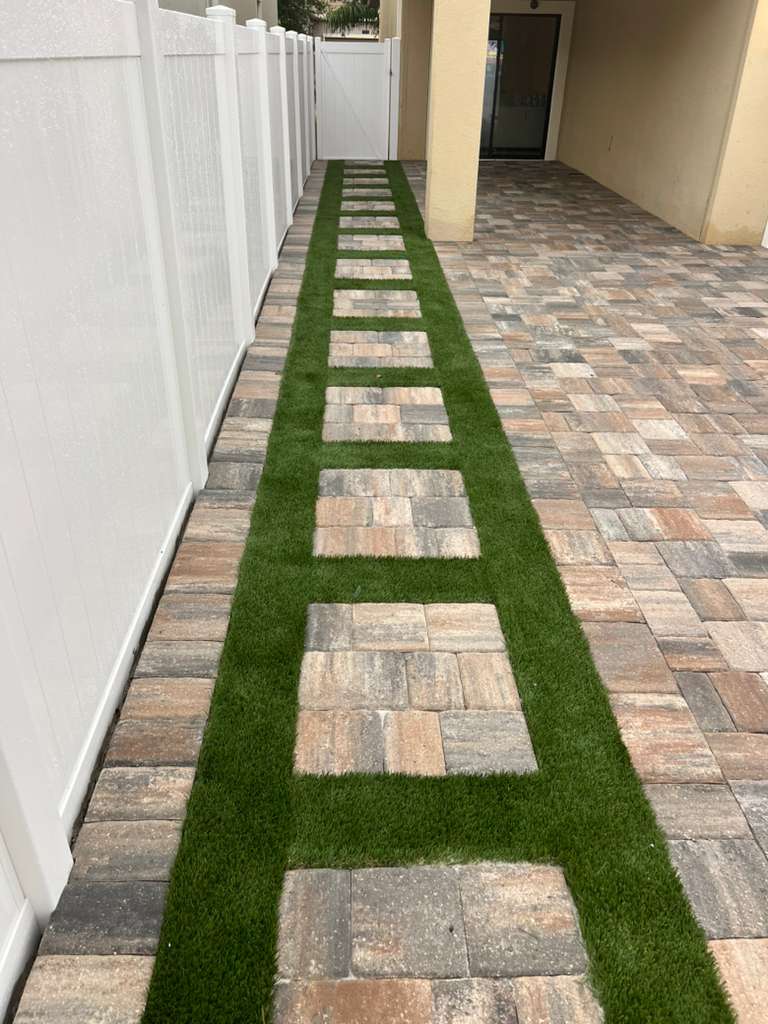
Wood still wins on two things that matter to real people. It is the least expensive way to get six feet of solid privacy up quickly, and it is the only material on this list you can restyle, stain a different color, or repair one board at a time with a trip to the lumber yard.
What it costs you is the maintenance obligation, and this is the line item that never appears on a comparison chart. A wood fence in Central Florida wants a clean and re-stain cycle every two to three years to hold off graying and moisture uptake. Price that honestly for your own fence: multiply your linear footage by the height, double it for both sides, divide by the coverage rate printed on the stain can, and add labor if you are not doing it yourself. Whatever that number is, it repeats four or five times across the life of the fence, and it is the difference between wood lasting 15 years and wood lasting 9.
The failure mode is worth understanding because it changes how you buy. Wood fences in Florida do not usually fail across the panels. They fail at the posts, at grade, where soil contact and irrigation overspray keep the wood damp and where the rot works from the inside out. A fence that looks fine from the patio can have four posts you can move by hand. If you are buying wood anyway, the two decisions that extend its life the most are post depth with a proper concrete collar, and keeping irrigation heads from spraying the fence line. Neither is expensive at install and both are nearly impossible to fix later.
Vinyl: The Florida Default, and the Quality Gap You Cannot See
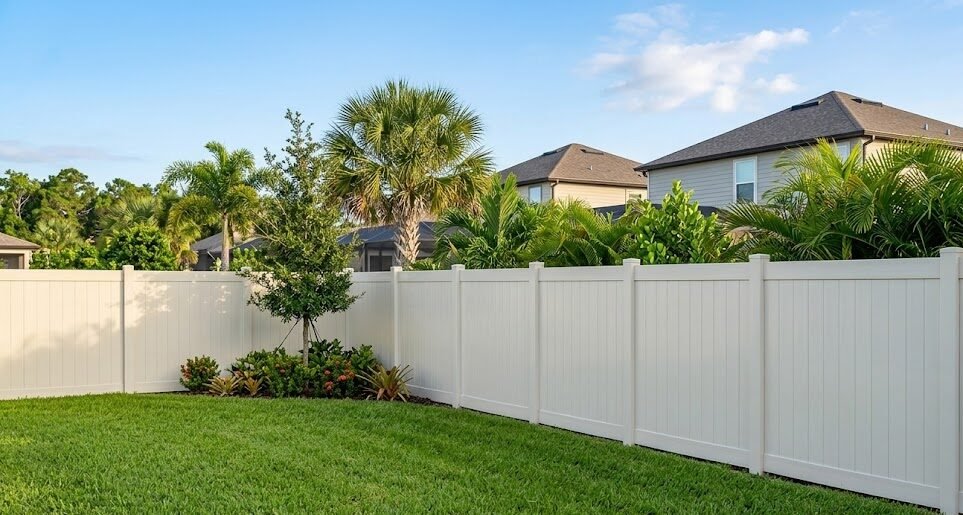
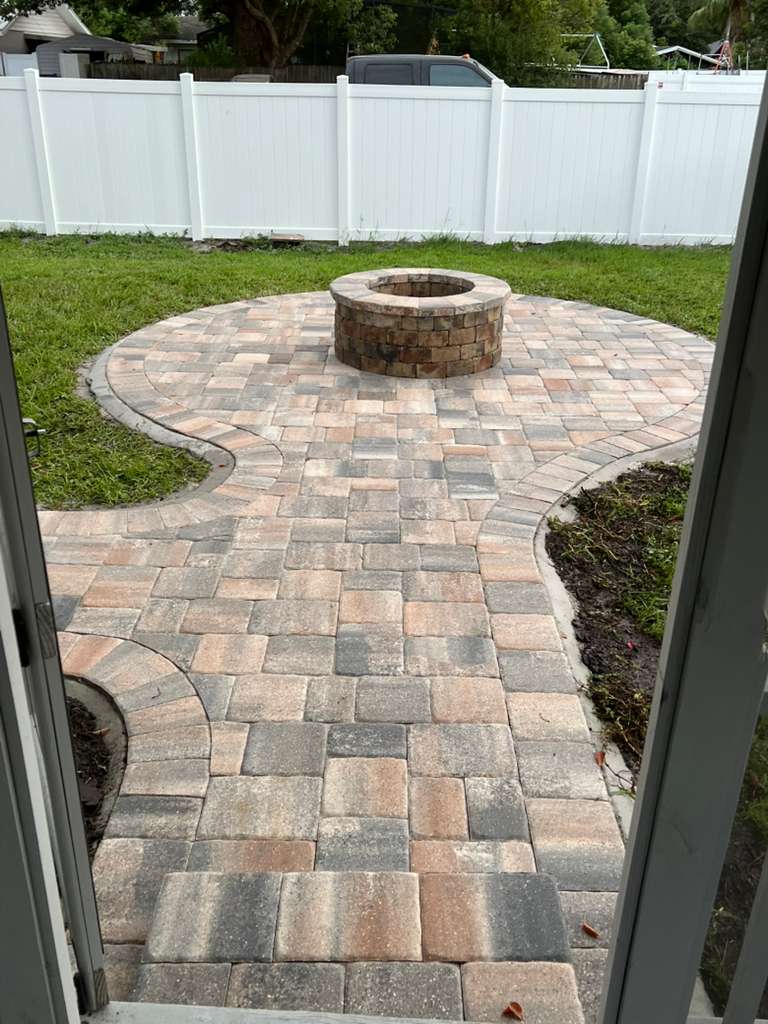
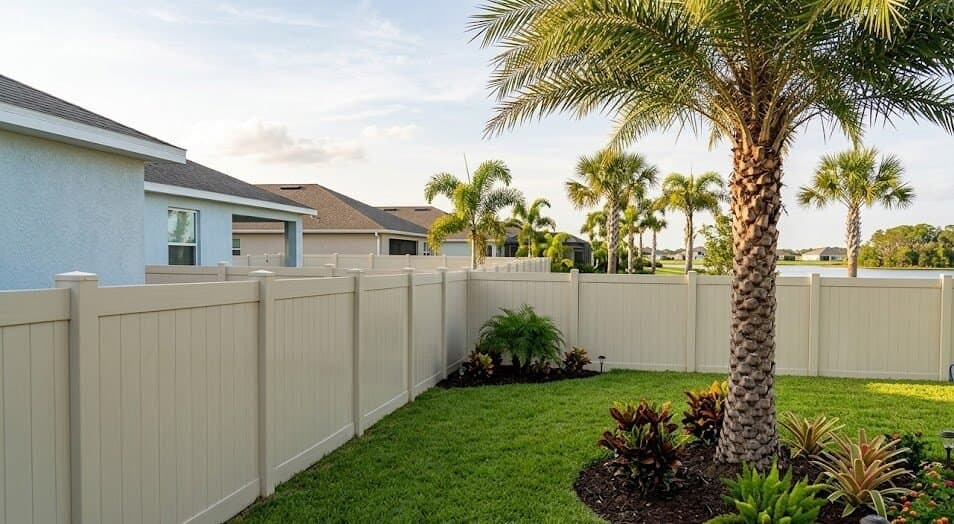
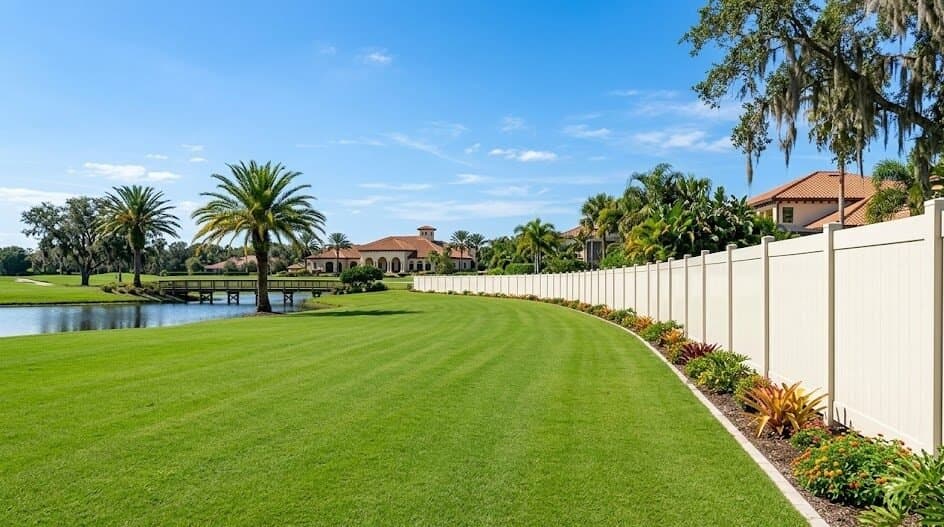
Vinyl is the most common privacy fence we install across Central Florida, and the reason is straightforward. It gives you the solid six-foot screen that wood gives you, with none of the rot, none of the insect exposure and none of the stain cycle. PVC is chemically indifferent to humidity and to salt air, which is why it holds up in coastal exposure that destroys other materials.
The trap in vinyl is that $20 per foot and $50 per foot look nearly identical in the driveway. The difference is in wall thickness of the pickets and rails, whether the bottom rail carries a galvanized steel or aluminum insert, and whether the UV inhibitor is compounded through the material or is essentially a surface treatment. Thin vinyl in full Florida sun goes chalky and brittle, and brittle vinyl cracks at the rail sockets the first time a storm loads the panel. Thick vinyl with a reinforced bottom rail does not.
Ask two questions of any vinyl quote: what is the picket wall thickness, and is the bottom rail reinforced. If the answer to either is vague, you are looking at the low end of that price range for a reason. Our privacy fence installation pages spell out the spec we install, which is a deliberate choice about which end of that range we want to be on.
(321) 353-7445Get Immediate Service
Aluminum: The Longest Life, and the One Job It Cannot Do
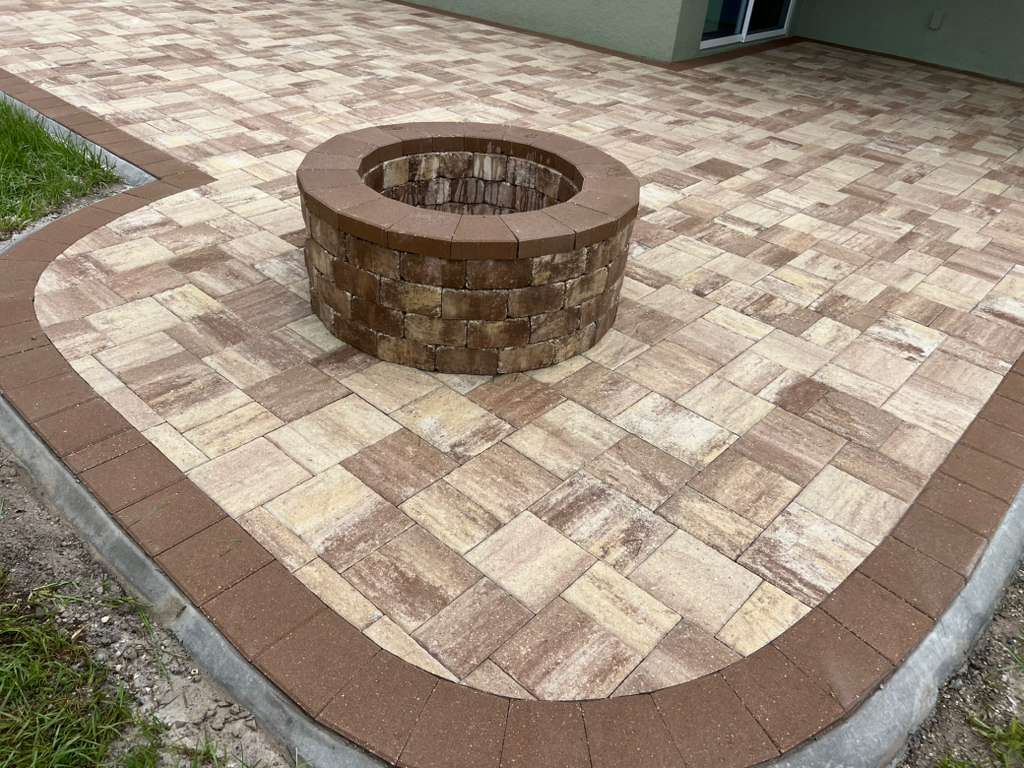
Aluminum is the best long-term value on this list by cost per year, and it is not the right answer for most backyards. Both statements are true.
It does not rust, which matters more in Florida than almost anywhere. It handles salt air better than anything else here, which is why it dominates near the coast. Powder coating holds color under years of direct UV without the fading and softening that other finishes show. Thirty to fifty years of service is a realistic expectation rather than a marketing figure, and the practical maintenance obligation is rinsing it.
What it cannot do is give you privacy. Aluminum is a picket product. You can see through it by design. That makes it the correct choice for a front yard, a property line where you want definition without a visual wall, a pool enclosure where code requires a barrier that a child cannot climb, and any HOA that mandates an open style. It makes it the wrong choice if the entire reason you are fencing is that you can see into your neighbor's lanai. That is what our decorative fence installation work is built around, and it is a different project from a privacy screen.
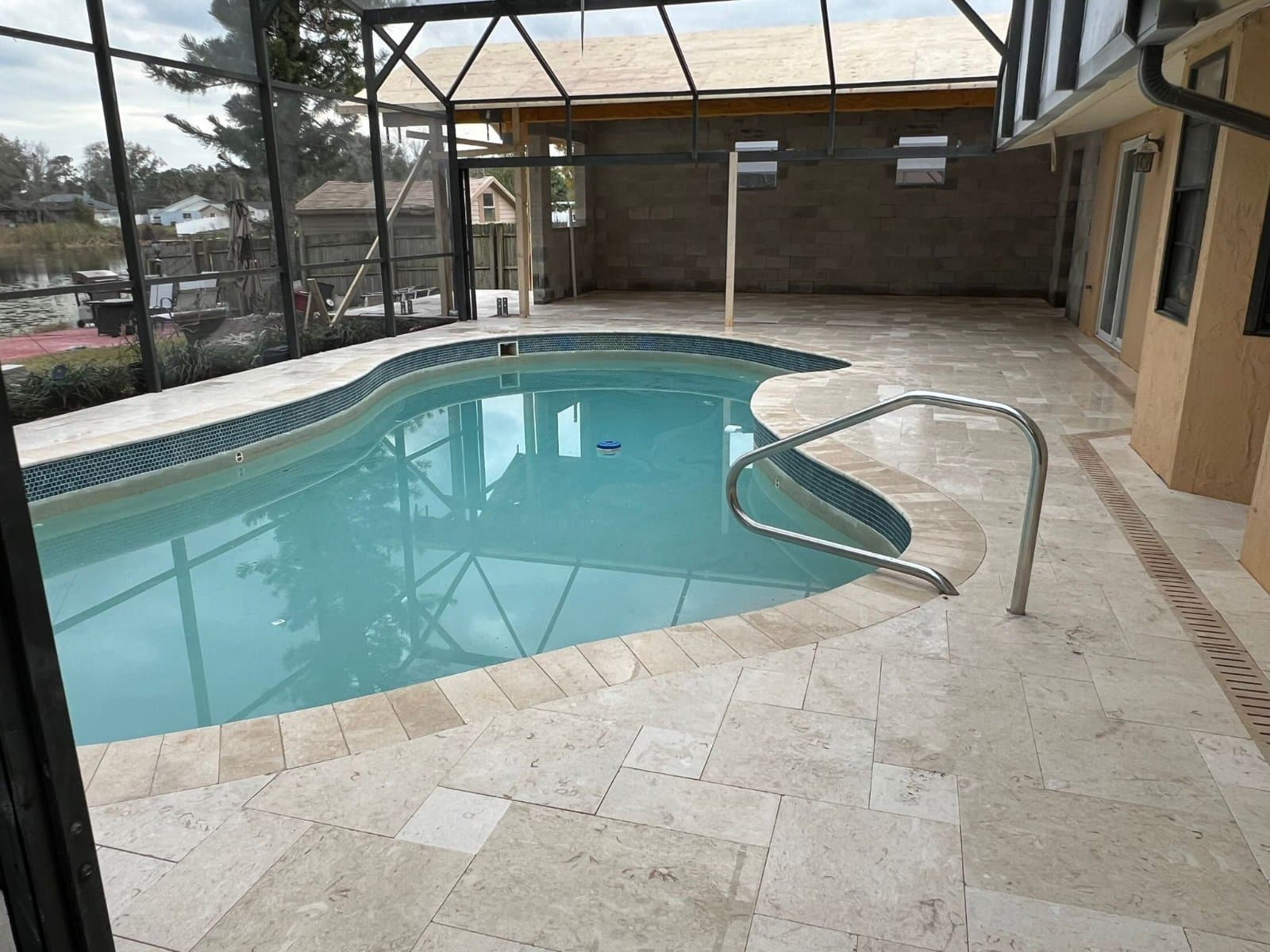
The other consideration is pool code. If the fence is serving as a pool barrier, the spacing, height and self-latching gate hardware requirements are not optional and they are inspected. Do not buy a fence for a pool yard without confirming that the specific product meets barrier requirements.
Chain Link: Undersold, and Right More Often Than People Admit
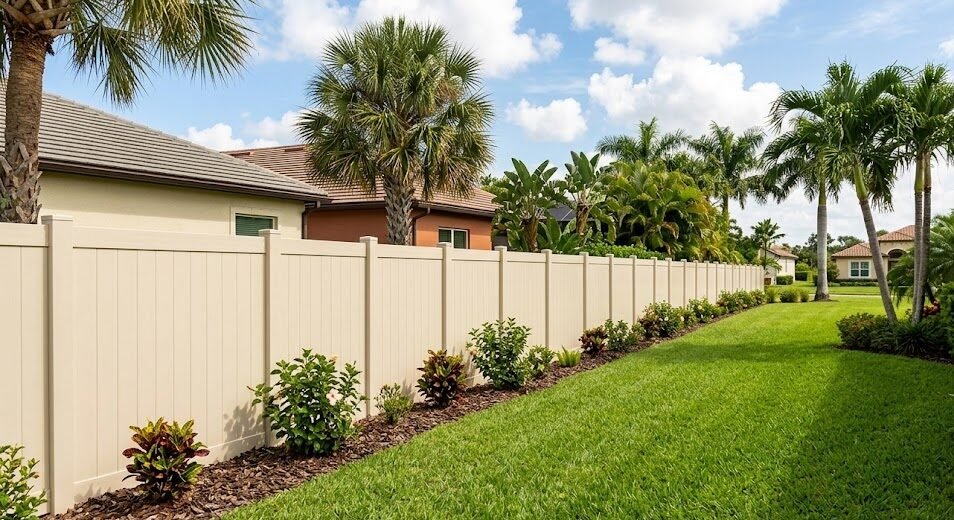
Chain link is the cheapest way to enclose a large area, and for a big lot where the goal is containing a dog or marking a boundary rather than screening a view, nothing else comes close on price per foot. Fifteen to twenty years of service for galvanized residential work is a reasonable expectation.
Two things extend it and both are free at install. Keep soil and mulch off the bottom rail, because that is where the galvanizing gets consumed first. And specify a heavier gauge mesh than the builder-grade default if the fence will contain a large dog, because the gauge, not the coating, is what determines whether the mesh deforms.
Black vinyl-coated chain link is worth a mention because it solves the aesthetic objection at modest cost. Against a hedge line it visually disappears at ten feet in a way galvanized does not.
Gates Are Where the Budget Actually Goes
This is the single most common source of surprise between a homeowner's mental estimate and a real quote. A gate is not priced per linear foot. It is a separate assembly with its own posts, hardware, bracing and, if it is wide enough, its own structural considerations.
- A walk gate is a modest add and most quotes assume one.
- A double drive gate is a different order of magnitude, because the posts have to carry a swinging load, the frame has to resist sagging across the span, and the hardware is doing real work.
- Automation multiplies it again, and in Florida it brings power, surge protection and outage behavior into scope.
If you are comparing two quotes and one is dramatically lower, count the gates in each before you conclude anything. This is where the difference usually is. If automation is on your list, our guide to gate and fence integration in Florida covers what actually survives salt air and hurricane season power outages, which narrows the hardware list considerably.
What Moves Your Quote Off These Ranges
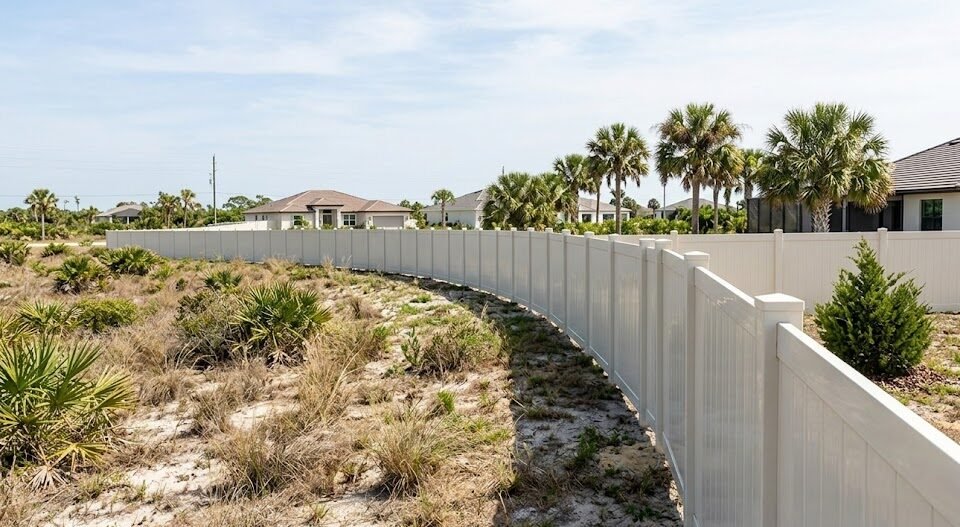
The published ranges assume a straightforward job. Here is what pushes a quote up, and each of these is a legitimate cost rather than padding.
- Demolition and haul-off of an existing fence. Pulling old posts set in concrete is slow, physical work and it is priced separately.
- Soil conditions. Central Florida sand digs easily, which is good, but it also holds a post poorly, which means proper concrete collars are not optional. Limerock close to the surface is the opposite problem and it slows post holes dramatically.
- Root systems. A property line under mature live oaks can turn a one-day post-setting job into a two-day job, and roots you cannot cut force post relocation.
- Grade change. A sloped run has to be either stepped or raked, and both cost more than a level run in labor and in waste.
- Access. If the crew cannot get equipment into the backyard, every post hole and every panel is carried by hand.
- Corners and ends. Terminal posts cost more than line posts, so a fence with many direction changes costs more per foot than a straight run of the same length.
HOA Rules Can Choose Your Material For You
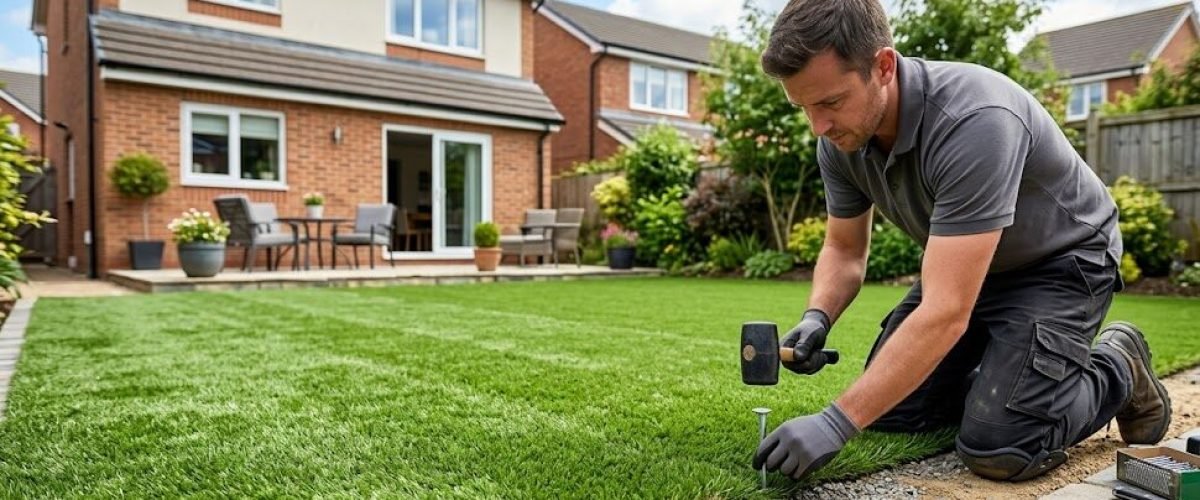
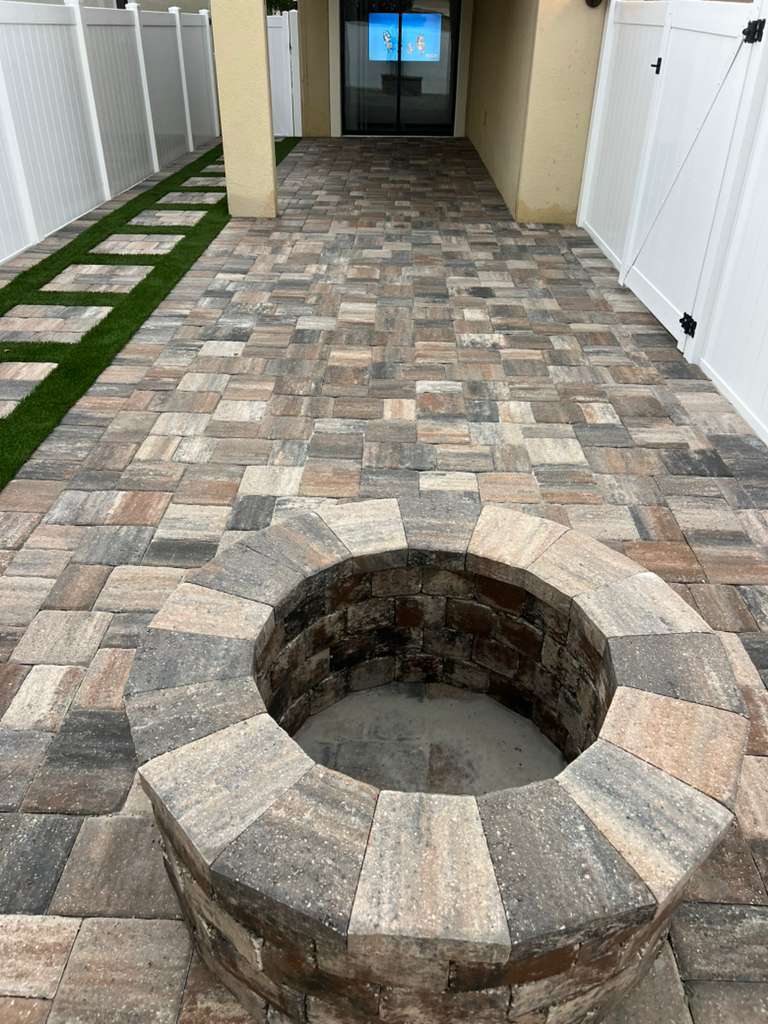
In a deed-restricted community, run the governing documents before you price anything. Many Central Florida HOAs specify material, height, color and style, and a fair number of them effectively mandate black aluminum on any elevation visible from the street. If that is your situation, the cost comparison above is academic and the real question is which grade of aluminum you buy.
The rules also changed recently in ways that favor homeowners, and boards do not always know it. Our breakdown of HOA fence rules in Florida for 2026 covers four restrictions boards can no longer enforce, and it is worth reading before you accept a denial. Submit to the architectural committee before you order material, not after, because a forced change after the panels arrive is entirely on you.
Permits, Setbacks and the Corner Lot Problem
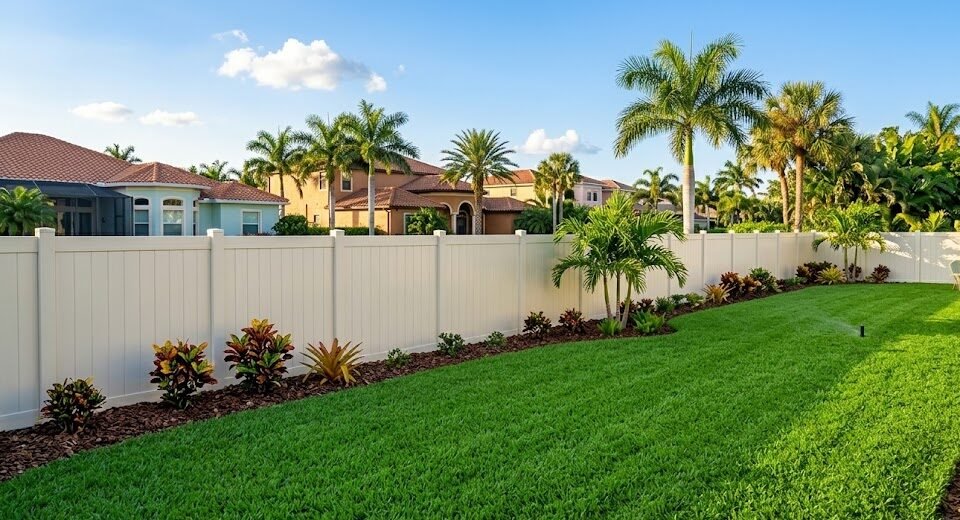
Most Central Florida jurisdictions require a permit for a residential fence, and the application typically wants a survey or site plan showing the fence location relative to your property lines and any easements. Two things catch people out.
Utility and drainage easements often run along rear property lines, and building a fence across one can mean the utility removes a section without replacing it. Corner lots carry a sight triangle restriction at the intersection, which limits fence height near the corner regardless of what you are allowed elsewhere on the lot. Both are found in the survey, which is why a real quote starts by looking at one.
What We Recommend, by Situation
- Backyard privacy, staying in the house long term: vinyl, mid-grade or better, with a reinforced bottom rail. Best combination of privacy, life and zero maintenance.
- Backyard privacy, selling within five years: wood is defensible here, because you are buying the appearance and not the twenty-year cost.
- Front yard, pool barrier, or HOA-mandated open style: aluminum. Nothing else matches the life, and privacy was never the goal.
- Coastal or salt-influenced exposure: aluminum or vinyl. Not wood, and not standard galvanized chain link.
- Large acreage, containment rather than screening: chain link, heavier gauge than builder grade, black vinyl coated if appearance matters.
KS Solutions installs all four across Central Florida, including Orlando, Lakeland and Winter Haven. If you already know the material and want it measured and priced properly, start at fence installation, and if you have a specific address in mind we cover it directly at fence installation in Orlando. Whatever material you land on, get the survey out first. It changes more quotes than the material does.