A Wind Rating Belongs to the Whole Fence, Not the Panel
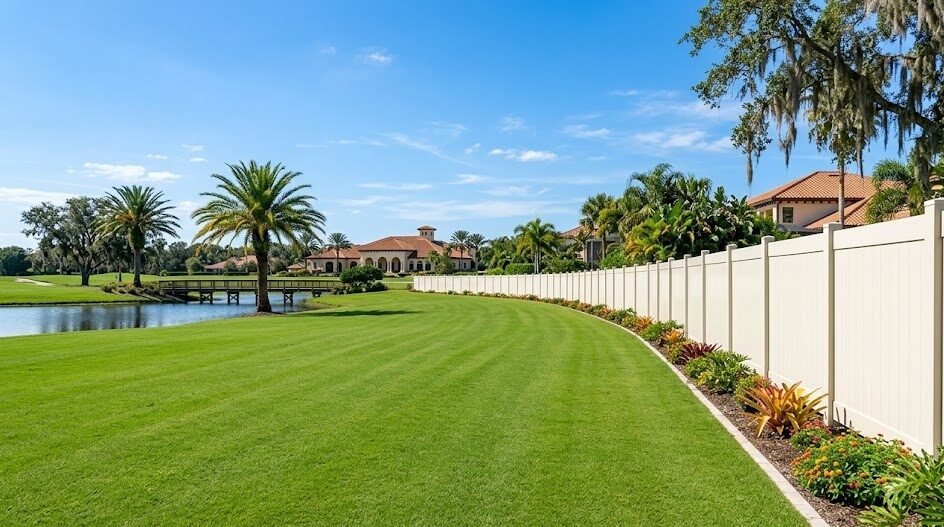
After every Florida hurricane, the same picture shows up across Central Florida neighborhoods: one backyard with a privacy fence lying flat in the grass, and the yard next door with a fence that barely moved. Most of the time both fences were sold as "hurricane rated." The difference is almost never the brand of panel. It is how the whole system was designed and built: the style of the fence, the posts, the footings, the fasteners and the gates.
A fence panel on its own has no meaningful wind rating. Manufacturers that publish wind numbers test complete systems, with a specific post size, post spacing, reinforcement, footing depth and hardware, and the rating only applies when the fence is built exactly that way. Florida products are often backed by a Florida Product Approval or a Miami-Dade Notice of Acceptance that lists those conditions. If the installer changes the post spacing, skips the aluminum stiffener or sets posts in shallow footings, the rating on the brochure no longer describes the fence in your yard.
This guide explains what wind speeds a Central Florida fence actually has to deal with, how much force that wind puts on a fence, how vinyl, aluminum, wood and chain link behave in a hurricane, and what to ask for so the fence you buy has a real chance of standing after the next storm.
What 130 mph Means in Central Florida
The Florida Building Code uses ultimate design wind speed maps to set wind loads for buildings. For typical homes, which fall in Risk Category II, most of inland Central Florida sits roughly in the 130 to 140 mph range on those maps, with higher values toward the coasts. Your exact number depends on your address, and your county building division can confirm it. The current 8th Edition of the code, based on ASCE 7-22, kept the Florida peninsula wind speeds the same as the previous edition, and raised them mainly in the Panhandle and Big Bend.
Those are 3 second gust speeds, measured at 33 feet above open ground. A fence sits much lower, and in a typical subdivision it is sheltered by houses and trees, so the wind it sees is usually less than the map value. That is good news. The bad news is that wind pressure rises with the square of wind speed. Doubling the wind speed does not double the force, it quadruples it. Wind at 100 mph pushes about twice as hard as wind at 70 mph, and wind at 130 mph pushes more than three times as hard.
Residential fences are generally not engineered like a house, and many jurisdictions do not require a wind calculation for a backyard fence. Pool barriers are the main exception, because they must meet the Florida Building Code pool barrier rules, and some manufacturers and HOAs require engineered installation details. For local height and permit rules, see our guide on fence permits in Florida.
How Much Force a Hurricane Puts on a Fence
Engineers start from a simple formula in ASCE 7: velocity pressure equals 0.00256 times the wind speed squared, adjusted for height, terrain and direction. At 130 mph, the basic number is about 43 pounds per square foot. Applying typical adjustments for a fence close to the ground and for the wind direction factor used for freestanding walls brings it down to roughly 21 pounds per square foot in a sheltered suburban lot and about 31 pounds per square foot on open ground.
Now apply that to a fence section. A standard solid privacy panel is 6 feet tall and 8 feet wide, or 48 square feet. At 21 to 31 pounds per square foot, that one panel is being pushed with roughly 1,000 to 1,500 pounds of force before any safety factor, and two posts carry all of it into the ground. Gusts load and unload the panel over and over, which is why posts loosen and fasteners work free over the course of a long storm.
These are simplified planning numbers, not an engineering design for your fence, but they make the main point clear: the more solid the fence, the more wind it catches, and the posts and footings decide whether it stays up.
Vinyl Privacy Fences in a Hurricane
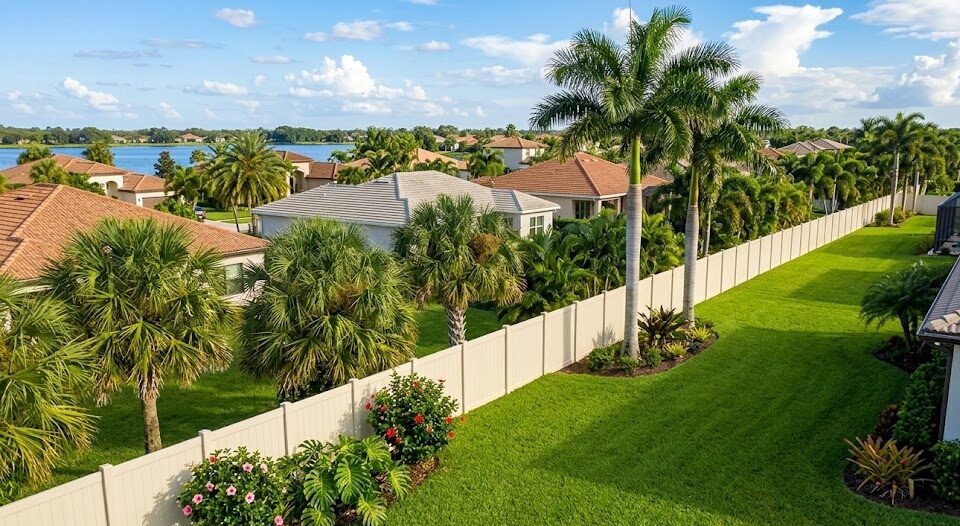
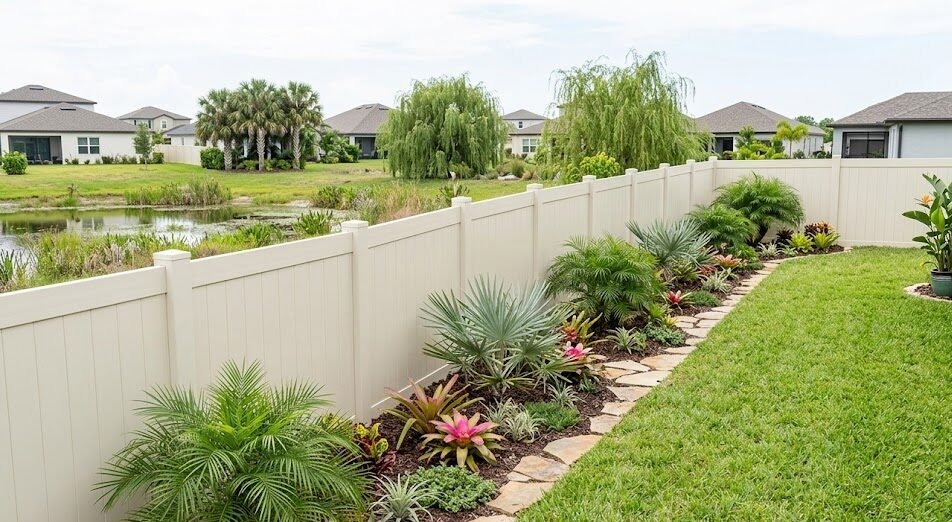
Solid vinyl privacy fences are the most popular style in Central Florida subdivisions, and they are also the style that catches the most wind. A well built vinyl fence can handle strong winds, but only when it is specified for them. Manufacturers that test vinyl privacy systems for Florida wind loads typically require some combination of the following:
- Aluminum reinforcement: aluminum channels inside the bottom rail and, for higher ratings, steel or aluminum stiffeners inside the posts, especially at gates and ends.
- Closer post spacing: some systems drop from 8 foot to 6 foot sections to reach a higher wind rating, which adds posts but cuts the load on each one.
- Deeper, wider footings: posts set in concrete deep enough to resist the overturning force. Hurricane-zone installation standards for a 6 foot fence commonly call for footings around 36 inches deep.
- Heavier profiles: thicker post walls and rails resist cracking and bowing better than the thinnest budget profiles.
Vinyl has one advantage in a storm: it does not rot, so a post set in concrete keeps its strength for decades. Its weakness is that a panel without reinforcement can bow and pop out of the rails, and a post without a stiffener can crack at the base. When you compare vinyl quotes, ask whether the price includes reinforcement and what wind speed the system is approved for at the post spacing being quoted.
(321) 353-7445Get Immediate Service
Aluminum Fences: The Strongest Performer by Design

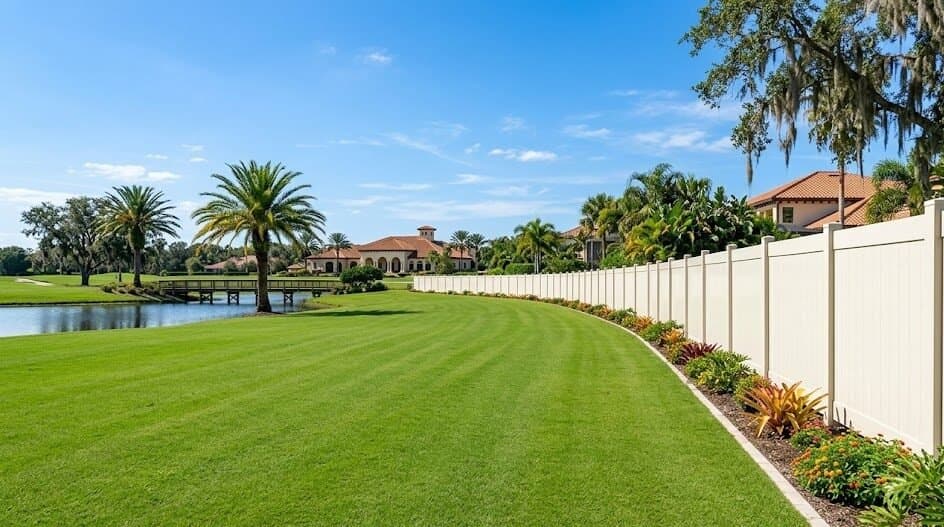
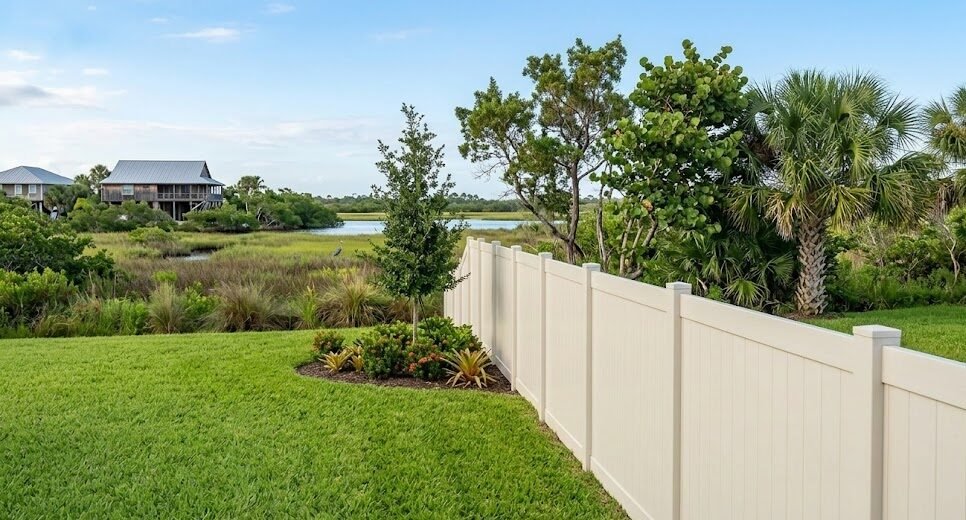
Aluminum picket fences usually come through hurricanes in the best shape, and the reason is simple. Most of the fence is open space. Wind passes between the pickets, so the load on each section is a fraction of what a solid panel carries. Aluminum also does not rust, which matters for a fence that lives in Florida humidity and rain.
Aluminum is the common choice for pool barriers, lake views and front yards where privacy is not the goal. For pool fences, check that the product is approved for pool barrier use and that the installation follows the manufacturer details for wind. The weak points are the same as any fence: posts set too shallow, cheap gate hardware and panels that were cut and re-fastened in the field without the right brackets. For a pool, the barrier rules come first and the wind details second.
Wood Privacy Fences: Strong When New, Weak at the Ground Line
A new pressure treated wood privacy fence can be very strong, and board-on-board or shadowbox styles let a little air pass between boards, which reduces the load slightly compared with a fully solid panel. The problem with wood in Florida is time. Posts rot at the ground line, where moisture and soil meet, and a post that looked fine from above can snap in the first strong gust.
- Post size: larger posts resist bending better. Many installers use 4x4 posts for standard runs and 6x6 posts at gates and corners.
- Ground contact rating: posts should be treated for ground contact, not just above-ground use.
- Fasteners: hot dipped galvanized or stainless fasteners resist corrosion. Cheap nails rust and let boards loosen.
- Inspection: push on every post each spring. Any post that rocks has lost its footing or started to rot and should be replaced before hurricane season.
Wood is often the lowest cost privacy option, but it needs more upkeep to stay hurricane ready. A wood fence that is ten years old with untouched posts is the most likely fence on the street to fail.
Chain Link and Semi-Privacy Styles
Plain chain link is one of the most wind resistant fences you can buy, because it is almost all open space. The catch is privacy slats and windscreen fabric. Once you add them, chain link becomes a solid panel with thin posts, and it can fold over in a strong storm. If you need slats or screen, plan to remove the fabric before a hurricane or choose heavier posts.
Semi-privacy styles, such as spaced pickets, lattice tops or shadowbox designs, are a useful middle ground. They block most of the view but let some wind pass, which reduces the load on posts and footings.
Fence Materials Compared for Hurricane Performance
| Fence type | Wind exposure | Main weak point | What to ask for |
|---|---|---|---|
| Vinyl privacy | High, solid panel | Unreinforced rails and posts | Aluminum rail reinforcement, post stiffeners, approved wind rating at quoted spacing |
| Aluminum picket | Low, mostly open | Shallow posts, gate hardware | Footing depth, pool barrier approval if needed, heavy duty hinges |
| Wood privacy | High, mostly solid | Post rot at ground line | Ground contact posts, 6x6 at gates, galvanized fasteners |
| Wood shadowbox | Medium to high | Post rot at ground line | Same as wood privacy, plus board spacing |
| Chain link | Very low without slats | Slats or screen turn it into a sail | Heavier posts if slats are added, removable screen |
Posts, Footings and Gates Decide Whether a Fence Stands
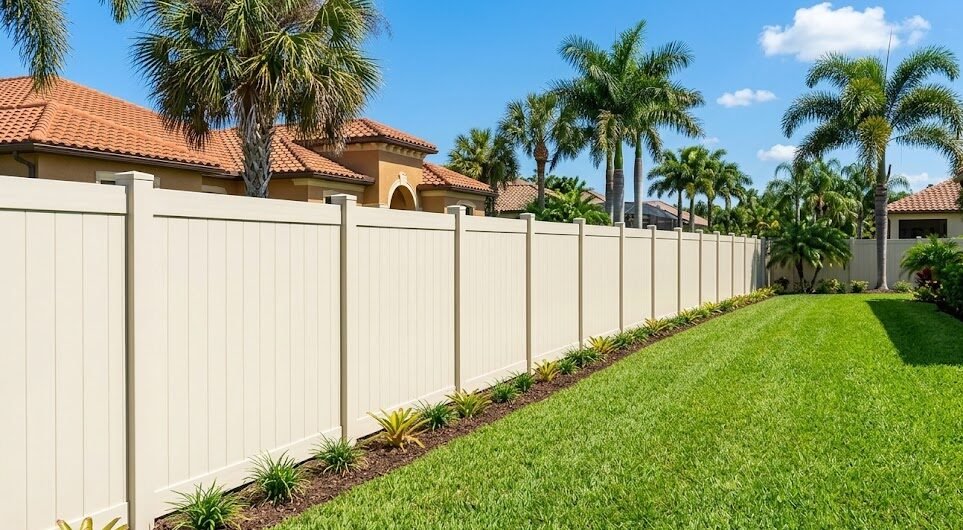
Every fence material above fails the same way most of the time: at the posts. Central Florida soil is often sandy, and after days of rain before and during a hurricane it can hold very little. A post that is too short, set in a narrow hole or set with dry-mixed concrete is the first thing to lean. Before you sign, ask how deep the posts will be set, how wide the holes will be and whether the concrete will be mixed wet.
Gates are the second weak point. A closed gate is a solid panel hanging on one post, and hinges and latches carry the load. Heavy duty hinges, a stiffened gate post and a drop rod that locks the gate open are worth the extra cost. Our hurricane prep checklist for pavers and fences explains what to do with gates and posts when a storm is coming.
Finally, remember insurance. Under most standard homeowners policies, a fence is covered under the other structures part of the policy, and hurricane damage is subject to your hurricane deductible, which is often a percentage of the dwelling coverage. For many homeowners, that deductible is larger than the cost of a fence section. A fence built to resist wind from day one is usually cheaper than a claim.
After a Storm: Repair or Replace the Fence?
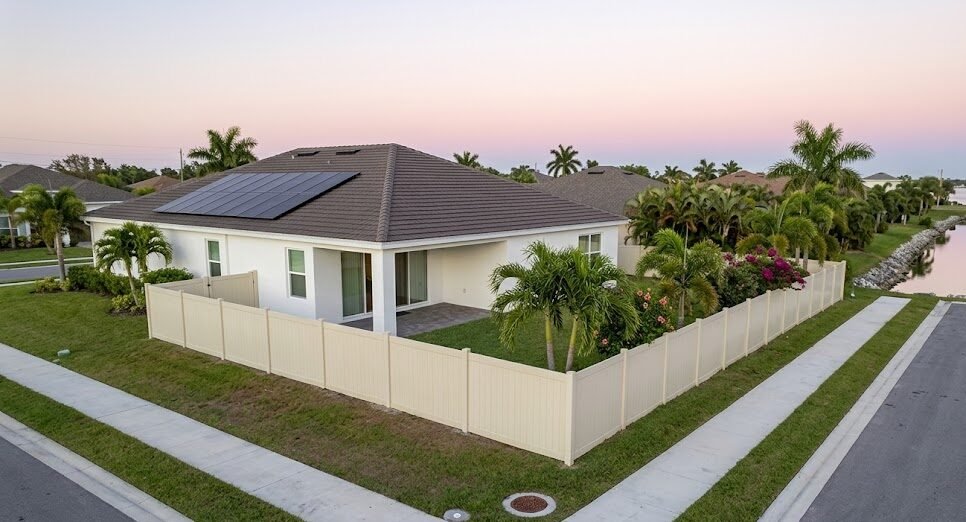
Not every damaged fence needs to come out. If a few panels blew out of their rails but the posts are still solid and plumb, re-setting or replacing those panels is usually the right call. If posts are leaning, cracked at the base or loose in their footings, replacing panels alone just sets up the same failure next season. The posts and footings have to be fixed first.
A good rule is to look at the pattern. Damage in one spot, such as a single gate or the run that faces an open field, points to a local weak point you can reinforce. Damage along the whole length usually means the fence was never specified for the wind it faces, and a rebuild with a more open style, closer post spacing or reinforced posts is the better long term answer. Take photos of everything before cleanup, because your insurer will ask for them.
Building a Hurricane-Ready Fence With KS Solutions
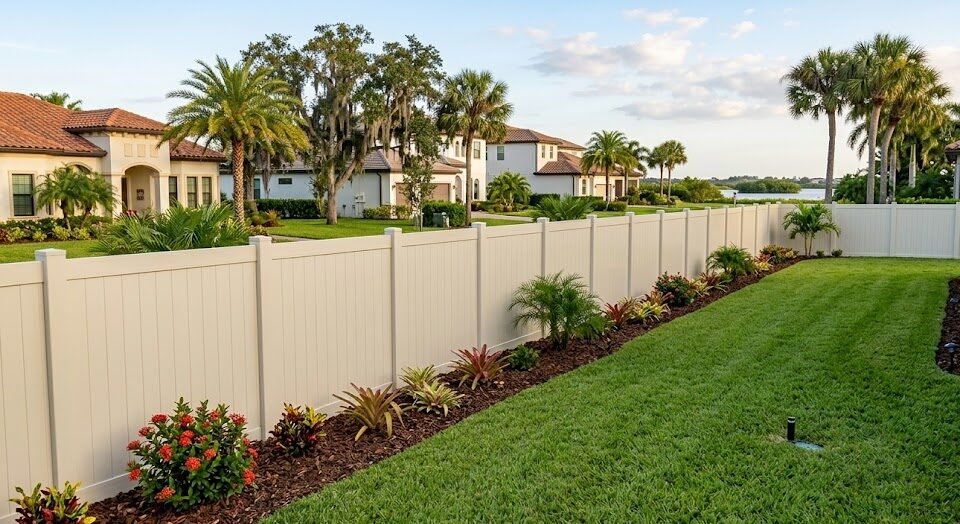
KS Solutions installs vinyl, aluminum, wood and chain link fences across Central Florida, and we build each one to the manufacturer installation details that its wind rating depends on. Before we quote, we look at your lot exposure, your soil and your gate locations, and we tell you which fence style, post spacing and reinforcement make sense for the wind your yard actually sees. Our fence installation service includes footing depth and gate hardware in every written quote.
We build fences throughout the region, including fence installation in Orlando, fence installation in Kissimmee and fence installation in Lakeland, and across Seminole County and Polk County. Tell us what you want the fence to do, and we will help you choose one that is still standing after the next storm.