KS Solutions installs fences in St. Cloud, FL for homeowners across Osceola County's Friendly City where East Lake Tohopekaliga's bass-fishing shoreline defines the northern boundary, the population tripled past 59,000 since 2000, and the mix of Spanish Revival downtown homes with newer subdivision construction along Canoe Creek Road creates fencing demand ranging from view-preserving lakefront aluminum to full-privacy vinyl on compact subdivision lots where the neighbor's slider sits 15 feet from yours. Call (321) 353-7445 for a free estimate.
Fencing The Friendly City's Diverse Neighborhoods
Fence installation in St. Cloud serves a city whose neighborhoods span the full residential spectrum. The historic downtown core holds early-1900s homes on tree-lined streets where the Spanish Revival commercial buildings designed by Ryan and Roberts still define the streetscape character. The newer subdivisions stretching south and east toward Harmony pack hundreds of contemporary homes on compact quarter-acre lots. And the lakefront properties along East Lake Toho's southern shore command premiums for the bass-fishing access and water views that no inland lot can replicate.
Each zone generates different fencing priorities. Downtown homeowners may need fencing that complements period architecture without looking imported from a modern planned community. Subdivision homeowners need privacy vinyl on day one because the builder delivered the house without any separation from the neighbor 15 feet away. And lakefront homeowners need aluminum that satisfies pool-barrier code while keeping the lake view intact from the pool deck and the lanai.
St. Cloud's population growth (tripling since 2000) means the subdivisions keep filling in, which means every existing home's comp pool expands as newer construction with fresher finishes enters the market. A quality fence on an established property signals the investment that buyers and appraisers register alongside the upgraded kitchen and new pool enclosure. A sagging fence on the same block signals deferred maintenance that drags the offer price regardless of what the interior looks like.
The Union Army veterans who founded this city as a retirement colony in 1911 built their community with organized streets, civic pride, and the kind of mutual accountability where every property contributed to the overall impression of the neighborhood. That founding principle persists in how neighbors evaluate each other's outdoor improvements, and a well-built fence visible from the street or the lake trail communicates the same property-pride message the veterans embedded in the city's DNA over a century ago. For homeowners along US-192 (the main commercial corridor running through the southern portion of the city), a solid privacy fence along the road-facing boundary provides the noise buffering and headlight screening that transforms the backyard from an extension of the highway into a genuine private retreat.
Materials for Lakefront, Historic, and Subdivision Properties
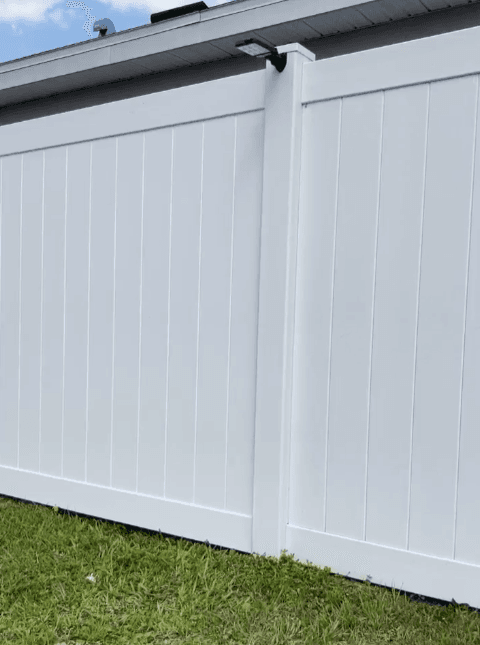
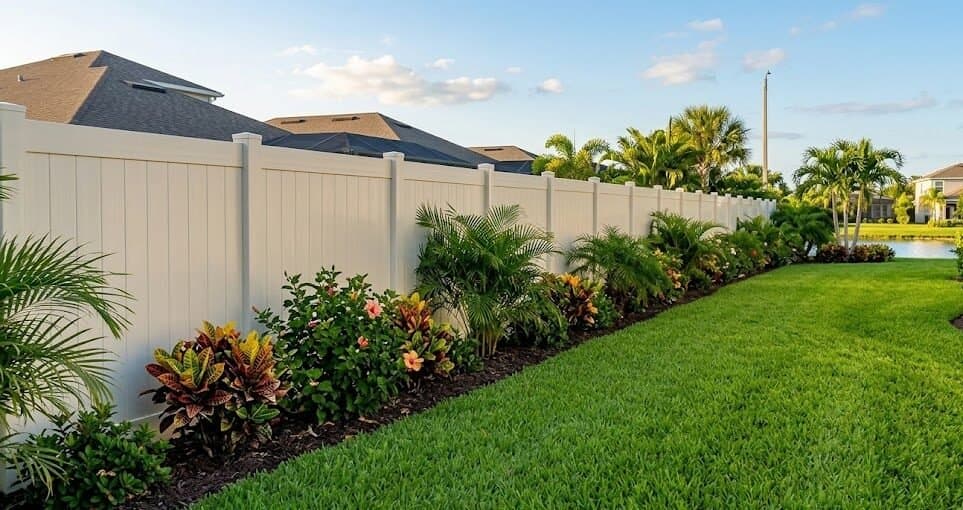
Vinyl tongue-and-groove privacy panels
dominate the subdivision fence orders because the product delivers total screening, pet containment, and zero lifetime maintenance. The PVC compound handles Osceola County's humidity without painting or staining across 20 years. White and tan are the most popular colors. Aluminum-stiffened posts resist the crosswind gusts that build speed crossing East Lake Toho's open water before hitting subdivision fence faces during afternoon thunderstorms.
Aluminum ornamental panels
in powder-coated black or bronze handle pool enclosures and lakefront boundaries where maintaining the East Lake Toho view is non-negotiable. The narrow vertical pickets become optically transparent against the lake-and-sky backdrop at normal viewing distance. Sub-four-inch picket spacing satisfies Florida's pool code. Bass-tournament anglers passing on the water evaluate lakefront fence quality the way street traffic evaluates front-yard fences, which makes the aluminum's clean, corrosion-free appearance matter from both the land side and the water side.
Cedar and cypress wood fencing
serves the downtown historic corridors where natural materials complement the Spanish Revival and early-Florida Vernacular architecture. Horizontal plank configurations give renovated downtown homes a contemporary edge while staying within the organic-material vocabulary the surrounding historic structures support. Shadow-box and board-on-board styles suit homes where airflow matters during thunderstorm gusts.
Chain link with vinyl coating
covers large-perimeter containment on the rural-edge lots along Canoe Creek Road and the acreage properties south of the city center at the lowest per-foot cost. Privacy slats add targeted screening at specific positions without upgrading the entire run to solid panels. On the acreage properties near Canoe Creek Road where the fence line may stretch 400 feet or more along a pasture boundary or a wooded tree line, chain link provides the perimeter definition the homeowner needs at a price that makes residential vinyl across that same distance impractical.
Pool Barriers Along East Lake Toho's Southern Shore
Florida's child-access barrier statute (48-inch exterior height, sub-four-inch vertical gaps, no climbing footholds, self-closing self-latching gate at 54 inches) wraps every residential pool in St. Cloud. On East Lake Toho waterfront lots where the pool faces the lake, aluminum pickets in black preserve the bass-fishing-waters panorama while satisfying code. Solid vinyl in the same position would wall off the scenery the lakefront lot's premium was purchased to enjoy.
The standard lakefront pool barrier pairs aluminum on the water-facing and house-facing runs with vinyl privacy on the side boundaries where neighbor screening adds value. KS Solutions constructs the vinyl-to-aluminum transition at a reinforced corner post. On lots where the pool gate opens toward the dock or boat ramp, the gate width accommodates the fishing equipment, cooler carts, and kayak dollies that East Lake Toho homeowners shuttle between the house and the water daily during the bass season.
Gate mechanisms use corrosion-resistant spring hinges whose tension KS Solutions calibrates until the gravity-drop latch catches from every opening arc with an audible click. A keyed deadbolt locks the barrier during travel. On subdivision lots where the pool sits in the compact backyard rather than facing the lake, the gate hardware still gets the same calibration because the code applies identically regardless of the lot's waterfront status.
Post Foundations on Sandy Osceola County Substrate
St. Cloud's sandy Osceola County substrate holds concrete post footings well during dry months but loosens during the wet season when 50-plus inches of annual rainfall saturate the upper soil layer. East Lake Toho waterfront lots face a secondary moisture variable: the water table rides higher on these parcels than on inland properties, and during prolonged wet periods the saturated zone can rise into the bottom of a shallow concrete footing.
KS Solutions bores every line post to 24 inches minimum. Corner posts and gate hangers drop to 30 inches. Wide driveway gates bore to 36 inches. On lakefront positions, crushed gravel beneath the concrete collar creates a drainage pocket that prevents standing water from softening the sand-to-concrete bond. Posts along the East Lake Toho shore use marine-grade or stainless-steel hardware because the lake-adjacent humidity keeps surfaces damp longer than inland lots experience, accelerating corrosion on standard galvanized fasteners.
Underground utility locates through 811 precede every project. The city's infrastructure spans 1911-era original systems through the massive expansion the population tripling demanded. Lakefront properties carry additional subsurface elements (dock electrical, boat-lift power, irrigation supply) that the 811 locate may not fully capture. KS Solutions probes manually near planned post positions on waterfront parcels.
(321) 353-7445Get Immediate Service
City of St. Cloud Permits and HOA Considerations
The City of St. Cloud operates its own building department. Standard rear-yard fences at six feet generally meet height limits. Side and front fences face additional restrictions. Pool enclosures must satisfy both city fence code and Florida's child-access statute. Properties near US-192 may face commercial-corridor considerations affecting fence placement on lots adjacent to the highway.
St. Cloud's newer subdivisions (including communities near Harmony and the developments along Canoe Creek Road's expansion corridor) carry HOA covenants with architectural review requirements governing fence material, color, height, and finished-side orientation. KS Solutions reviews the applicable covenants before proposing and prepares the architectural submittal when committee approval is needed. Older downtown neighborhoods and the lakefront corridors generally operate without HOA governance.
Lakefront East Lake Toho properties face waterfront-setback rules restricting how close fence posts can bore toward the shore. The setback protects the riparian buffer zone the county's environmental code designates along the lake system. KS Solutions identifies the setback boundary during the lot survey and designs the fence layout to stay inside the permitted zone while maximizing enclosed yard area. For homes where the fence runs along the public lakefront trail, the fence serves as both a property boundary and a daily visual impression evaluated by joggers, cyclists, and dog walkers passing at slow speed.
From Estimate to Finished Fence in St. Cloud
Every St. Cloud fence project starts with a free lot visit where our project manager walks the proposed fence line, measures total footage, probes the sandy Osceola County substrate for density and water-table proximity, photographs the lot, and discusses your privacy, pet, pool, lake-view, and noise-buffer priorities. We note HOA requirements, lakefront-setback conditions, and jurisdictional boundaries. Duration: 20 to 35 minutes depending on lot size, lakefront adjacency, and project complexity.
Your written bid arrives within 48 hours. Every post, panel, rail, gate, hardware piece, concrete bag, and labor hour appears individually priced. Material spec sheets and finish samples accompany the bid. The bid identifies which City of St. Cloud permits and any HOA approvals the project requires.
Installation runs one to three days. Posts auger and pour on day one, braced plumb while concrete cures overnight. Panels mount, gates hang, springs calibrate, latches verify on day two. The project wraps with panel-alignment sightline checks, gate-cycling tests at five opening angles, and complete debris removal. Every scrap of construction material loads onto our trailer. Call (321) 353-7445 to start your St. Cloud fence project.