KS Solutions installs vinyl, aluminum, wood, and Florida pool-code fencing in Ormond Beach, FL. Call (321) 353-7445 for your free on-site estimate.
Fencing Across the Halifax: Barrier Island vs Mainland Material Choices
Fence work in Ormond Beach is shaped by the same coastal split that drives every other exterior project in the city. The eastern half of Ormond Beach sits on the barrier island between the Halifax River and the Atlantic Ocean. The western half sits on the mainland between the Halifax and the Tomoka River, with Tomoka State Park on the northern edge. That single fact drives material selection more than any HOA rule, because salt-laden ocean air on the barrier island and brackish moisture on river-adjacent lots both punish the wrong fence materials within a few years.
Material selection on an Ormond Beach lot is not a stylistic preference; it is a durability calculation:
- Powder-coated aluminum (open picket): the strongest performer on the barrier island and on river-adjacent lots. Rust-resistant, salt-air tolerant, satisfies pool barrier code with 4 inch picket spacing, and preserves ocean or river views.
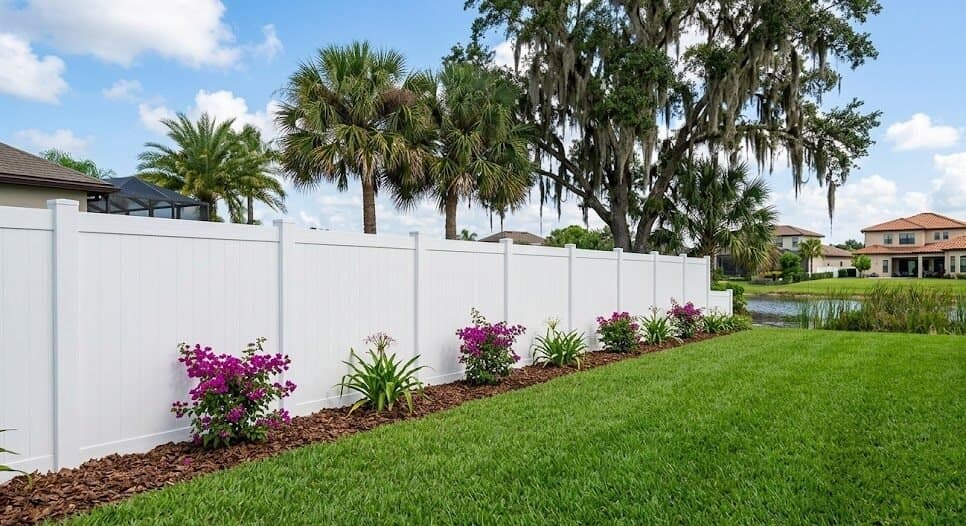
- Vinyl privacy: excellent on inland Ormond Beach lots and a strong choice for HOA communities that want a softer profile. UV-stabilized panels handle direct sun and salt exposure; budget vinyl can chalk in years three to five.
- Cypress, cedar, and pressure-treated pine: works on inland mainland lots; on barrier island and river-adjacent lots, expect a tighter sealing cycle and shorter service life than the same fence inland.
- Standard galvanized steel chain-link or plain wrought iron: not recommended on the barrier island or within roughly a mile of the Halifax or Tomoka rivers. Plain galvanized rusts faster than most homeowners expect.
- Black vinyl-coated chain-link: acceptable for back lot lines and pet runs on inland mainland lots; we still steer barrier island and riverfront homeowners toward aluminum.
Beyond material, the second variable is shoreline setback for any lot abutting the Halifax River, the Tomoka River, or the Tomoka State Park boundary. We confirm both the surveyed lot line and any HOA shoreline easement before staking a single post. Sightline matters too: a 6 ft solid privacy fence run straight toward the river or the ocean cuts off the view that drove the lot purchase. Hybrid fence design (privacy where the lot meets the neighbor, open aluminum near the shoreline) usually wins.
The Ormond Beach Fence Permit Path Through Click2Gov (Section 2-50(n) and the Finished-Side Rule)
The City of Ormond Beach is incorporated and runs its own Building Division, so fence permits do not go through Volusia County's general permitting flow. The city uses a Click2Gov-based public portal at ormb-egov.aspgov.com/Click2GovBP, the Building Division page lives at ormondbeach.org/328, and permit forms are at ormondbeach.org/332. Completed applications and supplemental documents go to bponline@ormondbeach.org.
Fence regulation in Ormond Beach lives in Section 2-50(n) of the Land Development Code, which sets out height, setback, material, and installation rules. One Ormond Beach rule that contractors from outside the city regularly miss: all fencing must be installed with the finished side facing the adjacent lot. That sounds simple, but it actually shapes how the fence is sequenced on the lot, where the post side falls relative to the property line, and how the gate is hung. Building a fence on the wrong side of the posts in Ormond Beach is exactly the kind of issue that triggers a callback at city inspection and a forced reinstall.
The clean step-by-step we follow on every Ormond Beach fence job:
- Pull a current scaled property survey, which the city requires in the permit packet.
- Draft the site plan showing existing structures, the proposed fence run, gate locations, post spacing, and the finished side orientation per Section 2-50(n).
- Confirm fence height fits the zoning district and the front, side, and rear setback rules.
- Submit the application through ormb-egov.aspgov.com/Click2GovBP with documents emailed to bponline@ormondbeach.org.
- Pay the applicable permit fee at submission.
- For any contract over $5,000, file the Notice of Commencement with the Volusia County Clerk before the first day of work.
- Schedule the city's required inspection at the milestone the permit specifies.
- Close the permit out at final inspection so the file is not left open against the property.
Pool Safety Barriers and the Florida Residential Swimming Pool Safety Act
Any fence that doubles as a pool barrier in Ormond Beach has to satisfy the Florida Residential Swimming Pool Safety Act, codified in Florida Statutes Chapter 515. The Act, also known as the Preston de Ibern/McKenzie Merriam Residential Swimming Pool Safety Act, took effect October 1, 2000, and it sets the floor that every pool-area fence in the state has to meet. Failure to install a compliant barrier (or another approved safety device) is a second-degree misdemeanor under state law.
What the statute actually requires for a perimeter fence used as a pool barrier:
- 4 ft minimum height measured from the outside of the barrier.
- No gaps a young child could crawl under, squeeze through, or climb over. Horizontal rails close enough together to function as a ladder are not allowed.
- Gate opens outward, away from the pool.
- Self-closing hinges and a self-latching locking device.
- Latch on the pool side of the gate, placed so a young child cannot reach it over the top or through any opening.
- Sufficient distance from the water so a child or medically frail adult who manages to breach the barrier does not fall directly into the pool.
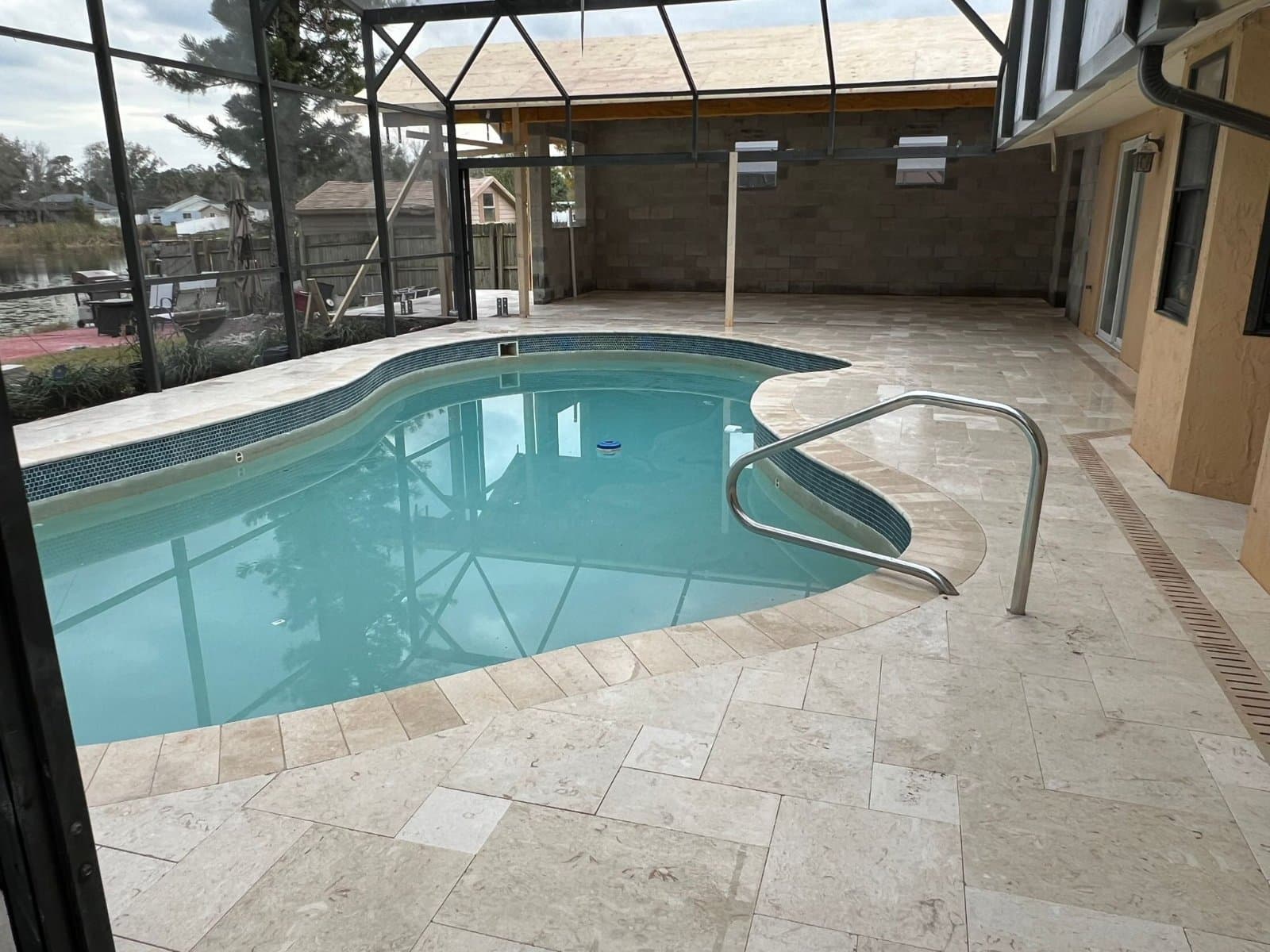
The aluminum picket fence is the most common pool-code answer in Ormond Beach because spacing between vertical pickets can be specified to 4 inches max (well inside the no-climb, no-squeeze rules), the open profile keeps the river or backyard view, and powder-coated aluminum holds up to chlorine, salt water, and the corrosive coastal air for decades. Vinyl pool fence is the next most common pick when an HOA wants a softer profile or a specific color match.
Plantation Bay and Halifax Plantation: Aluminum-First HOA Fence Standards
Plantation Bay Golf and Country Club spans more than 3,600 acres with 45 holes of championship golf, two upscale clubhouses, and tight architectural standards across dozens of subdivisions inside the gates. Annual HOA fees start around $2,400 a year. Halifax Plantation is one of Volusia County's premier gated golf communities, with an 18-hole championship course and HOA fees ranging $65 to $780 per month depending on the subdivision and home type. Both communities have a strong preference for powder-coated aluminum fencing in approved colors (typically black or bronze), and ARC committees in both communities are accustomed to approving aluminum quickly when the spec matches the community palette.
What that means for a homeowner trying to put up a fence in Plantation Bay or Halifax Plantation:
- Aluminum first. The committee already has approved palette colors and pre-approved profile shapes; submitting an aluminum spec that matches them clears review faster than vinyl or wood.
- Vinyl and wood require a stronger justification. Both can be approved, but the packet has to make the case that the proposed fence harmonizes with the surrounding homes.
- Pool barrier compliance is non-negotiable. Both communities care that pool barriers clear Florida Statutes 515.29; the ARC will not approve a non-compliant gate hardware spec.
- Subdivision-specific rules layered over community rules. Plantation Bay in particular has subdivision-level architectural standards inside the larger HOA; we confirm the homeowner's specific subdivision before pulling the packet.
KS Solutions prepares and submits the architectural review packet for both Plantation Bay and Halifax Plantation, frames the aluminum spec correctly for the approved palette, and only schedules the install start once both the ARC approval and the city Click2Gov permit are in hand.
(321) 353-7445Get Immediate Service
HOA Fence Approvals in Hunter's Ridge, Tomoka Oaks, and Smaller Communities
Beyond the two large golf communities, Ormond Beach has a real mix of smaller HOAs. Hunter's Ridge and Huntington at Hunter's Ridge are among the most recent communities to start in the city with new-construction inventory; ARC standards are evolving as the community matures. Tomoka Oaks runs its own homeowners association at tohaweb.com and approves exterior changes through the standard ARC process. Smaller subdivisions across mainland and barrier-island Ormond Beach run lighter HOA structures (or sometimes voluntary neighborhood associations only).
Florida HB 1203, signed in 2024, preempted certain HOA restrictions on visible structures, but ARC review of fence material, color, and placement is still firmly inside what associations are allowed to approve or reject. Skipping ARC and pulling only the city permit is how a finished fence ends up with a written demand to remove it.
The clean ARC submission flow looks like this:
- Pull the community's current ARC application form and material guidelines.
- Compile the packet: site plan, fence material spec sheet, color samples, gate location, finished-side orientation per Section 2-50(n), and contractor license.
- Submit to the HOA's ARC liaison or property manager and confirm receipt in writing.
- Respond to any committee questions or revision requests within the same business week.
- Receive written approval, then file the city permit through Click2Gov referencing the ARC approval.
- Schedule the install start only after both the city permit and the HOA approval are in hand.
Approval timelines typically run 2 to 4 weeks depending on when the committee meets.
Fence Pricing and Project Timelines in Ormond Beach
Pricing for fence work in Ormond Beach runs in the same general range as Volusia County overall. Statewide market data places the average vinyl fence install at roughly $3,626 for a typical residential run, with material, height, and gate count driving most of the spread. The variables that move price the most in Ormond Beach specifically are: barrier island salt-air material upgrades, river-adjacent post-setting requirements, and HOA ARC complexity in Plantation Bay and Halifax Plantation.
Aluminum (open picket)
Aluminum is the dominant pick for pool barriers, river and ocean sightline preservation, and Plantation Bay or Halifax Plantation HOA communities. Powder-coated finish, rackable panels for grade changes, and 4 inch picket spacing for pool-code compliance.
- Day 1: layout, post-hole digging, concrete set.
- Day 2: panels installed once posts have cured.
- Day 3: gates set with self-closing hinges and self-latching hardware (pool-code projects).
Vinyl privacy fence
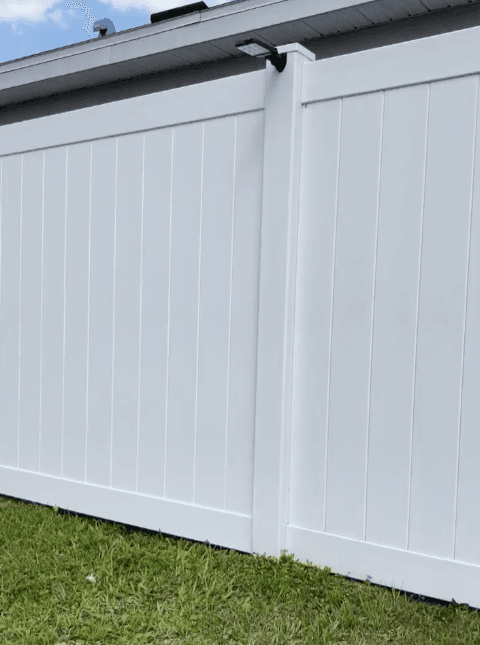
Vinyl is the most common pick for inland mainland yards that want full privacy between the home and the neighbor. UV-resistant white, almond, and tan are the standard colors; wood-grain textured vinyl is a softer profile for HOAs.
- Day 1: layout, marking utilities, demo of any existing fence.
- Day 2: post holes, concrete set, cure time begins.
- Day 3: panels and gates installed once posts have cured.
- Final inspection through Click2Gov once the run is complete.
Wood (cypress, cedar, or pressure-treated pine)
Wood is the right answer when an HOA requires natural material or when the home's architecture calls for a warmer profile. Salt-laden coastal air shortens service life on barrier-island and river-adjacent lots; we explain the sealing cycle at the estimate.
- Day 1 to 2: layout, post holes, concrete set, cure time.
- Day 3 to 4: rails and pickets installed with finished side facing the adjacent lot per Section 2-50(n).
- Optional: stain or sealer applied within 30 days of install once the wood has dried.
For most Ormond Beach fence projects, on-site work runs 2 to 4 days, plus permit time on the front end (filed through Click2Gov), plus 2 to 4 weeks for HOA architectural review if the property is in Plantation Bay, Halifax Plantation, Hunter's Ridge, or Tomoka Oaks.