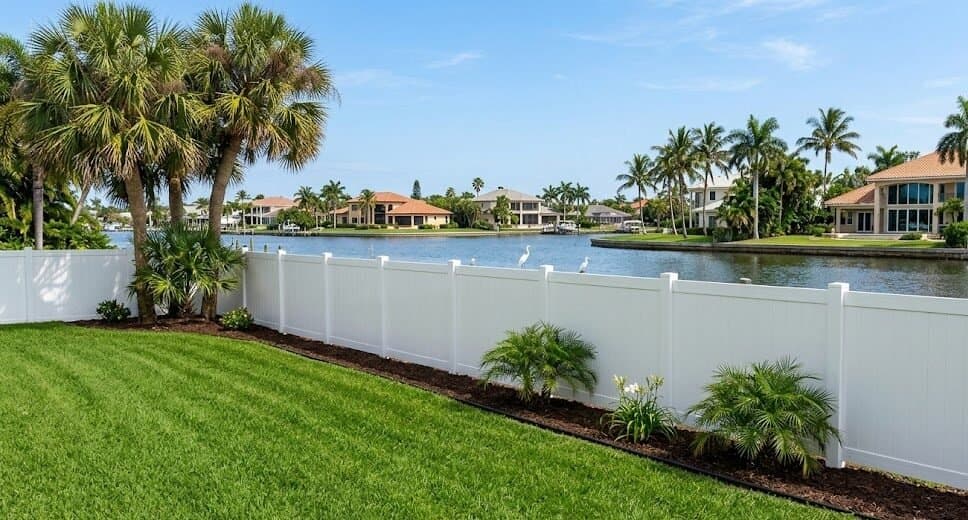
KS Solutions provides fence installation in Winter Haven, FL for residential and commercial properties across this lakefront city. Whether you're on Lake Howard, Lake Eloise, or one of the 50+ lakes connected by canals, we build fences that handle the unique soil and water-table conditions found throughout Polk County's Chain of Lakes region. Call (321) 353-7445 for your free estimate.
Lakefront Fencing for Winter Haven's 50+ Connected Lakes
Fence installation in Winter Haven starts with understanding the geography. This city sits at the heart of Polk County's Chain of Lakes, where over 50 bodies of water are linked by navigable canals. That layout shapes how fences need to be designed, installed, and maintained. A lakefront property on Lake Howard or Lake Eloise isn't like a standard suburban lot. The ground stays saturated longer after rain. Soil near the waterline shifts with seasonal water levels. And the view that drew you to the property in the first place shouldn't be walled off by a fence that blocks it.
For Winter Haven lakefront homes, aluminum ornamental fencing is the go-to solution. Black powder-coated aluminum panels give you a defined property boundary and keep children and pets away from the water's edge without obstructing your lake view. The open picket design lets breezes pass through, which matters on humid Polk County afternoons. Aluminum won't rust in the moisture-heavy air near the water, and it doesn't rot like wood does when ground-level humidity stays high for weeks at a time.
KS Solutions installs lakefront fencing throughout Winter Haven's waterfront neighborhoods. We account for flood zones, setback requirements from the water's edge, and the gradual slope that most lakefront lots have between the home and the shoreline. Posts near the waterline get deeper footings with additional concrete volume because saturated sandy soil provides less lateral support than dry ground further from the lake.
Boat-Gate Access and Wide Openings for Winter Haven Trailer Owners
With 50+ lakes and public boat ramps scattered across the city, Winter Haven has one of the highest rates of boat ownership per capita in Central Florida. That means driveways with trailers, side yards storing kayaks, and backyards leading to private docks. A fence that doesn't account for boat access becomes a daily frustration rather than an asset.
Standard residential gates run 36 to 48 inches wide. A boat trailer needs 10 to 16 feet of clearance, depending on the beam width of the boat. Rolling cantilever gates or double-swing gates solve this problem, but they demand heavier posts, reinforced hinges, and concrete footings sized to handle the weight and wind resistance of a 16-foot opening.
KS Solutions designs fence layouts for Winter Haven boat owners that include properly sized access gates without compromising the fence's security or appearance. We install 6×6 steel-reinforced gate posts for openings wider than 10 feet, with heavy-duty self-closing hinges rated for the gate's actual weight. The gate drops into a ground receiver that locks it in the closed position, preventing it from swinging in wind gusts off the lake.
For Winter Haven homes with side-yard boat storage, we position the wide gate along the driveway extension and run standard-width pedestrian gates elsewhere. This keeps the fence line clean and continuous while giving you the clearance you need to launch and retrieve your boat without removing fence sections every weekend.
Pool Safety Barriers in a City Where Swimming Season Never Ends
Winter Haven's mild year-round temperatures mean pools don't close for the season. Florida statute 515.29 requires a barrier around every residential pool that stands at least 4 feet tall, has no openings a child could pass through, and includes self-closing, self-latching gates with the latch at least 54 inches above grade on the pool side. These aren't optional recommendations. Code enforcement in Winter Haven takes pool barriers seriously, and non-compliant properties face fines and sale complications.
Many older Winter Haven homes, especially the mid-century ranch houses built in the 1950s and 1960s, had pools added before current barrier codes existed. When those properties change hands, inspectors flag the missing or outdated barrier, and the new owner needs a compliant fence installed before they can close. KS Solutions handles these time-sensitive pool fence installations throughout Winter Haven, typically completing the work within 5 to 7 business days from our initial site visit.
Black aluminum pool fencing remains the most popular choice in Winter Haven. It satisfies every code requirement while giving you a clear sightline to the pool from inside the house, which is important for supervision. The narrow picket spacing blocks entry without creating the heavy, boxed-in feeling that a solid privacy fence produces around a pool area. For Winter Haven properties where the pool sits close to a lakefront boundary, we combine the pool barrier with the lakefront perimeter fence to avoid doubling up on materials and cost.
Post Installation in Winter Haven's High Water Table and Sandy Soil
Winter Haven's proximity to dozens of lakes creates a water table that sits unusually close to the surface. On properties within a few hundred yards of any lake, you can hit standing water at 18 to 24 inches when digging post holes. That's a problem because a solid fence post needs to sit at least 30 inches deep for a 6-foot panel, and gate posts require 36 inches. If the bottom of the hole fills with water before the concrete sets, you get a weak footing that won't hold under wind load.
The sandy soil common across Polk County makes it worse. Sand drains quickly when it's above the water table, but below that line it acts more like soup. Posts set in waterlogged sand without proper footing technique will lean within a year, especially on the side of the fence that catches prevailing wind off the nearest lake.
KS Solutions uses fast-setting hydraulic concrete for every Winter Haven fence post near the water table. This mix begins curing within minutes, even in standing water, and reaches working strength before the surrounding groundwater can undermine the footing. We also crown every footing above grade level so rainwater sheds away from the post rather than pooling at the base. For fence runs along lake-adjacent property lines in Winter Haven, we increase post diameter from 4×4 to 4×6 or 6×6 to compensate for the reduced lateral grip in saturated soil.
Wood posts in high-water-table zones get ground-contact-rated pressure treatment at a minimum. We recommend going one step further with posts rated for in-ground freshwater contact, which use a higher concentration of preservative and resist the constant moisture exposure that Winter Haven's lakefront soil creates.
(321) 353-7445Get Immediate Service
Fencing Historic Downtown vs. New Subdivisions on Winter Haven's Edges
Winter Haven's 49,000+ residents live in neighborhoods that span a full century of development patterns. The historic downtown district around Central Avenue features Colonial Revival homes from the 1920s and 1930s with mature oak canopies, established root systems, and narrow lot layouts. Head east toward the US-27 corridor and you'll find subdivisions built in the last decade with wide, flat lots, young landscaping, and HOA covenants governing everything from fence color to post cap style.
These two environments require completely different fencing approaches. In Winter Haven's historic core, tree root systems restrict where you can dig post holes. Live oaks with 60-foot canopies have root networks that extend just as far, and cutting through major roots damages trees that took decades to grow. KS Solutions does a root survey before placing post locations on older Winter Haven lots, adjusting the fence line by inches where needed to avoid damaging significant roots while keeping the fence straight and properly spaced.
In the newer subdivisions along the eastern and southern edges of Winter Haven, the challenges are different. HOA architectural review boards control fence materials, colors, heights, and sometimes even the manufacturer. Communities built along US-17 and US-27 often require white or tan vinyl exclusively, and some ban wood entirely. The approval process can take two to six weeks depending on how frequently the board meets.
We prepare HOA submission packages for Winter Haven communities that include product specifications from the manufacturer, color samples, a scaled site plan showing the fence layout relative to property lines and easements, and a written scope of work. Getting the paperwork right the first time saves weeks of back-and-forth revisions. KS Solutions has worked with HOAs throughout Polk County and knows what each board expects before we submit.
Fence Materials and Pricing for Winter Haven Properties
Fence costs in Winter Haven depend on the material you choose, how many linear feet you need, and the specific conditions of your lot. Lakefront properties with high water tables cost more per post due to the extra concrete and specialized setting technique required. Properties with mature tree root systems may need additional labor for careful hand-digging around roots. But the mild Polk County climate means your fence gets used year-round, making it one of the better property investments you can make.
Vinyl privacy fencing
runs $28 to $45 per linear foot installed in Winter Haven. A typical backyard enclosure of 140 to 180 linear feet costs $3,920 to $8,100. Vinyl handles Polk County's humidity and UV exposure without rotting, warping, or needing paint. It's the lowest-maintenance option available and the one we install most often across Winter Haven's newer subdivisions where HOAs prefer its clean, consistent appearance.
Wood privacy fencing
in pressure-treated pine costs $20 to $35 per linear foot. Cedar runs $30 to $50. Wood works well on Winter Haven's historic properties where the character of natural grain fits the home's architecture better than vinyl. Budget for staining every 2 to 3 years at $400 to $650 per treatment cycle, which is the trade-off for wood's design flexibility and traditional look.
Aluminum ornamental fencing
for pools and lakefront boundaries runs $30 to $55 per linear foot. Boat-access gates with reinforced posts and heavy-duty hardware add $800 to $2,200 depending on the opening width and gate type. Factors that increase costs in Winter Haven include the water table depth, root zone complexity, HOA-required materials, and distance from road access for material delivery. KS Solutions provides itemized written estimates so every cost is transparent before work begins. Call (321) 353-7445 for your free Winter Haven fence quote.


