
Brick Paver Installation in Clermont, FL
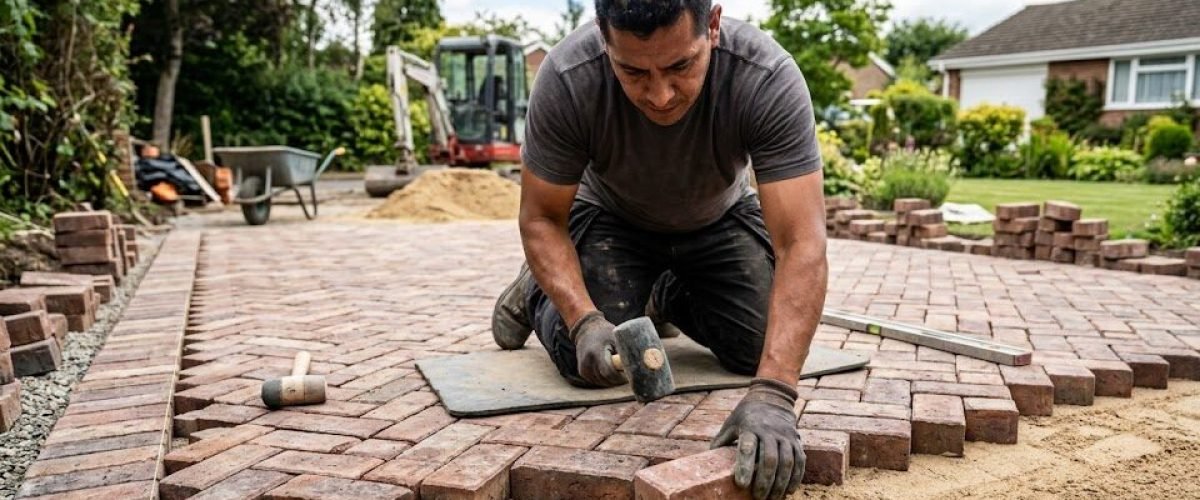
KS Solutions provides brick paver installation in Clermont. Call (321) 314-2569 for your free estimate.
Brick Paver Installation in Clermont: Hillside Hardscaping for Lake County’s Fastest-Growing City
Brick paver installation in Clermont, FL works with terrain that no other Central Florida city offers. Sitting on the northern portion of the Lake Wales Ridge with elevation changes that reach 300 feet above sea level, Clermont’s rolling hills create grading challenges and design opportunities that the flat lots dominating most of the Orlando metro area don’t present. A paver driveway that climbs 6 feet from the street to the garage, a tiered patio that steps down a hillside overlooking a lake, and a pool deck that transitions between two grade levels all require the sloped-surface engineering that flat-ground installers don’t carry in their standard approach.
With a population exceeding 54,000 and growth rates above 3 percent annually, Clermont adds hundreds of new homes each year across developments along Hartwood Marsh Road, Hancock Road, and the corridors radiating from the Florida Turnpike interchange. These new neighborhoods join established communities around Lake Minneola, Lake Louisa, and the chain of lakes that define Clermont’s landscape character. Both the new construction and the established homes need paver work that accounts for the grade variations, drainage patterns, and soil conditions that Clermont’s ridge-top position produces.
KS Solutions installs brick pavers throughout Clermont for properties where the terrain demands the slope-aware engineering that produces surfaces built to last on grade rather than fighting against it. Clermont operates its own municipal government in Lake County with city permits through the Building Department. Many newer subdivisions have HOA requirements that we verify and manage. The city’s rapid growth means HOA guidelines are well-established, and we prepare architectural review submissions with the documentation each community requires.
Retaining Walls That Create Usable Space from Unusable Slopes
Clermont backyards that drop away from the house at 15 to 30 percent grade are common on the ridge-top lots that define this city’s topography. Without retaining walls, these slopes are unusable grass areas that are difficult to mow, impossible to furnish, and wasted square footage that the homeowner maintains but can’t enjoy. A retaining wall at the appropriate point on the slope creates a level terrace behind it where a patio, fire pit, or outdoor kitchen can sit on a flat surface while the land falls away below the wall to the natural grade.
We build Clermont retaining walls using interlocking concrete block systems that mechanically lock each course to the one below through a built-in lip creating a setback of roughly 3/4 inch per course. This batter angle tilts the wall face into the hillside, letting the weight of the retained soil help stabilize the wall rather than working against it. Walls above 3 feet in exposed height require geogrid reinforcement, sheets of high-strength polymer mesh that extend horizontally into the backfill behind the wall and lock the soil mass to the wall face, preventing the shear failure that unreinforced walls develop when the soil’s lateral pressure exceeds the wall’s resistance.
Drainage behind every Clermont retaining wall is the detail that determines whether the wall lasts 5 years or 25. Water accumulating behind the wall creates hydrostatic pressure that pushes outward against the wall face with increasing force as the water column rises. We install 6 inches of drainage aggregate against the wall’s back face with a 4-inch perforated pipe at the base that routes collected water to a daylight outlet at the low end of the wall. This drainage system keeps the backfill dry and the pressure on the wall face at levels the block system is engineered to resist.
KS Solutions builds Clermont retaining walls with paver-capped top courses that create usable seating along the wall’s upper edge. The cap stones match the adjacent patio pavers in color and finish, integrating the wall visually into the terrace it creates. The wall stops looking like a structural necessity and starts looking like a designed feature that frames the patio space with the same intentionality that a built-in seating wall provides. The dual function, structural retention plus comfortable seating, maximizes the value of every linear foot of wall construction.
Sloped Driveway Engineering for Clermont’s Ridge-Top Properties
Clermont driveways frequently climb or descend grades that would be unusual in most Florida cities. A driveway rising 4 to 8 feet from the street to the garage over a 30 to 50-foot run creates forces that flat driveways don’t experience. Gravity pulls rainwater, vehicle weight, and the pavers themselves downhill with a lateral force component that flat installations don’t produce. A paver surface that holds perfectly on a flat lot will creep downhill over years on a Clermont slope if the edge restraint and base engineering don’t account for the grade’s directional forces.
We install concrete edge restraints along the downhill side of every Clermont sloped driveway with 12-inch spikes driven through the restraint into the compacted aggregate below. The standard 8-inch spikes used on flat lots can’t resist the cumulative downhill force that gravity and vehicle braking transfer into the edge restraint on a slope. The longer spikes extend into the base deep enough to anchor in material that isn’t affected by the surface-level forces acting on the restraint.
Herringbone pattern is required on Clermont’s sloped driveways because it’s the only pattern where each paver is mechanically interlocked against lateral movement in every direction. Running bond and stack bond patterns have continuous joint lines running in one direction, and on a slope, gravity pulls pavers apart along those continuous joints. Herringbone eliminates continuous joints entirely, which is why it’s the industry-required pattern for any vehicular surface and especially critical on grades where gravity adds a directional sliding force to the normal traffic loads.
KS Solutions builds Clermont sloped driveways with the aggregate base terraced into level steps connected by compacted transition ramps rather than laid as a continuous slope. Each level step holds its material in place because it’s essentially flat. The ramps between steps are short enough that the aggregate can’t develop sliding momentum. This terraced base approach prevents the downhill aggregate migration that a continuous-slope base develops over time as rain and vehicle vibration work material toward the low end of the driveway.
Tiered Patio Design for Lake-View and Conservation-View Lots
Clermont’s premium lots overlook lakes, conservation lands, and the rolling terrain that makes this city visually distinct from the flatlands east toward Orlando. A patio on one of these view lots should orient toward the view rather than turning its back on the scenery the homeowner paid a premium to enjoy. But the grade between the house’s back door and the view often drops several feet, making a single flat patio impractical because it either sits too high to connect with the yard below or too low to connect with the door above.
Tiered patios solve this by splitting the outdoor living space across two or three connected levels that step down the grade between the house and the viewpoint. The upper tier sits at the door threshold level, creating a dining and cooking zone directly accessible from the kitchen. The lower tier sits 18 to 30 inches below, reached by paver steps, and provides a lounge zone with seating walls oriented toward the lake or conservation view. The vertical separation between tiers creates distinct functional zones while maintaining visual connection because neither level is enclosed.
Short retaining walls between tiers serve as both grade transitions and design elements. Capped with matching paver stones, these walls provide seating along the tier boundary and create the visual boundary between zones that planters or furniture would provide on a flat patio. The wall height of 18 to 24 inches between tiers matches comfortable seating height so guests can sit on the wall caps and face either direction: toward the upper tier’s dining action or toward the lower tier’s fire pit and view.
KS Solutions designs Clermont tiered patios with the view orientation as the primary design driver. The fire pit goes on the lower tier where the viewer’s sightline reaches over the tier wall and across the view rather than stopping at the house wall behind them. The cooking area goes on the upper tier where the cook stands at the grill and looks out over the lower tier’s activity with the view as the backdrop. Every element placement follows the view geometry because that’s the feature that makes these Clermont lots worth the premium they command.
Drainage Engineering on Clermont’s Hillside Properties
Water moves fast on Clermont’s slopes. A summer thunderstorm dropping 2 inches of rain on a hillside property sends concentrated runoff down every paved surface, across every lawn section, and into every low point with velocity and volume that flat properties don’t experience. A paver patio at the base of a slope receives the accumulated runoff from everything above it unless drainage features intercept the water before it reaches the patio surface. Without interception, the concentrated flow washes joint sand from the paver surface, erodes the base at the patio’s uphill edge, and deposits soil and debris across the pavers that requires cleanup after every significant rain event.
We install channel drains along the uphill edge of every Clermont patio and pool deck that sits below a sloped lawn or adjacent higher grade. The channel drain intercepts sheet flow before it crosses the paver surface, capturing it in a grated channel and routing it through underground pipe to a discharge point below the patio. The channel grate sits flush with the paver surface, creating a clean visual break between the lawn and the patio that also serves as the functional barrier between uncontrolled runoff and the protected paver surface below.
Driveway drainage on Clermont slopes requires cross-slopes that move water laterally off the surface before it reaches the garage door at the top of the grade. A driveway climbing a hill naturally channels water downhill along its surface, and without lateral cross-slopes the entire run of the driveway becomes a stream during heavy rain. We crown the driveway surface, raising the center 1/4 inch per foot above the edges, so water sheds to both sides rather than running the full length.
KS Solutions documents the drainage plan for every Clermont hillside installation, showing how water enters the property from above, crosses or is intercepted by the paver surface, and exits toward the designed drainage point below. This documentation serves the city’s permitting requirements and gives the homeowner a reference for understanding how the drainage system works when they’re planning future landscape additions that might affect water flow patterns across the property.
Paver Costs for Clermont’s Hillside and Lake-View Properties
Brick paver installation in Clermont costs $12 to $24 per square foot depending on material, slope complexity, and whether retaining walls are part of the project scope. Hillside installations cost 15 to 25 percent more than flat-ground equivalents because the terraced bases, slope-anchored edge restraints, and drainage interception systems add labor and materials that level properties don’t require. The premium reflects the engineering intensity these installations demand, not just the surface area being paved.
Sloped driveway installations cost $15 to $22 per square foot including terraced base and reinforced edge restraint. A 450 square foot hillside driveway runs $6,750 to $9,900. Tiered patios cost $14 to $22 per square foot for the paver surfaces plus $25 to $45 per square face foot for the retaining walls connecting the tiers. A two-tier patio with 400 square feet of surface and 30 linear feet of tier wall runs $7,000 to $12,000.
Pool decks on graded lots cost $14 to $22 per square foot. Channel drain installation along uphill edges adds $1,500 to $3,500 depending on run length. Retaining walls for creating usable terraces cost $25 to $50 per square face foot depending on height and geogrid reinforcement requirements. Walls above 3 feet require engineered plans.
Clermont city permits apply for retaining walls and applicable hardscape projects. Many subdivisions have HOA requirements that we manage. Installation timelines run 3 to 5 days for patios and driveways, 5 to 10 days for tiered projects with retaining walls. Call (321) 314-2569 for your free Clermont paver estimate.
Related Services in Clermont, FL
- Fence Installation in Clermont, FL – Vinyl, aluminum, and wood fencing for privacy, pool barriers, and pet containment.
- Artificial Turf Installation in Clermont, FL – Low-maintenance synthetic lawns, pet relief zones, and play areas.
- All KS Solutions Services in Clermont, FL – Overview of every service we offer across Clermont properties.
- Brick Paver Installation Services – Learn more about our driveway, patio, and pool deck paver work.
Frequently Asked Questions
Slopes add directional forces from gravity that flat installations don’t experience. We use terraced aggregate bases, 12-inch edge restraint spikes, and herringbone patterns exclusively on sloped driveways. Hillside installations cost 15 to 25 percent more than flat equivalents due to terraced bases, reinforced restraints, and drainage systems. The engineering prevents the downhill creep that gravity produces on improperly installed slopes.
Sloped driveways cost $15 to $22 per square foot ($6,750 to $9,900 for 450 square feet). Tiered patios run $14 to $22 for surfaces plus $25 to $45 per square face foot for tier walls. Pool decks cost $14 to $22. Retaining walls for terracing cost $25 to $50 per square face foot. Channel drains along uphill edges add $1,500 to $3,500.
Yes. A retaining wall at the appropriate slope point creates a level terrace behind it for patios, fire pits, and outdoor kitchens. Walls above 3 feet need geogrid reinforcement and drainage behind the wall face. Cap stones matching the patio pavers integrate the wall as a design feature and provide comfortable seating along the wall’s upper edge.
Water moves fast on slopes. We install channel drains along the uphill edge of patios and pool decks to intercept runoff before it crosses the surface. Driveways get crowned surfaces that shed water to both sides. Underground pipes route captured water to discharge points below the installation. Every Clermont project includes documented drainage plans.
Many newer Clermont subdivisions have HOA guidelines specifying approved paver materials, colors, and patterns. We research each community’s requirements and prepare architectural review submissions. Clermont operates its own city building department in Lake County for permits. We handle all regulatory and HOA administrative requirements for every project.
Get a Free Paver Estimate in Clermont, FL
SCHEDULE AN APPOINTMENT
Top-Rated by Homeowners: Your Trusted Choice for Outdoor Transformations.
Last updated: March 23, 2026