
Artificial Turf Installation in Conway, FL
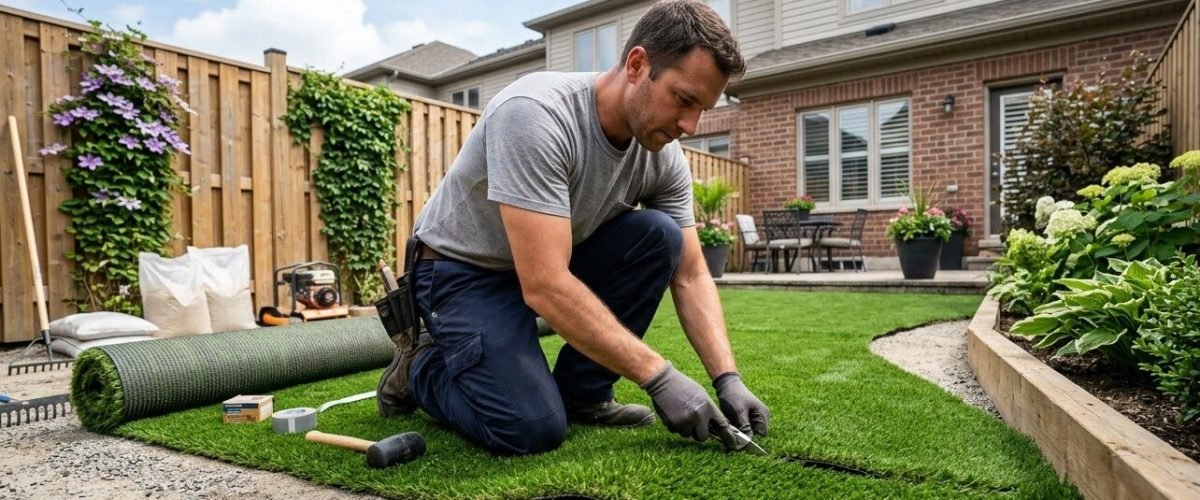
KS Solutions installs artificial turf in Conway. Call (321) 314-2569 for your free estimate.
Artificial Turf in Conway: Year-Round Green Lawns for South Orlando’s Lakeside Community of Long-Term Homeowners
Artificial turf installation in Conway, FL delivers the permanently maintained lawn appearance that this south Orlando community’s 86-percent homeownership rate and $400,000-plus property values demand. Nearly 13,000 residents occupy Conway’s established streets near the Conway Chain of Lakes, and the mature tree canopy that’s grown over 40 to 60 years of residential development now blocks the sunlight that warm-season grass needs to thrive. Warm-season sod varieties planted beneath Conway’s towering oaks and magnolias get only 1 to 3 hours of dappled light per day, producing lawn coverage so sparse and moss-laden that no amount of money spent on fertilizer addresses the root cause: insufficient solar energy reaching the leaf tissue where carbohydrate production happens.
Long-tenured Conway residents have experienced this decline firsthand over their ownership. The lawn that thrived in 2000 when the oak canopy still had gaps for afternoon sun has progressively thinned as the trees matured and closed those gaps permanently. The annual lawn care budget creeps higher while the results keep getting worse, creating an expense-to-outcome ratio that worsens every year. Synthetic turf stops the downward spiral because its appearance depends on fiber technology, not photobiology. Full canopy coverage is irrelevant to a product that generates its color from pigment rather than chlorophyll.
KS Solutions installs artificial turf across Conway for homeowners who’ve exhausted the shade-tolerant sod varieties, the fertilizer programs, and the irrigation schedules that lawn care companies recommend for shaded Orlando-area yards. Conway falls within Orange County’s jurisdiction. Some neighborhoods have HOA guidelines that we verify and manage. The Conway Chain of Lakes creates additional considerations for waterfront properties that we address during the planning phase.
High Water Table Drainage on Conway Chain of Lakes Properties
The Conway Chain of Lakes keeps groundwater across nearby properties closer to the surface than what inland Orange County lots experience. During the wet season, the water table beneath lakefront and near-lake Conway properties rises to within 10 to 18 inches of the ground surface, entering the zone where turf aggregate bases sit. A base built at standard depth on a chain-of-lakes lot may become saturated from below during the wettest weeks when the lake level rises and pushes surrounding groundwater upward into the aggregate layer.
We address this on Conway’s chain-adjacent properties by building the aggregate base at 5 to 6 inches rather than the 3 to 4 inches that inland lots need. The thicker pad raises the turf surface further above the seasonal groundwater peak so the upper portion of the aggregate stays dry and structurally rigid even when the bottom inch or two contacts rising moisture. The dry upper zone provides the firm walking surface and drainage capacity the turf requires while the saturated lower zone drains downward as the water table recedes after the wet season passes.
Lateral perimeter drain lines along the turf’s low edge intercept groundwater migrating horizontally from the lake toward the turf base. A 4-inch perforated pipe in a gravel trench captures this lateral flow and routes it to a discharge point rather than letting it saturate the aggregate from the side. The drain is invisible once the turf is installed but does critical work during the months when lake-influenced groundwater would otherwise turn the base into a sponge.
KS Solutions probes the water table at multiple points across every Conway chain-of-lakes turf site during the evaluation. The probe reveals the current groundwater depth, and the historical data for that lake segment tells us how much higher it rises during peak wet season. Together, the probe and the history determine the base depth specification that keeps the turf performing through the full annual water table cycle rather than just the dry-season snapshot the probe captures on a single visit day.
Screened Enclosure Integration: Turf Inside and Outside the Pool Cage
Conway homes with screened pool enclosures often have turf opportunities both inside and outside the screen. The strip of lawn between the screen enclosure wall and the privacy fence is one of the most neglected grass zones on any Conway property: too narrow for comfortable mowing, too shaded by the screen and fence to receive adequate sunlight, and too heavily trafficked by foot traffic between the screen door and the side gate to maintain grass coverage. This 3 to 6-foot-wide corridor dies within the first year after sod installation and stays as bare dirt for the life of the property unless an alternative surface replaces it.
Synthetic turf in the screen-to-fence corridor transforms a persistent eyesore into a clean, green passage. The turf handles the shade that killed the grass, drains the rain and condensation that runs off the screen roof and fence panels, and provides a clean footing for the daily traffic that crosses this space between the backyard gate and the pool area entrance. The narrow width requires precision cutting to fit the turf panels exactly between the screen frame and the fence without gaps that show the base material or bunching that creates trip hazards in a confined walking space.
Inside the screen enclosure, turf can replace the natural grass that some Conway homeowners maintained within the screened area around the pool deck’s perimeter. The screen roof reduces sunlight by 20 to 30 percent, and combined with the root competition from nearby trees, the enclosed grass struggles even more than the open-air lawn. Turf inside the enclosure sits at the same height as the adjacent pool deck pavers, creating a green accent zone that frames the hard surfaces without the maintenance burden that natural grass imposes in a space where mowing equipment barely fits.
KS Solutions installs Conway screen-enclosure turf with drainage routed toward the enclosure’s existing drain outlets rather than creating new penetrations in the screen foundation. The enclosure already has drainage points designed to handle condensation and incidental water from inside the screen. We grade the turf base toward these existing drains, keeping water management within the established drainage infrastructure rather than adding new outlets that may require separate permitting.
Pet Turf on Conway’s Compact Lots Where Neighbor Proximity Makes Odor Control Critical
Conway’s suburban density puts neighboring homes 15 to 30 feet apart, close enough that pet odor from one yard reaches the adjacent patio within seconds on a still summer evening. A natural grass dog yard on a Conway lot generates detectable ammonia odor during the warm months because urine absorbed into the soil creates a bacterial environment that produces the sour smell homeowners and their neighbors both notice. The compact lot size concentrates pet waste in a smaller area, intensifying the per-square-foot odor load compared to rural properties where the same dog’s output distributes across a half-acre.
Pet turf with ZeoFill antimicrobial infill on Conway properties addresses the odor concern that neighbor proximity creates. The zeolite mineral in the infill absorbs ammonia through ion exchange and neutralizes it without chemical treatments or rinse agents. The result is a pet surface that produces no detectable odor at the property line even during the warmest months when bacterial activity in untreated surfaces peaks. For Conway homeowners whose pet yard sits 20 feet from the neighbor’s screened patio, the odor elimination isn’t a comfort preference. It’s a neighbor-relations necessity.
We install Conway pet turf with 50 to 60-ounce face weight at 1 to 1.25-inch pile height for the balance of durability, drainage speed, and cleanup ease that residential dog ownership demands. The fiber density handles daily running and playing from dogs up to 80 pounds without the path-matting that lighter products develop along the fence-line routes dogs patrol daily. The short pile passes liquids through to the drainage layer below rather than holding moisture at the fiber base where bacterial growth starts.
KS Solutions extends Conway pet turf to every fence and wall boundary of the dog area, eliminating the exposed soil strips that dogs dig along fence perimeters. On Conway’s tight lots, the fence line where two properties meet is the zone where dogs from both yards concentrate attention, and bare soil along this boundary becomes a mud strip that tracks into both homes during rain. Turf over the full pet zone prevents digging, eliminates mud, and maintains a clean edge against the shared fence that both neighbors appreciate.
Long-Term Property Value Protection Through Permanent Lawn Quality
Conway’s $400,000-plus median home values and 86 percent homeownership rate create a market where exterior property condition directly affects neighborhood-wide values. A home with a deteriorating lawn on a block where neighbors maintain their yards creates a visual drag that the surrounding homeowners notice and that comparative market analyses quantify when properties sell. In Conway’s stable, long-term-ownership environment, the homeowner with the bad lawn doesn’t move away after 3 years. They stay for decades, and the declining lawn remains the block’s weak spot for as long as the homeowner can’t or won’t maintain it.
Artificial turf permanently removes the homeowner from the lawn-quality fluctuation that Conway’s shaded, sandy, high-water-table conditions produce on natural grass. The lawn looks the same in year 1 as it does in year 15: uniformly green, properly manicured-appearing, and consistent across seasons when natural grass cycles through green, brown, and patchy phases that Conway’s tree canopy and soil conditions amplify beyond what even professional lawn care can fully correct.
For Conway homeowners approaching retirement who plan to age in place for the next 20 to 30 years, turf eliminates the physical lawn care burden that becomes increasingly difficult as mobility decreases. Mowing, edging, and bending to pull weeds require physical capabilities that decline with age, and hiring lawn services at $150 to $250 monthly becomes a fixed expense on a fixed income. Turf converts that recurring expense into a one-time investment made while the homeowner has the discretionary budget to fund it, then delivers decades of zero-cost lawn maintenance during the retirement years when the budget tightens.
KS Solutions positions Conway turf installations as long-term property protection investments rather than cosmetic upgrades. The combination of permanent lawn quality, eliminated maintenance costs, and reduced physical burden delivers returns that extend well beyond the aesthetic improvement the homeowner sees on day one. The lawn that looks perfect today will look exactly the same when the homeowner lists the property in 2040 or 2045, and the buyer walking the lot will see a maintained surface that signals a cared-for property from front door to back fence.
Turf Costs for Conway’s Established South Orlando Properties
Artificial turf installation in Conway costs $9 to $16 per square foot depending on product type, pet specifications, and whether chain-of-lakes drainage engineering is involved. Conway’s $400,000-plus property values make turf a proportionally modest investment that delivers both daily quality-of-life improvement and long-term financial return through eliminated maintenance costs and protected resale presentation.
Front yard installations under canopy of 250 to 500 square feet cost $2,250 to $8,000. Backyard installations of 300 to 600 square feet cost $2,700 to $9,600. Pet zones with ZeoFill antimicrobial infill cost $11 to $16 per square foot. A 200 square foot dog area runs $2,200 to $3,200. Screen-to-fence corridor turf for 100 to 250 square foot narrow passages costs $9 to $14 per square foot.
Chain-of-lakes drainage upgrades with thicker base and lateral drain lines add $3 to $5 per square foot on waterfront and near-water lots. Conway homeowners spending $150 to $300 monthly on lawn service and irrigation for shade-challenged natural grass save $1,800 to $3,600 annually with turf. Over the 15 to 20-year product lifespan, total savings reach $27,000 to $72,000.
Orange County regulations apply. Some Conway neighborhoods have HOA requirements. Lakefront properties face additional buffer zone considerations. We handle all administrative requirements. Installation runs 2 to 4 days for standard properties. Call (321) 314-2569 for your free Conway turf estimate.
Related Services in Conway, FL
- Brick Paver Installation in Conway, FL – Custom driveways, patios, pool decks, and walkways built on compacted aggregate bases.
- Fence Installation in Conway, FL – Vinyl, aluminum, and wood fencing for privacy, pool barriers, and pet containment.
- All KS Solutions Services in Conway, FL – Overview of every service we offer across Conway properties.
- Artificial Turf Installation Services – Details on our synthetic lawn, pet turf, and play area products.
Frequently Asked Questions
Synthetic turf doesn’t need sunlight, performing identically in full shade as in full sun. Conway’s 40 to 60-year-old oaks block 70 to 90 percent of direct light, well below what St. Augustine grass needs. Turf provides the uniform green appearance that shade-challenged natural grass can’t maintain regardless of fertilizer or irrigation investment.
Standard installations cost $9 to $13 per square foot. Pet zones with antimicrobial infill cost $11 to $16. Front yards run $2,250 to $8,000 for 250 to 500 square feet. Chain-of-lakes drainage upgrades add $3 to $5 per square foot. Annual savings of $1,800 to $3,600 from eliminated lawn service and irrigation.
The chain keeps groundwater higher during the wet season. We build bases at 5 to 6 inches on near-lake lots and add lateral perimeter drain lines to intercept groundwater migrating from the lake. We probe water table depth at multiple points across the site and reference historical lake data to specify the base depth that handles peak wet-season conditions.
Yes. ZeoFill antimicrobial infill neutralizes ammonia through ion exchange, producing no detectable odor at the property line even during warm months. This is critical on Conway’s compact lots where neighboring patios sit 15 to 30 feet from the pet area. A weekly hose rinse refreshes the infill. Turf extends to all fence boundaries to eliminate the mud strips dogs create along fence lines.
Yes. Turf replaces the struggling grass that some enclosures contain around the pool deck perimeter. We grade the base toward existing enclosure drain outlets rather than creating new penetrations. Turf also works in the narrow corridor between the screen wall and the privacy fence where shade and foot traffic kill natural grass within the first year.